Cart (
Overview
There are two broad categories of portable fire extinguisher — stored pressure units, which are permanently pressurised and use a pressure gauge as a readiness indicator, and cartridge-operated units, which are unpressurised until the moment of actuation. The cartridge-operated type is the dominant design choice in marine environments, offshore installations, and industrial settings where long-term equipment reliability under challenging conditions is the overriding concern. The reason is straightforward: a stored pressure extinguisher is only as reliable as its pressure seal, and seals degrade over time — particularly in humid, salt-laden, or temperature-cycling environments. A cartridge-operated extinguisher carries no standing pressure in the body at all. The agent charge and the CO2 propellant are kept entirely separate until the lever is depressed and the cartridge is punctured at the point of use.
That design philosophy places the CO2 propellant cartridge at the centre of the extinguisher’s operational readiness. The cartridge holds the gas charge under a solid seal — not a pressure valve, not a gauge-monitored system, but a one-time-use seal that is either intact or it has been punctured. If it has never been punctured, the gas cannot escape. This is why cartridge-type extinguishers are trusted in environments where stored pressure units have historically caused problems: the propellant is physically sealed until needed, and the extinguisher body itself is inspectable, maintainable, and rechargeable across multiple service cycles.
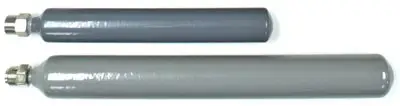
These CO2 Cartridges for Portable Fire Extinguishers are the correct propellant replacement components for cartridge-operated portable fire extinguishers — the grey-bodied, puncture-pin actuation cartridges used inside the extinguisher body. They are the component that makes a serviced cartridge-type extinguisher ready to operate. For marine safety equipment managers, HSE officers, and fire safety service contractors who maintain cartridge-type extinguisher inventories, having access to the correct replacement CO2 cartridges is a non-negotiable part of keeping that equipment in a genuinely serviceable condition.
Key Features
Solid Seal Design — Zero Leakage Until Actuation
The defining characteristic of these CO2 cartridges is the solid seal that retains the gas charge until the extinguisher lever is depressed and the cartridge is punctured. There is no valve, no pressure regulator, and no gradual gas loss pathway — the seal is either intact or it has been broken. This is the technical basis for the reliability advantage of cartridge-type extinguishers over stored pressure designs: an intact cartridge seal is a verifiable guarantee that the propellant charge is fully retained. For marine environments and offshore locations where equipment may be stored for extended periods between inspections, the absence of a slow-leak failure mode is a practical and meaningful safety advantage.
Internal Mounting — Located Inside the Extinguisher Body
Unlike the larger cartridges used in wheeled mobile extinguishers — which are mounted externally — CO2 cartridges for portable extinguishers are located inside the extinguisher body, typically within the agent charge. This internal position is a standard design feature of portable cartridge-type extinguishers and is one of the visual identifiers that distinguishes them from stored pressure units: a cartridge-operated portable extinguisher has no pressure gauge on the head assembly. For fire safety service technicians, the internal cartridge position requires the extinguisher to be opened for cartridge inspection and replacement — a straightforward task during annual service.
Lever-Actuated Puncture Mechanism — Immediate Pressure at Point of Use
When the extinguisher lever is depressed, a puncture pin drives through the cartridge seal, releasing CO2 instantly into the extinguisher body and pressurising the agent charge for discharge. The puncture mechanism is mechanically simple, requires no electrical input, and has no moving parts beyond the lever and pin assembly. This simplicity is a reliability feature: there is no solenoid to fail, no circuit to corrode, and no battery to deplete. In an emergency, the extinguisher operates exactly as designed with a single lever depression — a straightforward operational characteristic that matters in high-stress fire response situations.
Reliable Performance in Marine and High-Humidity Environments
Cartridge-type portable extinguishers — and the CO2 cartridges that power them — are the preferred specification in marine environments precisely because the unpressurised extinguisher body is not subject to the corrosion and seal degradation that affects stored pressure units in salt-air and high-humidity conditions. The CO2 cartridge’s solid seal is not exposed to the ambient environment in the same way a pressure valve is, and the cartridge itself is protected within the extinguisher body. For vessel operators, offshore platform managers, and marine fire safety contractors maintaining extinguisher inventories in harsh maritime conditions, cartridge-type equipment with correctly maintained CO2 cartridges provides a demonstrably more reliable service life than stored pressure alternatives.
No Pressure Gauge Required — Readiness Confirmed by Cartridge Inspection
Stored pressure extinguishers use a pressure gauge needle position as a readiness indicator — a system that depends on gauge accuracy and is vulnerable to gradual pressure loss between service intervals. Cartridge-type extinguishers have no pressure gauge because none is needed: readiness is confirmed by inspecting the CO2 cartridge seal. An unbroken, correctly weighted cartridge in a serviced extinguisher body is a direct and unambiguous readiness indicator. For fire safety service contractors, this makes the annual service inspection of cartridge-type extinguishers a physically verifiable process rather than a gauge-reading exercise.
Rechargeable Extinguisher Body — Repeated Service Cycles with Cartridge Replacement
One of the practical advantages of cartridge-operated portable extinguishers is that the extinguisher body is designed to be recharged and returned to service after discharge — the agent charge is refilled and a new CO2 cartridge is fitted. This contrasts with disposable stored pressure units, where discharge typically means replacement. For vessel operators and industrial facilities maintaining large portable extinguisher inventories, the recoverability of cartridge-type extinguishers after post-discharge service has a direct impact on the total cost of ownership over the extinguisher’s service life. The CO2 cartridge is the consumable component that makes recharging possible.
Technical Specifications
Product Name: CO2 Cartridges for Portable Fire Extinguishers
Cylinder Colour: Grey / Silver
Propellant Gas: Carbon Dioxide (CO₂)
Actuation Type: Puncture-pin (lever-depressed)
Seal Type: Solid seal — no pressure valve, zero leakage until punctured
Mounting Position: Internal — located inside the extinguisher body
Compatible Extinguisher Type: Cartridge-operated portable fire extinguishers (no pressure gauge on head)
Typical Compatible Brands: Yamato Protec, Hatsuda (Japanese); Unitor, Gloria, Desaulter, Sicili, Britannia (European); Hercules, SRI, Eversafe (Asia Pacific)
Application: Annual service replacement, post-discharge recharge
Primary Markets: Marine vessels, offshore platforms, industrial facilities, commercial buildings
Product Category: Fire Extinguishers & Accessories
Benefits
The solid seal design provides a physically verifiable readiness assurance that pressure gauge systems cannot match. A CO2 cartridge with an intact seal and correct charge weight is an unambiguous indicator of extinguisher readiness — not a gauge needle that may have drifted or a seal that may have been slowly leaking for months. For HSE managers responsible for fire safety compliance across large portable extinguisher inventories, this verifiability matters: it makes the annual service inspection a definitive check rather than an estimate.
Cartridge replacement after discharge returns the extinguisher to full operational status — no unit replacement required. After a cartridge-type extinguisher is deployed, fitting a new CO2 cartridge and refilling the agent charge restores it to service. For vessel operators and facilities managers maintaining inventories of 50 or more portable extinguishers, the ability to recharge rather than replace discharged units has a meaningful impact on annual maintenance costs — particularly for vessels making regular port calls where emergency service may have been required.
Marine-environment reliability reduces the risk of finding an extinguisher non-operational during an actual fire emergency. In a marine or offshore environment, fire safety equipment is subjected to salt air, humidity, temperature cycling, and mechanical vibration — all conditions that accelerate the degradation of stored pressure seals and gauge mechanisms. The CO2 cartridge in a correctly maintained cartridge-type portable extinguisher is not exposed to these conditions in the same way: it is sealed inside the extinguisher body, protected from the ambient environment, and its solid seal is not subject to the slow-leak degradation mechanisms that affect pressure gauge systems.
Correct cartridge supply supports on-schedule service completion and SOLAS compliance documentation. For marine fire safety service contractors completing extinguisher service during vessel port calls, having the correct CO2 cartridges available from a local Singapore supplier means service can be completed within the port call window — without the delays that come with sourcing non-stocked or specialist cartridge models at short notice. Completed, documented service supports the extinguisher maintenance records required for SOLAS compliance and class society survey.
Who It’s For
The Vessel Master or Chief Officer Managing Onboard Fire Safety Equipment
Your vessel carries cartridge-operated portable fire extinguishers across accommodation areas, the engine room, the bridge, and cargo spaces — standard equipment on Japanese-built and European-built commercial vessels. At each annual survey port call, the fire safety contractor boards to service the extinguisher inventory, and that service includes CO2 cartridge replacement. You need to be confident that the correct cartridges are available at the port — not that the contractor will discover a sourcing problem mid-service that delays completion and creates a documentation gap ahead of class society inspection. A local Singapore supplier with stock of the correct cartridge models for your vessel’s extinguisher brands removes that risk from your port call maintenance planning.
The Fire Safety Service Contractor Boarding Vessels at Singapore
You service portable fire extinguisher inventories on commercial vessels calling at Singapore — bulkers, tankers, container ships, and offshore support vessels carrying a mix of Japanese, European, and Asia Pacific brand cartridge-type extinguishers. At each service visit, CO2 cartridge replacement is a standard task across the entire inventory. The variety of cartridge specifications across brand groups — Japanese thread standard for Yamato and Hatsuda, European specifications for Unitor and Gloria, Asia Pacific specifications for Hercules and SRI — means you need a supplier who stocks across all three groups, not just one. Alright Engineering Solutions’ cartridge range covering Japanese, European, and Asia Pacific brand specifications means you can source the complete cartridge requirement for a mixed-brand vessel inventory from a single Singapore transaction.
The HSE Officer at a Commercial Building or Industrial Facility
Your facility carries cartridge-operated portable fire extinguishers — either as the original installation specification or as replacements chosen for their reliability and serviceability advantages over stored pressure units. Annual service is a regulatory requirement under the Singapore Fire Safety Act, and that service includes CO2 cartridge replacement as a standard maintenance task. When your contracted fire safety service provider requests the cartridges for your specific extinguisher brand and model, you need the supply confirmed quickly and without sourcing uncertainty. Alright Engineering Solutions can confirm the correct cartridge specification for your extinguisher models and supply against your annual service schedule.
Possible Applications
- Commercial vessels — annual service at Singapore port calls — CO2 cartridge replacement for cartridge-type portable extinguishers across accommodation, engine room, bridge, and cargo spaces on bulk carriers, tankers, container ships, and passenger vessels during scheduled port call service visits
- Offshore platforms and FPSOs — Annual service cartridge replacement for portable extinguishers across living quarters, control rooms, process areas, and escape route stations on fixed and floating offshore production installations in Southeast Asian and Pacific offshore sectors
- Shipyard and dry dock maintenance — Cartridge replacement for vessel portable extinguisher inventories during drydock refit and class renewal surveys, where comprehensive extinguisher service is a standard drydock scope item
- Marine vessel post-discharge recharge — CO2 cartridge fitting and agent recharge for portable extinguishers deployed during an onboard fire incident or training exercise, returning units to service before the vessel’s next voyage
- Commercial buildings and shopping centres — Annual service cartridge replacement for cartridge-type portable extinguishers in commercial premises under SCDF fire safety licensing and SS 578 servicing requirements
- Industrial manufacturing facilities — Routine annual service cartridge replacement for portable extinguishers across factory floors, warehouses, chemical storage areas, and process equipment bays at manufacturing and logistics facilities
- Marine fire safety contractor service stock — Pre-positioned cartridge stock held by fire safety service contractors operating in Singapore and regional ports, covering Japanese, European, and Asia Pacific brand specifications for mixed-fleet vessel service programmes
- Post-PSC inspection deficiency rectification — Emergency cartridge supply for portable extinguisher deficiency rectification following port state control inspections at Singapore and regional ports, where extinguisher service status is a routinely checked compliance item
Trust and Certifications
SOLAS Chapter II-2 — International Fire Safety Equipment Maintenance Requirements
SOLAS Chapter II-2 sets out the fire safety equipment requirements for commercial vessels operating internationally, including the requirement that portable fire extinguishers be maintained in serviceable condition and serviced at prescribed intervals. For cartridge-type extinguishers, serviceability is directly tied to CO2 cartridge condition: an extinguisher with an expired or missing cartridge is not in a serviceable condition, regardless of the condition of the body and agent charge. Maintaining portable extinguishers with correctly replaced CO2 cartridges at each annual service is the documented maintenance standard required to satisfy SOLAS and class society survey requirements.
Singapore Fire Safety Act and SS 578 — Local Regulatory Compliance
Under the Singapore Fire Safety Act, fire extinguishers at regulated premises must be maintained in serviceable condition and serviced by SCDF-licensed contractors to the requirements of SS 578, the Singapore Standard for fire extinguisher servicing. SS 578 requires that replacement components — including CO2 propellant cartridges — be appropriate to the extinguisher manufacturer’s specification. Correct cartridge selection and replacement is not optional: it is a specific technical requirement of the applicable Singapore Standard, with compliance traceability required through service labels and maintenance records that are subject to SCDF inspection.
Tokyo MOU and Paris MOU Port State Control Inspection
Port state control inspections under the Tokyo MOU (Asia Pacific region) and Paris MOU (European region) include routine inspection of fire fighting equipment condition and service records. Portable fire extinguisher service status — including cartridge replacement records — is a standard inspection item. Vessels found with extinguishers in non-serviceable condition risk deficiency notifications, detention, and the cost and delay of emergency rectification at port. Maintaining extinguisher inventories with correctly replaced CO2 cartridges and documented service records is standard practice for vessel operators operating in Tokyo MOU and Paris MOU port state control inspection regions.
Supplied by Alright Engineering Solutions
CO2 Cartridges for Portable Fire Extinguishers are supplied through Alright Engineering Solutions Pte. Ltd., a Singapore-based fire safety and gas detection equipment distributor. Alright Engineering Solutions stocks CO2 cartridges covering Japanese brand specifications (Yamato Protec, Hatsuda), European brand specifications (Unitor, Gloria, Desaulter, Sicili, Britannia), and Asia Pacific brand specifications (Hercules, SRI, Eversafe) — providing a single regional source for the complete cartridge range required to service mixed-brand portable extinguisher inventories across marine, offshore, and industrial clients in Singapore and the wider Asia Pacific region.
Accessories and Variants
CO2 Cartridge Variants by Brand Group
CO2 Cartridges for Japanese Portable Fire Extinguishers (Yamato Protec, Hatsuda) — Cartridges manufactured to the YAMATO · HATSUDA thread standard; available across nine model variants including IMPA-coded variants B30 (IMPA 331050), C30 (IMPA 331032), and N2 CO2 D61 (IMPA 331059) for marine procurement by reference number
CO2 Cartridges for European Portable Fire Extinguishers (Unitor, Gloria, Desaulter, Sicili, Britannia) — European-specification cartridges for the most commonly encountered European-brand cartridge-type extinguishers on internationally trading vessels and offshore installations
CO2 Cartridges for Asia Pacific Portable Fire Extinguishers (Hercules, SRI, Eversafe) — Asia Pacific-specification cartridges for the most widely deployed regional-brand cartridge-type extinguishers in Singapore, Southeast Asia, and the Pacific
CO2 Cartridges for Mobile (Wheeled) Fire Extinguishers
CO2 Cartridges for Mobile Fire Extinguishers — Larger-format, hand-turn release CO2 cartridges for wheeled mobile fire extinguishers; for sites and vessels carrying both portable and mobile extinguisher types requiring a single cartridge supplier for the complete inventory
Fire Extinguisher Mounting Accessories
Marine Fire Extinguisher Brackets (Small / Regular / Large) — Adjustable marine-rated bulkhead mounting brackets for portable extinguishers on vessels and offshore installations; three sizes covering the cylinder diameter range of Japanese, European, and Asia Pacific portable extinguisher models
Universal Heavy Duty Bracket (FEA-K-UB-R / FEA-K-UB-L) — Adjustable heavy duty steel frame wall brackets for industrial and commercial portable extinguisher mounting
Fire Extinguisher L Hook Brackets (FEA-K-BRK01 / BRK02 / BRK03 / BRK04) — Fixed-size L hook wall brackets for standard commercial building portable extinguisher mounting
Get in Touch
If you need to source CO2 cartridges for portable fire extinguishers — for a vessel port call service, a drydock maintenance programme, an offshore installation service schedule, or a commercial facility annual service — contact Alright Engineering Solutions to confirm the correct cartridge specification for your specific extinguisher brand and model, and request a formal supply quotation.
Our team can assist with cartridge brand and model identification for your portable extinguisher inventory, confirm stock availability for your service window, and support supply to vessels at Singapore and delivery to regional ports and offshore locations.
📍 3791 Jalan Bukit Merah #06-01, E-Centre @ Redhill, Singapore 159471