Cart (
Overview
Class B and Class C fires — fuelled by flammable liquids, gases, and energised electrical equipment — are among the most destructive fire risks in industrial and marine environments. A fire fed by petroleum product, aviation fuel, or an LPG leak does not behave the same way as a solid-fuel fire, and an extinguisher specified for it needs to match those demands both in agent chemistry and in total discharge capacity. Smaller portable units have their place, but in high-risk industrial environments — flammable liquid stores, refineries, fuel jetties, airport ramps, and vessel engine rooms — a 50 KG wheeled trolley unit is often the only portable extinguisher capable of producing the sustained agent discharge needed to knock down a large Class B or C fire before it escalates.
The ABS 50 KG Karate BC Powder Trolley Cartridge Fire Extinguisher is a heavy-duty, cartridge-operated dry chemical powder extinguisher engineered for exactly these environments. With a 50 KG BC Karate powder charge, a nitrogen propellant cartridge system, a 41-second discharge time, and an 11-metre throw distance, it delivers the agent volume and reach required to address large-scale Class B and C fire incidents across open industrial sites, enclosed equipment rooms, and marine spaces. What separates this unit from comparable trolley extinguishers is the cartridge-operated design: no workshop refill equipment required, no cylinder depressurisation for recharge, and no downtime between discharge and return-to-service. The crew replaces the spent cartridge and refills the powder — the extinguisher is back in service.
Tested to EN 3 standard and bearing a 233 IV C fire rating, the ABS Karate trolley meets the requirements of the most demanding industrial and marine fire safety specifications — and its operating temperature range of -30°C to +60°C ensures reliable function from Arctic offshore installations to equatorial refineries and everything in between.
Key Features
Cartridge-Operated Design — No Workshop Required for Recharge
The ABS Karate trolley uses a separate nitrogen propellant cartridge (3LTR N2) rather than a stored-pressure cylinder design. After discharge, the unit is recharged by replacing the spent propellant cartridge and refilling the powder agent — both tasks that can be carried out in the field by trained crew or maintenance personnel without specialist refill equipment or a pressurised workshop facility. On board a vessel between port calls, at a remote offshore platform, or at a site without a local extinguisher service contractor, this means the extinguisher can be returned to full operational status immediately after use — a critical advantage when a single discharge could precede a second fire event.
50 KG BC Karate Powder Agent — Effective on Class B and C Fires
The Karate powder formulation is a BC-rated dry chemical powder specifically engineered for Class B (flammable and combustible liquids and gases) and Class C (energised electrical equipment) fires. The 50 KG agent charge provides a sustained discharge mass capable of suppressing large-area fires involving pooling flammable liquids, gas jet fires from LPG or natural gas equipment, and electrical fires on switchgear, generators, and control panels. For environments where a fire involving flammable materials could grow rapidly — fuel storage areas, refinery process units, generator rooms, and fuel jetties — 50 KG of BC powder provides the fire suppression capacity that smaller portable units cannot match.
11-Metre Throw Distance — Reach Without Exposure
With a rated throw distance of 11 metres, the ABS Karate trolley allows the operator to begin agent discharge at a safe standoff distance from the fire source — a significant safety factor when dealing with flammable liquid pool fires or pressurised gas jet fires where close-range approach exposes the operator to heat radiation, flash-back risk, and toxic combustion products. For airport ramp emergencies, vessel engine room incidents, or open refinery fires, the 11-metre range provides the standoff distance that operational safety protocols for Class B fire response typically require.
41-Second Discharge Time — Sustained Attack Capability
The 41-second discharge time is a direct function of the 50 KG agent capacity and the 3LTR N2 propellant cartridge pressure specification. Class B fires — particularly those involving large-area liquid spills or pressurised gas leaks — require a sustained agent attack to achieve knockdown: a short discharge burst may temporarily suppress visible flame without achieving full extinguishment, allowing re-ignition once the powder cloud disperses. The 41-second discharge window gives the operator enough agent duration to work the fire systematically — sweeping the base of a liquid pool fire or directing agent at the root of a gas jet — rather than exhausting agent in a single burst.
Wide Cylinder Opening — Powder Condition Inspection
The ABS Karate trolley incorporates a wide cylinder opening specifically to allow crew to inspect and confirm the condition of the powder charge using an adjustable spanner — without the need for specialist tools or a service technician. Dry chemical powder can cake or compact over time in damp environments, reducing discharge efficiency. The ability to inspect powder condition at each maintenance check ensures the unit is confirmed serviceable rather than assumed serviceable — a distinction that matters in environments where the next fire event could occur without notice. This feature directly supports the routine maintenance requirements of fire safety management systems on vessels and industrial sites.
Operating Temperature Range -30°C to +60°C — Built for Harsh Environments
The ABS Karate trolley is rated for operation across a temperature range of -30°C to +60°C, covering the full spectrum of operating environments from cold-climate offshore platforms and Arctic vessel operations through to tropical refineries, desert industrial sites, and equatorial port facilities. This range exceeds the operating window of many comparable trolley extinguishers, which are often rated only to -20°C or +40°C. For procurement teams specifying extinguishers across a geographically diverse asset portfolio — ships trading globally, installations in extreme climates, or facilities subject to seasonal temperature extremes — the -30°C to +60°C rating eliminates the need for climate-specific product variants.
Durable Wheeled Trolley Construction — 84 KG Fully Charged
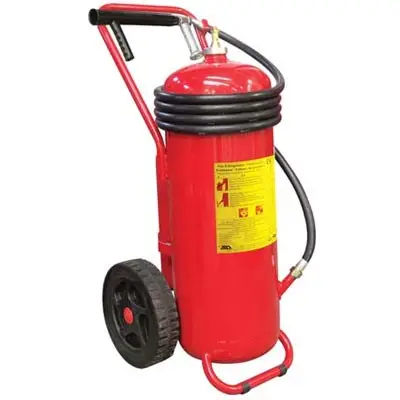
At 84 KG fully charged, the ABS Karate trolley requires a wheeled carriage for practical deployment — and the unit’s robust trolley frame with large-diameter wheels is designed for movement across the surfaces found in industrial and marine environments: grating, deck plating, concrete aprons, and uneven ground. The handle configuration allows the unit to be repositioned during a fire event, enabling the operator to change approach angle or withdraw to a safer position without abandoning the unit. Dimensions of 1050mm height × 450mm width × 550mm depth reflect a compact footprint for a 50 KG unit — relevant for storage in confined industrial equipment rooms and on vessel decks where space allocation is managed.
Technical Specifications
Model: 14151_10 / FEM-AB-DC50-BC
Capacity / Agent: 50 KG BC Karate Dry Powder
Propellant: 3LTR N2 (Nitrogen Cartridge)
Operation Method: Cartridge Operated
Test Standard: EN 1866
Fire Rating: 233 IV C
Discharge Time: 41 Seconds
Throw Distance: 11 M
Height: 1050 MM
Width: 450 MM
Depth: 550 MM
Total Weight (Charged): 84.0 KG
Operating Temperature: -30°C to +60°C
Working Pressure: 14 Bar
Test Pressure: 30 Bar
Part No: FEM-AB-DC50-BC
Benefits
Reduced Maintenance Dependency — Field-Recharge Capability
The cartridge-operated design fundamentally changes the maintenance economics of a 50 KG trolley extinguisher. Stored-pressure units in this size class require a pressure workshop for recharge after discharge — which typically means removing the unit from service, transporting it to a service facility, and waiting for service completion. With the ABS Karate trolley, discharge and recharge happens on-site: cartridge out, new cartridge in, powder refilled, unit back in service. For vessels between drydock cycles, remote industrial sites, and facilities without local extinguisher service contractors, this translates directly into maintained fire protection availability without service-dependency gaps.
Regulatory Compliance — Meeting Fire Safety Standards in High-Risk Industries
EN 1866 testing and 233 IV C fire rating provide documentary evidence that the ABS Karate trolley meets the performance requirements of European and international fire safety standards for wheeled fire extinguishers. For HSE officers, safety managers, and compliance teams preparing for port state control inspections, flag state surveys, insurance audits, or local regulatory inspections, specification of EN 1866-tested equipment with a documented fire rating provides the compliance basis that extinguisher-type approval documentation requires. The unit’s fire rating — 233 IV C — represents substantial Class B and C suppression capacity, exceeding the minimum fire rating requirements of most industrial and marine portable extinguisher specifications.
Operational Confidence in Extreme Conditions
The -30°C to +60°C operating range, 14 Bar working pressure, and 30 Bar test pressure collectively define an extinguisher built to perform reliably under conditions that would compromise lesser equipment. Fire events do not occur in controlled conditions — they occur under pressure, in heat, in environments that may already be compromised by the incident that caused them. The ABS Karate trolley’s design margins and environmental ratings provide the confidence basis that procurement teams need when specifying safety-critical equipment for high-consequence environments: not an extinguisher that might work, but one engineered and tested to work.
Cost Efficiency Over Service Life
Cartridge-operated extinguishers typically offer lower total service cost over their operational life compared to stored-pressure equivalents of the same agent capacity — the cartridge replacement and powder refill cost per recharge cycle is lower than the workshop refill cost for a stored-pressure 50 KG unit, and the absence of cylinder depressurisation means no pressure vessel service cycle costs associated with hydrostatic testing intervals. For procurement teams managing large extinguisher inventories across multiple vessels or industrial sites, the cumulative service cost difference across a fleet of heavy trolley units represents a meaningful lifecycle cost saving.
Who It’s For
HSE Officers and Safety Managers at Refineries and Petrochemical Plants
A process safety officer responsible for fire equipment specification at a refinery or petrochemical complex faces a specific challenge: fire protection at a site where Class B fire risk — from hydrocarbons, solvents, and fuel products — is constant and where a fire event can escalate rapidly. The ABS Karate BC trolley is specified for exactly this environment — its 50 KG BC powder capacity and 11-metre throw distance address the large-area pool fire and jet fire scenarios that a refinery HSE specification needs to plan for, while the EN 1866 test standard and documented fire rating give the safety manager the compliance documentation trail that a regulated industrial site requires.
Marine Superintendents and Vessel Procurement Officers
A technical superintendent managing a fleet of tankers, chemical carriers, or offshore support vessels needs extinguishers that can be maintained at sea without waiting for port facilities — and that will survive the environmental conditions of marine operations. The ABS Karate trolley’s cartridge-operated recharge design eliminates the workshop dependency that makes large stored-pressure trolley units impractical for vessel operations between port calls. The -30°C to +60°C operating range covers the full global trading range from Arctic to equatorial routes, and the EN 1866-tested performance provides flag state compliance documentation for SOLAS fire fighting equipment requirements.
Airport Fire Safety Coordinators and Ground Operations Managers
Airport ramp environments combine Class B fire risk — aviation fuels, hydraulic fluids, de-icing agents — with the need for fast, large-capacity fire suppression response. A fire involving aviation fuel on an aircraft ramp or in a fuel storage area requires immediate, high-volume agent discharge at safe standoff distance. The ABS Karate trolley’s 11-metre throw distance and 41-second discharge time directly match the tactical requirements of airport ramp fire response: reach the fire without getting inside the heat radiation zone, and sustain agent discharge long enough to achieve full suppression. The unit’s wide operating temperature range covers the full seasonal temperature range of airports in both cold-climate and tropical locations.
Possible Applications
Petroleum Refineries and Petrochemical Process Units
Process areas handling crude oil fractions, refined petroleum products, and chemical feedstocks present constant Class B fire exposure. Trolley-mounted 50 KG BC extinguishers are positioned at process unit boundaries, pump stations, manifold areas, and storage tank bunds as first-response fire suppression equipment supplementing fixed suppression systems.
Commercial and Military Airports — Ramp and Hangar Applications
Airport ramp fire equipment requirements typically specify wheeled extinguishers capable of addressing aviation fuel fires. The ABS Karate trolley is positioned on fuel dispensing ramps, aircraft parking aprons, hangar access points, and fuelling vehicle parks as first-response equipment for aviation fuel fire events — supplementing vehicle-mounted ARFF equipment for initial attack while major response is mobilised.
Vessels — Engine Rooms and Machinery Spaces
Marine machinery spaces carry significant Class B and C fire risk from fuel oil systems, lube oil circuits, electrical switchgear, and generator sets. Wheeled trolley extinguishers positioned at machinery space entrances provide the large-capacity first-response fire suppression capability required by SOLAS fire fighting equipment provisions for machinery spaces on vessels above defined tonnage thresholds.
Military Installations — Ammunition and Fuel Stores
Military facilities storing flammable materials, propellants, and fuels require fire protection capable of addressing large-scale Class B fire incidents. BC powder trolley extinguishers are standard equipment at fuel stores, ammunition handling areas, and vehicle maintenance facilities on military bases — consistent with the product description noting suitability for military environments.
Flammable Liquid Warehouses and Chemical Stores
Commercial and industrial warehousing facilities storing flammable liquids, aerosols, and Class B materials require wheeled extinguisher provision at defined intervals within the storage area. The 50 KG capacity and 11-metre throw distance allow a single trolley unit to address a fire in a storage aisle without the operator entering the storage area — maintaining safe standoff distance in an environment with high re-ignition risk.
Offshore Oil and Gas Platforms
Offshore platform fire protection strategies typically include wheeled BC powder extinguishers at process module boundaries, drilling deck areas, and wellhead zones. The ABS Karate trolley’s -30°C to +60°C operating range addresses the environmental requirements of platforms operating in the North Sea, Arctic waters, and equatorial offshore fields — a single specification covering the full geographic range of global offshore operations.
Coastal and Port Facilities — Fuel Jetties and Tank Farms
Fuel transfer operations at port facilities and coastal tank farms involve Class B fire risk at jetty loading arms, pipeline manifolds, and tank bund areas. Wheeled extinguishers positioned along jetty walkways and at tank bund access points provide first-response capability for fuel spill fire events during vessel loading and discharging operations — a critical first-response resource during transfer operations when fixed suppression systems may not provide adequate coverage at the transfer point.
Trust & Certifications
EN 1866 — European Standard for Wheeled Fire Extinguishers
EN 1866 is the European standard that specifies the construction, performance, and testing requirements for wheeled (mobile) fire extinguishers. Testing to EN 1866 covers agent discharge performance, operating mechanism reliability, pressure containment, temperature cycle resistance, and corrosion resistance — verifying that the extinguisher performs to specification across the full range of conditions it may encounter in service. For procurement teams specifying extinguishers for European Union facilities, vessels operating under European flag state regulations, or international facilities aligning to European fire safety standards, EN 1866 compliance is the foundational performance verification requirement for wheeled extinguisher procurement.
233 IV C Fire Rating — Performance-Verified Suppression Capability
The fire rating 233 IV C is the classification assigned following successful completion of standardised fire test arrays under EN 3 / EN 1866 conditions. The numeric component (233) represents the Class B test fire size suppressed; the IV designation indicates the Class B fire category addressed; the C suffix confirms Class C (electrical) capability verification. A 233 IV C rating represents substantial Class B suppression performance — the fire rating that procurement teams and HSE officers use to verify that a specified extinguisher can address the fire sizes present in a given risk assessment, rather than relying on nominal capacity alone.
ABS — Fire Safety Equipment Brand for Harsh Environments
The ABS brand is associated with fire extinguisher products specified for demanding commercial, industrial, and marine environments — including vessels, coastal installations, and military applications as referenced in the product description. The Karate powder range is a documented product line with identifiable model numbers (14151_10, part number FEM-AB-DC50-BC), supporting the procurement documentation trail required by HSE management systems and vessel safety equipment inventories. Specification by model number and part number provides an unambiguous procurement reference for repeat orders and service parts sourcing.
SOLAS Chapter II-2 Alignment — Marine Fire Fighting Equipment Compliance
The International Convention for the Safety of Life at Sea (SOLAS) Chapter II-2 establishes fire protection, fire detection, and fire extinction requirements for commercial vessels. Portable and wheeled fire extinguishers carried on SOLAS vessels must meet defined performance standards and be maintained to the manufacturer’s service schedule. EN 1866-tested wheeled extinguishers with documented fire ratings provide the compliance evidence basis for SOLAS Chapter II-2 fire fighting equipment requirements — relevant for vessel operators, flag state surveyors, and classification society surveyors verifying fire safety equipment compliance during periodic surveys and port state control inspections.
Accessories & Variants
Replacement Propellant Cartridge — 3LTR N2
The ABS Karate 50 KG trolley uses a 3LTR N2 nitrogen propellant cartridge. Replacement cartridges should be stocked alongside the extinguisher to enable immediate field recharge following discharge — the core maintenance advantage of the cartridge-operated design. Confirm the correct cartridge specification with your supplier to ensure compatibility with the specific unit model.
BC Karate Replacement Powder — 50 KG Refill
Following discharge, the powder agent charge is replaced with fresh BC Karate dry chemical powder. Stocking a 50 KG replacement powder charge alongside the unit ensures immediate recharge capability following a discharge event — particularly relevant for vessels and remote sites where local restocking may not be immediately available. Confirm the correct powder specification (BC Karate) to maintain the extinguisher’s fire rating compliance.
Available Variant — FEM-AB-DC50-BC
FEM-AB-DC50-BC — 50 KG BC Karate Powder Trolley | Cartridge Operated | Model 14151_10 | EN 1866 tested | Fire Rating 233 IV C | -30°C to +60°C operating range
For Class B and Class C fire protection requirements above 50 KG capacity, or for ABC powder variants covering Class A fires in addition to Class B and C, contact the supplier to confirm available model options and agent specifications.
Related Fire Safety Products
Portable BC Powder Extinguishers (6 KG / 9 KG / 12 KG) — Hand-portable BC powder units for personal issue and close-access positioning in the same risk areas as the 50 KG trolley; complement the trolley unit for first-response use by personnel in the immediate vicinity of a fire event before the trolley can be deployed
CO2 Extinguishers — Clean-agent electrical fire suppression for switchgear rooms, server rooms, and control panel areas where powder contamination from BC dry chemical would cause secondary damage to sensitive equipment
Fire Extinguisher Trolley Brackets and Storage Cabinets — Secure mounting and weatherproof storage solutions for wheeled extinguisher units deployed in outdoor and semi-exposed environments including vessel decks, jetty walkways, and plant perimeter positions
Get in Touch
If you are specifying wheeled BC powder fire extinguishers for a refinery, offshore platform, vessel fleet, airport facility, or industrial site — or if you need to confirm the correct model, fire rating, and quantity for a specific risk assessment or fire safety schedule — contact us to discuss your requirement and request a formal procurement quotation.
Our team can assist with product selection against your fire safety specification, confirm availability and lead times, and support procurement documentation for audit and compliance purposes.
📍 3791 Jalan Bukit Merah #06-01, E-Centre @ Redhill, Singapore 159471