Cart (
Overview
Most fire extinguisher failures in industrial and marine environments are not equipment failures — they are maintenance failures. A unit that cannot be serviced on-site sits out of compliance until a service contractor arrives, a workshop processes the recharge, and the unit is returned. On a vessel three weeks out from port, at an offshore platform on a two-week crew rotation, or at a coastal installation with no local extinguisher contractor, the gap between a discharge event and a fully recharged, serviceable unit can be days or weeks. That gap is a fire protection risk — and it is entirely avoidable with the right extinguisher design.
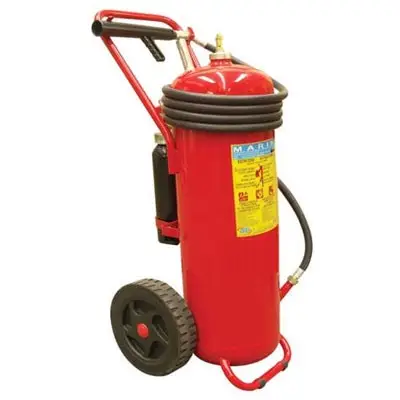
The ABS ABC Dry Powder Trolley Cartridge Fire Extinguisher is built specifically to eliminate that gap. Available in three agent capacities — 25 KG, 50 KG, and 100 KG — this cartridge-operated wheeled unit covers all common fire classes: Class A (solid materials), Class B (flammable liquids and gases), and Class C (energised electrical equipment). After discharge, the crew replaces the spent CO2 propellant cartridge and refills the powder agent. No workshop, no specialist tooling, no service contractor required. The extinguisher returns to full operational status in the field.
Tested to EN 1866 standard across all three variants, with a 233 IV B fire rating and an operating temperature range of -30°C to +60°C, the ABS ABC trolley is designed and verified for the most hostile operating environments — onboard vessels, coastal installations, oil rigs, and industrial facilities where fire protection cannot be conditional on workshop proximity. The range of three capacities allows procurement teams to match extinguisher size to the risk profile of each location without compromise: 25 KG for moderate-risk positions, 50 KG for process and machinery areas, and 100 KG for large-area or high-consequence fire risk locations.
Key Features
ABC Dry Powder Agent — All Common Fire Classes Covered
The ABC monoammonium phosphate dry powder formulation addresses Class A, Class B, and Class C fires from a single agent charge — solid combustibles, flammable liquid and gas fires, and energised electrical equipment. In environments where multiple fire risk classes coexist — an engine room with fuel systems, electrical panels, and combustible materials simultaneously present — a single ABC trolley unit provides fire suppression capability across the full range of likely fire scenarios without the need for multiple extinguisher types positioned at the same location. For procurement teams simplifying fire equipment inventories across diverse site types, ABC agent coverage reduces the number of distinct extinguisher specifications required.
Cartridge-Operated Design — Field Recharge Without a Workshop
All three ABS ABC trolley variants use a CO2 propellant cartridge system rather than a stored-pressure cylinder. The 25 KG and 50 KG models use a 3LTR CO2 cartridge; the 100 KG model uses a 5.4LTR CO2 cartridge. Following discharge, recharge consists of two tasks: replace the spent cartridge with a new one, and refill the cylinder with fresh ABC powder. Both tasks can be completed by trained crew or maintenance personnel without a pressure workshop, without cylinder depressurisation equipment, and without a service contractor on-site. For vessels at sea, offshore platforms between supply vessel visits, and remote industrial sites, this is the most practically significant feature of the unit — it keeps the extinguisher in service, not waiting for service.
Three Capacity Variants — 25 KG, 50 KG, 100 KG
The range covers three agent capacities, each with a distinct discharge profile suited to different risk environments. The 25 KG variant (Model 14134) discharges in 25 seconds with an 11-metre throw distance — suited to moderate-risk positions where a rapid first-attack capability is needed. The 50 KG variant (Model 14163) discharges in 41 seconds with an 11-metre throw distance — the standard specification for machinery spaces and process areas. The 100 KG variant (Model 14166) delivers a 99-second discharge at 12-metre throw distance — the choice for large-area fire risk positions where sustained suppression capacity is the critical specification. All three variants share the same EN 1866 test standard, 233 IV B fire rating, and -30°C to +60°C operating range — a consistent compliance baseline across the full range.
11–12 Metre Throw Distance — Safe Standoff from the Fire
The 25 KG and 50 KG models achieve an 11-metre throw distance; the 100 KG model reaches 12 metres. For Class B fire scenarios involving flammable liquid pool fires or pressurised gas releases, the ability to begin agent discharge from beyond the heat radiation zone and the immediate fire perimeter is a direct operator safety requirement. At 11–12 metres of effective reach, the operator can position the trolley at a safe distance, direct the discharge nozzle at the fire base, and work the fire without entering the high-risk zone closest to the ignition source. In confined industrial environments and on vessel decks where retreat options may be limited, throw distance is not an incidental spec — it is an operational safety parameter.
Wide Cylinder Opening — On-Site Powder Condition Verification
The wide cylinder opening allows crew to inspect the condition of the ABC powder charge using a standard adjustable spanner — confirming that the powder is free-flowing and not caked or compacted before the next inspection interval. ABC dry powder can absorb moisture and compact in humid environments, particularly in marine and coastal locations, reducing discharge flow rate and suppression effectiveness. The ability to verify powder condition at each service check — rather than assuming the powder remains serviceable — is a concrete maintenance quality control step that supports a genuine service record, not just a compliance checkbox.
Operating Temperature Range -30°C to +60°C — Global Deployment Ready
All three variants are rated across a -30°C to +60°C operating range — covering Arctic offshore operations, cold-climate industrial facilities, and high-temperature tropical environments within a single specification. For ship managers operating vessels across multiple trading routes, for offshore operators with assets in both North Sea and equatorial fields, and for facility managers with sites in climate-diverse locations, a single extinguisher specification that performs across the full global temperature range eliminates the need for climate-specific product variants and simplifies both procurement and maintenance documentation.
EN 1866 Tested — Verified Performance Under Standard Conditions
EN 1866 is the European standard for wheeled fire extinguishers, covering construction, performance, operating mechanism reliability, pressure containment, temperature resistance, and corrosion resistance. Testing to EN 1866 provides independent verification that the extinguisher performs to its rated specification — not just under controlled factory conditions but across the range of environmental stresses the standard requires. For HSE officers, flag state surveyors, and insurance inspectors verifying compliance of fire fighting equipment, EN 1866 test certification is the documentary basis for confirming that wheeled extinguishers meet the performance requirements of their specification.
Technical Specifications
Model: 14134 (25KG) | 14163 (50KG) | 14166 (100KG)
Extinguish Agent: 25KG ABC | 50KG ABC | 100KG ABC
Test Standard: EN1866 (all variants)
Propellant: 3LTR CO2 Cart (14134, 14163) | 5.4LTR CO2 Cart (14166)
Discharge Distance: 11M (14134, 14163) | 12M (14166)
App Discharge Time: 25 Sec (14134) | 41 Sec (14163) | 99 Sec (14166)
Height: 1020mm (14134) | 1050mm (14163) | 1290mm (14166)
Width: 430mm (14134) | 450mm (14163) | 540mm (14166)
Depth: 535mm (14134) | 550mm (14163) | 700mm (14166)
App Total Weight: 60KG (14134) | 85KG (14163) | 120KG (14166)
Operating Temperature: -30°C to +60°C (all variants)
Working Pressure: 14 Bar (all variants)
Test Pressure: 30 Bar (all variants)
Fire Rating: 233 IV B (all variants)
Part No: FEM-ABDC25 (14134) | FEM-ABDC50 (14163) | FEM-ABDC100 (14166)
Benefits
Fire Protection That Stays Serviceable Without Shore Support
The most direct operational benefit of the ABS ABC trolley is the elimination of service-dependency for post-discharge recharge. Vessels, offshore platforms, and remote industrial sites that carry stored-pressure trolley extinguishers face the reality that a discharge event — whether in a genuine fire emergency or during an accidental actuation — takes the unit out of service until a workshop can complete the recharge. The cartridge-operated ABS ABC trolley removes that dependency entirely: recharge happens on-site, on schedule, with materials that can be stocked alongside the unit. Fire protection continuity is maintained without waiting for external service provision.
Compliance Documentation Across the Full Risk Spectrum
EN 1866 test certification and a documented 233 IV B fire rating provide the compliance evidence that flag state surveyors, port state control inspectors, insurance underwriters, and HSE audit teams require when verifying fire fighting equipment against SOLAS, local regulatory, or insurance specification requirements. The consistent test standard and fire rating across all three capacity variants means that a single extinguisher specification covers positions requiring 25 KG, 50 KG, and 100 KG units — simplifying the compliance documentation structure for facilities and fleets carrying multiple capacity variants.
One Extinguisher Specification for All Common Fire Types
ABC agent coverage across Class A, B, and C fires means a single product specification addresses the full range of common fire scenarios encountered in industrial and marine environments — solid fuel fires, flammable liquid and gas fires, and electrical fires. For facilities managers and procurement teams specifying fire protection across diverse site types and risk profiles, consolidating on an ABC trolley extinguisher reduces the number of distinct specifications, reduces the variety of replacement agents that need to be stocked, and simplifies crew training — one extinguisher type, one set of operating procedures, applicable across all common fire scenarios.
Scalable Capacity Matched to Risk Level
The three-variant range allows fire protection specifications to be matched precisely to the risk profile of each location without specifying a larger unit than required or accepting insufficient capacity. A 25 KG unit at a moderate-risk position, a 50 KG unit in a process area or machinery space, and a 100 KG unit at a high-consequence fire risk location — all from the same product family, the same maintenance regime, and the same replacement parts supply chain. For ship managers or facilities operators maintaining multiple sites or vessels with varying risk profiles, a single-family product specification simplifies procurement, service planning, and spare parts management.
Who It’s For
Vessel Technical Superintendents and Ship Managers
A technical superintendent managing a mixed fleet — tankers, bulk carriers, offshore support vessels — needs fire equipment specifications that work in the field without creating service-dependency problems between port calls. The ABS ABC trolley addresses the specific challenge of maintaining wheeled extinguisher serviceability on vessels operating long passages away from port facilities. The cartridge-operated design allows the ship’s crew to maintain the units to service standard at sea; EN 1866 certification and documented fire ratings support SOLAS compliance documentation at flag state and port state control surveys; and the -30°C to +60°C operating range covers the full temperature range of global vessel operations from Arctic to equatorial routes.
HSE Officers at Offshore Oil and Gas Installations
An HSE officer responsible for fire protection at an offshore platform operates in an environment where fire risk is constant, resupply logistics are constrained, and compliance with platform safety case fire protection requirements is non-negotiable. The 100 KG variant addresses the large-area fire suppression requirements of process module and wellhead area fire protection specifications; the cartridge-operated design supports on-platform recharge between supply vessel visits; and the combination of ABC agent coverage and EN 1866 test certification provides the fire class coverage and compliance documentation that offshore safety case requirements demand. The -30°C to +60°C rating covers North Sea and equatorial field operations from a single specification.
Fire Safety Procurement Teams at Industrial Facilities
A procurement officer managing fire equipment supply for a coastal installation, tank farm, or chemical processing facility needs a wheeled extinguisher specification that can be matched to multiple risk positions across the site without managing multiple product families. The ABS ABC trolley’s three-variant range — 25 KG, 50 KG, 100 KG — with consistent compliance certification across all variants allows a single supplier relationship and a single procurement specification to cover the full range of wheeled extinguisher positions across a complex industrial site, from moderate-risk perimeter positions to high-consequence process area fire protection requirements.
Possible Applications
Vessel Engine Rooms and Machinery Spaces
Marine machinery spaces present simultaneous Class A, B, and C fire risk from fuel oil systems, lube oil circuits, electrical switchgear, and combustible insulation materials. Wheeled ABC trolley extinguishers are positioned at machinery space access points as first-response fire suppression equipment, with the 50 KG variant the standard specification for most commercial vessel machinery space requirements under SOLAS Chapter II-2 fire fighting equipment provisions.
Offshore Oil and Gas Platform Process Modules
Offshore platform process areas handling hydrocarbons, associated gas, and produced water require large-capacity fire suppression at process module boundaries. The 100 KG variant provides the sustained discharge time — 99 seconds at 12-metre throw distance — required for first-response suppression of large-area Class B fires in process module environments, supplementing fixed suppression systems during the initial fire response phase.
Coastal Fuel Terminals and Tank Farms
Fuel transfer operations at coastal terminals and tank bund areas require wheeled extinguisher provision at jetty loading arms, manifold areas, and tank bund access points. The ABS ABC trolley’s ABC agent coverage addresses the mixed fire risk of fuel transfer environments — Class B liquid spill fires at the transfer point combined with Class C electrical fire risk from pump motors and control equipment in the same area.
Industrial Chemical Processing Plants
Chemical processing facilities handling flammable solvents, reactive chemicals, and energised process equipment require fire protection capable of addressing Class A, B, and C fire scenarios from a single unit positioned at process area boundaries. ABC powder coverage and large agent capacity make the 50 KG and 100 KG variants the standard specification for wheeled extinguisher positions in chemical processing environments.
Military Bases — Vehicle Parks, Fuel Stores, and Ammunition Handling Areas
Military facilities with fuel storage, vehicle maintenance, and ammunition handling areas carry all common fire class risks simultaneously. ABC trolley extinguishers are standard equipment at vehicle park fire points, fuel store access positions, and ammunition handling facility perimeters — the ABS brand is explicitly referenced as suitable for military environments in the product documentation.
Airport Ground Operations — Ramp and Fuel Dispensing Areas
Airport ramp environments combine Class B aviation fuel fire risk with Class C electrical risk from ground power equipment and aircraft systems. Wheeled ABC trolley extinguishers at fuel dispensing positions and aircraft parking stands provide first-response fire suppression capability pending ARFF vehicle response — the 11-12 metre throw distance supporting safe standoff during initial attack on aviation fuel spill fires.
Remote Industrial Sites — Mining, Power Generation, and Construction
Remote sites without local extinguisher service contractors — mining operations, remote power generation facilities, and large construction sites — benefit from the cartridge-operated design that enables on-site recharge. The 25 KG variant addresses first-response requirements at equipment positions; the 50 KG and 100 KG variants cover generator rooms, fuel storage areas, and high-consequence fire risk positions where sustained suppression capacity is required.
Trust & Certifications
EN 1866 — European Wheeled Fire Extinguisher Standard
EN 1866 is the European harmonised standard specifying construction requirements, performance testing, and safety verification for wheeled (mobile) fire extinguishers. Testing covers discharge performance, operating mechanism reliability across multiple actuations, pressure containment at working and test pressure, temperature cycle resistance, and corrosion resistance. For procurement teams specifying fire equipment for European Union facilities, vessels operating under European flag state regulation, or international facilities aligning fire equipment specifications to European standards, EN 1866 compliance across all three ABS ABC trolley variants provides the performance verification baseline that the specification requires.
233 IV B Fire Rating — Verified Class B Suppression Performance
The 233 IV B fire rating is assigned following successful completion of standardised Class B fire test arrays under EN 3 / EN 1866 conditions. The numeric component (233) represents the Class B test fire size suppressed; IV denotes the Class B fire category; B confirms the agent classification. A 233 IV B rating represents substantial Class B fire suppression capacity — verified by standardised testing rather than manufacturer claim. For HSE officers and safety managers verifying that specified extinguishers meet the fire rating requirements of a site fire risk assessment, the 233 IV B rating provides the documented suppression performance basis that the verification process requires.
SOLAS Chapter II-2 Alignment — Marine Fire Fighting Equipment
SOLAS Chapter II-2 establishes fire protection and extinguishing requirements for commercial vessels, including provisions for portable and wheeled fire extinguishers in machinery spaces and other high-risk areas. EN 1866-tested wheeled extinguishers with documented fire ratings provide the performance evidence basis for SOLAS-compliant fire fighting equipment specification — relevant for vessel operators preparing for flag state surveys, classification society surveys, and port state control inspections under the Paris MOU, Tokyo MOU, and other regional port state control regimes.
ABS Brand — Fire Safety Equipment for Demanding Environments
The ABS extinguisher range is documented as suitable for onboard vessels, coastal installations, oil rigs, and military environments — environments that subject fire equipment to conditions well beyond those encountered in standard commercial or institutional applications. Product documentation references rigorous testing as the basis for suitability in hostile environments, and the -30°C to +60°C operating range, 14 Bar working pressure, and 30 Bar test pressure across all three variants reflect design margins appropriate for equipment specified in high-consequence fire protection roles. Model numbers (14134, 14163, 14166) and part numbers (FEM-ABDC25, FEM-ABDC50, FEM-ABDC100) provide unambiguous procurement references for HSE documentation and inventory management.
Accessories & Variants
Replacement CO2 Propellant Cartridges
3LTR CO2 Cartridge — Replacement propellant for Model 14134 (25KG) and Model 14163 (50KG). Stock alongside the unit to enable immediate field recharge following discharge — the cartridge is the enabling component of the field-recharge capability that defines the operational advantage of these units.
5.4LTR CO2 Cartridge — Replacement propellant for Model 14166 (100KG). The larger cartridge matches the higher propellant requirement for the 99-second discharge duration of the 100KG variant. Confirm the correct cartridge size when ordering replacement stock for the 100KG unit — the 3LTR and 5.4LTR cartridges are not interchangeable.
ABC Replacement Powder — Refill Charges
25KG ABC Powder Refill — For Model 14134 (FEM-ABDC25). Stock a refill charge alongside the unit to enable immediate recharge after discharge.
50KG ABC Powder Refill — For Model 14163 (FEM-ABDC50). Essential stock item for vessels and remote sites where local powder supply is not available.
100KG ABC Powder Refill — For Model 14166 (FEM-ABDC100). Given the 100KG agent charge, confirm storage and handling logistics for the refill quantity at each installation location.
Available Variants — Full Model Reference
FEM-ABDC25 (Model 14134) — 25KG ABC | 3LTR CO2 Cart | 11M throw | 25 Sec discharge | 60KG total weight | EN1866 | 233 IV B
FEM-ABDC50 (Model 14163) — 50KG ABC | 3LTR CO2 Cart | 11M throw | 41 Sec discharge | 85KG total weight | EN1866 | 233 IV B
FEM-ABDC100 (Model 14166) — 100KG ABC | 5.4LTR CO2 Cart | 12M throw | 99 Sec discharge | 120KG total weight | EN1866 | 233 IV B
Related Fire Safety Products
ABS 50KG Karate BC Powder Trolley Cartridge (FEM-AB-DC50-BC) — BC-rated trolley for Class B and C fire-only positions where ABC coverage is not required; for refineries, airports, and fuel handling areas where the BC Karate powder formulation is the specified agent type
Portable ABC Powder Extinguishers (6KG / 9KG / 12KG) — Hand-portable ABC units for personal-issue and close-access positioning in the same risk areas as the trolley units; complement the wheeled unit for immediate first-response use by personnel nearest a fire event
CO2 Extinguishers — Clean-agent units for electrical fire positions — switchgear rooms, server rooms, and control panels — where dry powder discharge would cause unacceptable secondary damage to sensitive equipment
Get in Touch
If you are specifying ABC dry powder trolley extinguishers for a vessel fleet, offshore installation, coastal facility, or industrial site — or if you need guidance on selecting the right capacity variant for a specific risk position or fire safety schedule — contact us to discuss your requirement and request a formal procurement quotation.
Our team can advise on capacity selection for your fire risk profile, confirm stock availability across all three variants, and support procurement documentation for SOLAS compliance, HSE audit, and insurance verification purposes.
📍 3791 Jalan Bukit Merah #06-01, E-Centre @ Redhill, Singapore 159471