Cart (
Overview
A crankcase explosion on a marine diesel engine is one of the most destructive events that can occur in an engine room. They happen fast, with little warning, and the consequences — structural damage to the engine, fire, and serious risk to crew — are severe enough that SOLAS and classification society rules require oil mist detection systems to be operational whenever a diesel engine is running. The detection system’s job is to catch the problem before it becomes a catastrophe: identify abnormal oil mist concentrations building inside the crankcase, trigger an alarm, and allow the crew to slow or stop the engine before ignition conditions are reached.
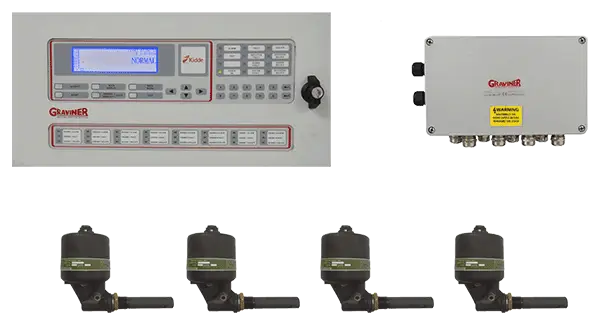
The Kidde Graviner Mk6 Oil Mist Detector (OMD) Control Bulk Unit is a complete, centrally managed oil mist detection system for marine diesel engines — capable of monitoring up to 64 individual detectors across eight separate engines from a single control unit. Built around analogue addressable detection technology, the Mk6 OMD delivers real-time, continuous oil mist concentration data from every monitored point on every engine, with a full system scan completed in 1.2 seconds. This is not a basic threshold alarm system — it is a precision monitoring platform that gives engineers meaningful, quantified data on crankcase conditions, not just a binary “alarm or no alarm” output.
What sets the Graviner Mk6 apart from earlier-generation oil mist detection systems is the elimination of sample pipes, air supply infrastructure, and extractor fans. Older pipe-based systems required a network of sample pipes running from each monitored point back to a central analyser — adding installation complexity, maintenance overhead, and potential failure points in the sampling circuit itself. The Mk6’s compact, engine-mounted detectors connect directly to the control unit via a simple cable run and junction box, with no sample pipe infrastructure required. For new vessel builds and retrofit installations alike, this pipe-free architecture significantly reduces installation cost and complexity while removing a category of maintenance problems that plague older sampling-based systems.
Key Features
Monitors Up to 64 Detectors Across Eight Engines from a Single Control Unit
The Mk6 bulk control unit supports up to 64 individual oil mist detectors distributed across up to eight separate engines — all managed and monitored from one central panel. For vessels with multiple main engines, auxiliary engines, or generator sets requiring individual oil mist detection compliance, this multi-engine capability means a single Mk6 system can cover the entire engine room monitoring requirement without installing separate standalone detectors on each engine. This consolidates alarm management, event logging, and system oversight into one operator interface — reducing the complexity burden on the engineer on watch.
Full 64-Detector System Scan in 1.2 Seconds
The Mk6 control unit scans all 64 detector positions in 1.2 seconds — providing effectively real-time monitoring of oil mist concentrations across all monitored engine positions simultaneously. The speed of this scan matters because crankcase conditions that lead to oil mist accumulation can develop and escalate within seconds. A detection system with a slow scan cycle may miss a rapidly developing condition or respond to it too late to allow effective engine slowdown. The 1.2-second full scan rate ensures the system has current, actionable data across all monitored points at all times.
Analogue Addressable Detection Technology
Unlike basic threshold-based detectors that output only an alarm signal when a set limit is exceeded, the Mk6 uses analogue addressable technology — meaning each detector continuously reports its actual measured oil mist density value back to the control unit, and each detector is individually identified by address. This gives the engineer on watch a real picture of crankcase conditions across all monitored engines: not just which engine has alarmed, but which specific detector position is showing elevated readings, what the current density value is, and how quickly conditions are changing. This level of detail supports more informed decision-making when managing an early-stage crankcase condition.
Pipe-Free Installation — No Sample Pipes, Air Supply, or Extractor Fans Required
The Mk6 eliminates the sample pipe infrastructure that older oil mist detection systems depend on. Detectors are compact units mounted directly on the engine at monitored positions — connected to the control unit via a cable run through a junction box, with no pipe network, pressurised air supply, or extraction fans needed. This pipe-free architecture reduces initial installation cost and complexity substantially, and removes an entire category of ongoing maintenance requirements: sample pipe blockages, filter replacements, airflow fault diagnostics, and pump maintenance are not factors in the Mk6 installation. For retrofit applications on existing vessels, the simplified installation footprint also means less disruption to engine room infrastructure.
Fully Configurable — One to Eight Engines, System-Wide
The Mk6 system is configurable from one engine up to eight engines, with detector counts scaled to match the specific monitoring requirement. This flexibility means the same control platform serves a single-engine coastal vessel and an eight-engine large cargo vessel equally well — and that the system can be expanded as vessel configuration changes without replacing the central control unit. Operators can configure alarm thresholds, detector groupings, and engine-specific parameters to match the operational characteristics of each monitored engine, rather than applying a one-size-fits-all alarm setting across different engine types and sizes.
Compact Engine-Mounted Detectors with Plug/Socket Connection
The Mk6 detectors are compact units designed for direct engine mounting — positioned at the crankcase inspection doors or other specified monitoring points on each engine. Plug-and-socket connection at each detector simplifies installation and, critically, simplifies detector replacement during maintenance. A failed or due-for-service detector can be unplugged and replaced without disturbing the wiring installation — reducing maintenance time and the risk of installation errors during detector servicing.
Event Log — Oil Mist Density Data and Alarm History per Detector
The Mk6 control unit records oil mist density data and alarm events for each individual detector — maintaining a logged history of crankcase conditions across the monitored engine fleet. This event log supports post-incident analysis, maintenance trend monitoring, and the documentary record that classification society surveyors and flag state inspectors may request when reviewing engine room safety system maintenance records. For ship managers and HSE officers who need to demonstrate that the oil mist detection system has been performing correctly and that alarm events have been responded to appropriately, the event log is a practical compliance and management tool.
Technical Specifications
Model: Kidde Graviner Mk6 OMD (Oil Mist Detector) Control Bulk Unit
Detection Technology: Analogue addressable oil mist detection
Maximum Detectors: 64 detectors
Maximum Engines: 8 engines per system
Scan Rate: 64 detectors in 1.2 seconds
Power Supply: 24V DC
Detector Connection: Plug/socket, via junction box to control unit
Installation: Pipe-free — no sample pipes, air supply, or extractor fans required
Configuration: 1 to 8 engines, scalable
Data Logging: Oil mist density data and alarm events per detector
Display: Central control unit with LCD display panel
Category: Marine Oil Mist Detection System
Manufacturer: Kidde Graviner (UTC Fire & Security)
Benefits
Real-time crankcase condition awareness across the entire engine room. The 1.2-second full system scan and analogue density reporting give the engineer on watch a continuously updated picture of crankcase conditions across all monitored engines — not just an alarm state, but actual measured density values per detector. This allows early-stage conditions to be identified and responded to before they reach alarm thresholds, and gives the watch engineer the information needed to make a proportionate response to developing conditions.
Significantly reduced installation cost compared to pipe-based systems. Eliminating the sample pipe network, air supply infrastructure, and extraction fans from the installation removes a substantial portion of the cost and complexity of fitting an oil mist detection system — whether on a new build or a retrofit. The simple cable run between detectors, junction boxes, and the control unit is straightforward to install, inspect, and maintain.
Lower ongoing maintenance overhead. Without sample pipes to clean, filters to replace, pumps to service, or airflow circuits to diagnose, the Mk6 system’s maintenance requirement is focused on the detectors and control unit — both of which are accessible and serviceable without specialist infrastructure. Plug-and-socket detector connections mean detector replacement is a straightforward maintenance task rather than a complex rewiring job.
Single system covers the full engine room monitoring requirement. For vessels with multiple engines, the Mk6’s eight-engine, 64-detector capacity means one system and one operator interface covers the entire vessel’s oil mist detection compliance requirement. This simplifies alarm management, reduces the number of systems the engineer on watch must monitor, and provides a single source of event log data for the entire engine room.
Event log supports compliance documentation and post-incident review. The per-detector density and alarm history log provides the documentary record that class surveyors, flag state inspectors, and ISM Code audits may require when reviewing engine room safety system performance. For ship managers, it also supports proactive maintenance by identifying detectors or engines showing trends toward elevated readings before an alarm condition develops.
Who It’s For
The Chief Engineer on a Multi-Engine Vessel
You’re responsible for engine room safety on a vessel with multiple main engines or a combination of main engines and auxiliary generator sets — all of which require individual oil mist detection compliance. You need a system that consolidates monitoring across all engines into a single, clear operator interface, gives you real density data rather than just alarm states, and doesn’t require a maintenance-intensive pipe infrastructure to keep operational. The Mk6 bulk system is designed for this configuration, and the analogue addressable technology means you’re managing actual crankcase data, not just alarm lights.
The Ship Manager or Technical Superintendent Specifying Engine Room Safety Systems
You’re specifying oil mist detection systems for a new vessel build or evaluating a retrofit option for an existing fleet. You need a system that meets SOLAS and class requirements, scales to the specific engine configuration of each vessel in your fleet, minimises installation cost and complexity, and reduces ongoing maintenance demands on vessel crews. The Mk6’s pipe-free architecture, scalable configuration, and 24V DC power supply make it a straightforward system to specify, install, and maintain across a range of vessel types and engine room configurations.
The HSE Officer or Safety Manager at a Ship Management Company
You’re responsible for ensuring that the vessels in your managed fleet maintain operational oil mist detection systems and that alarm events are documented in a way that supports ISM Code compliance and class survey requirements. The Mk6’s per-detector event log — recording density data and alarm history for each detector across all monitored engines — gives you the documentary foundation for demonstrating that the engine room safety system is being maintained and managed correctly. When a class surveyor asks to review oil mist detection system records, you have data to show.
Possible Applications
- Bulk carriers and large cargo vessels — Multi-engine monitoring across main propulsion engines and auxiliary generator sets, with a single Mk6 bulk system covering the entire engine room detection requirement
- Crude oil and product tankers — Oil mist detection on large two-stroke main engines and auxiliary engines, where continuous crankcase monitoring is required under SOLAS and flag state regulations
- Container ships and ro-ro vessels — High-scan-rate monitoring across multiple engine room diesel installations on liner service vessels where engine reliability and safety system compliance are continuous operational priorities
- Offshore support vessels and platform supply vessels — Oil mist detection across multi-engine diesel-electric propulsion configurations common in offshore vessel designs, where engine room safety system availability is a continuous operational requirement
- Passenger vessels and cruise ships — Comprehensive crankcase monitoring across main propulsion and auxiliary diesel installations, supporting the enhanced engine room safety system standards required for passenger vessel class and flag state compliance
- New vessel builds — Pipe-free installation architecture makes the Mk6 a practical specification choice for newbuilding projects, reducing engine room installation complexity and commissioning time compared to pipe-based oil mist detection systems
- Retrofit installations on existing vessels — Simple cable-run installation without pipe infrastructure makes the Mk6 a practical retrofit option for vessels upgrading from older oil mist detection systems, with minimal disruption to existing engine room installations
- Generator set monitoring in power plant vessels and FPSOs — Scalable multi-engine configuration supports oil mist detection across large numbers of diesel generator sets in vessels with high electrical generation requirements
Trust and Certifications
Kidde Graviner — Over 50 Years of Marine Oil Mist Detection
Graviner, now part of Kidde (UTC Fire & Security), has been manufacturing oil mist detection systems for the marine industry for over 50 years. The Graviner name is effectively synonymous with marine oil mist detection — the Mk series of detectors has been specified as OEM equipment by major shipyards worldwide across multiple vessel generations, and the Graviner Mk6 is one of the most widely installed oil mist detection systems in the current global commercial fleet. This depth of market presence and operational track record provides a level of technology and reliability assurance that newer entrants to the oil mist detection market cannot replicate.
SOLAS Chapter II-1 — Regulatory Requirement Context
Oil mist detection systems on marine diesel engines are required under SOLAS Chapter II-1 and supporting classification society rules to be installed and operational whenever engines are in service. The specific requirements vary by engine power output and vessel type, but the principle is consistent: crankcase conditions must be continuously monitored, and the detection system must be capable of providing early warning of abnormal oil mist concentrations. The Graviner Mk6 is designed and type-approved to meet these requirements — providing a detection system that satisfies the regulatory standard and the practical performance requirements for crankcase explosion prevention.
Classification Society Type Approval
The Graviner Mk6 OMD carries type approval from major classification societies including Lloyd’s Register, DNV, Bureau Veritas, ClassNK, and American Bureau of Shipping. Classification society type approval confirms that the system design has been independently evaluated and accepted as meeting the technical and performance standards required for use on classed vessels. For ship managers and procurement teams specifying oil mist detection systems, type approval from the vessel’s classification society is the relevant compliance standard — and the Mk6’s broad type approval coverage means it is accepted across the major classification societies used by the global commercial fleet.
Supplied by Alright Engineering Solutions
The Kidde Graviner Mk6 Oil Mist Detector Control Bulk Unit is supplied through Alright Engineering Solutions Pte. Ltd. — a Singapore-based specialist in marine safety system equipment, oil mist detection systems, and fixed and portable gas detection. Alright Engineering Solutions supports vessel operators, ship managers, shipyards, and marine service companies across Singapore and the wider regional market with equipment supply, spare parts sourcing, and technical procurement support.
Accessories and Variants
Graviner Mk6 Individual Detectors and Detector Assemblies
The Mk6 bulk system requires compatible Mk6 detector units for each monitored engine position. Alright Engineering Solutions can supply Mk6 detectors and associated mounting hardware to complete the bulk system installation, as well as replacement detectors for existing Mk6 installations requiring detector servicing or replacement.
Graviner Mk6 Spare Parts — Main PCB, LCD Assembly, and System Components
For existing Mk6 installations requiring component-level maintenance, Alright Engineering Solutions stocks key Mk6 spare parts including the Main PCB (44782-K071-02) and the Main PCB and LCD Assembly kit (43782-K178) — the replacement solution for EEPROM faults and older-generation PCB failures. Contact our team with your specific Mk6 component requirements for availability and quotation.
Junction Boxes and Cabling Accessories
The Mk6 system’s engine-to-control-unit cable run connects through junction boxes at each engine. Compatible junction boxes and associated installation accessories are available to support new installation and system extension projects. Contact our team for the specific installation accessories required for your vessel configuration.
Related Products from Alright Engineering Solutions
Graviner Mk6 Main PCB (44782-K071-02) — Replacement main processor PCB for Mk6 detector control units
Graviner Mk6 Main PCB & LCD Assembly (43782-K178) — Complete replacement kit for EEPROM faults and older-generation PCB failures
GX-8000 Sample Draw Multi Gas Monitor — Portable marine sample draw multi-gas monitor for vessel confined space entry
RX-8700 Portable Gas Detector — ATEX/IECEx/MED-certified portable multi-gas monitor for marine applications
Get in Touch
If you’re specifying a Graviner Mk6 Oil Mist Detector system for a new vessel build, evaluating a retrofit option for an existing installation, or need to discuss system configuration for a specific engine room layout — contact Alright Engineering Solutions to discuss your requirements and request a formal quotation.
Our team can also assist with Mk6 spare parts sourcing, detector supply, and related marine engine room safety equipment for your vessel or fleet programme.
📍 3791 Jalan Bukit Merah #06-01, E-Centre @ Redhill, Singapore 159471