Cart (
Overview
A liferaft that stays lashed to a sinking vessel’s deck is not a survival tool — it is a piece of equipment that failed at the moment it was most needed. In a rapid sinking scenario, crew may have seconds to act, not minutes. If the liferaft is not automatically released from its cradle and inflated before the vessel goes under, the crew’s last line of survival disappears with the ship. The hydrostatic release unit is the single mechanical component that determines whether the liferaft deploys automatically or sinks with the vessel — and its performance in that moment is entirely dependent on whether it was correctly specified, correctly installed, and within its approved service life.
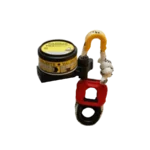
The Hydrostatic Release Unit (Disposable Type) by HAMMAR is a purpose-built, single-use liferaft release mechanism designed to automatically release a liferaft from its deck cradle when submerged to a depth of 1.5–4.0 metres. At that depth, water pressure activates the hydrostatic mechanism, which severs the red weak link — rated at 2.2 kN — freeing the liferaft container from its lashing. The white rope sling, with a minimum breaking strength of 15 kN, remains connected to the vessel’s painter line, ensuring the inflating liferaft does not drift away from survivors in the water. The entire sequence is automatic, requires no crew action, and functions whether the crew are present, incapacitated, or already in the water.
What sets this HAMMAR HRU apart from alternatives in the liferaft safety equipment market is the combination of three critical factors in a single disposable unit: glass fibre reinforced nylon construction that eliminates corrosion-related mechanical failure, a maintenance-free design that requires no annual service or spare parts, and a capacity range that covers liferafts from 6 up to 150 persons — making it a single product specification that works across the full range of vessel types and liferaft capacities in use on SOLAS-regulated commercial shipping. No size-specific variants, no capacity-restricted approvals, no secondary specification decisions.
Key Features
Automatic Hydrostatic Activation at 1.5–4.0 Metres — Float-Free Liferaft Release
The HRU activates automatically when submerged to a depth of between 1.5 and 4.0 metres, triggered by the hydrostatic pressure of the water column acting on the internal mechanism. At that pressure threshold, the mechanism severs the red weak link, releasing the lashing that secures the liferaft container in its cradle, allowing the liferaft to float free of the sinking vessel and inflate via its painter line. This activation sequence is entirely automatic — it requires no crew action, no manual release, and no electrical power. In the worst-case sinking scenario — a sudden flooding event, a capsize, or a vessel going down at night with no time for organised abandonment — the automatic float-free function is the only reliable means by which the liferaft can reach the surface and be available to survivors.
Red Weak Link — 2.2 kN Breaking Strength
The red weak link is the component that the HRU severs at activation, releasing the liferaft container from its lashing. Its breaking strength of 2.2 kN is a precisely specified value — strong enough to secure the liferaft container in its cradle against the vessel’s motion at sea, but weak enough to be severed by the HRU mechanism at the activation depth without requiring any additional force. The 2.2 kN value is the IMO-specified breaking strength for the weak link in a hydrostatic release unit, ensuring that the release mechanism is calibrated to function reliably at the correct depth without inadvertent activation from wave action or vessel motion at the surface. For vessel operators and safety equipment surveyors, the weak link specification is the critical mechanical parameter that confirms the HRU is correctly matched to the liferaft lashing system.
White Rope Sling — Minimum 15 kN Breaking Strength
The white rope sling connects the liferaft container to the vessel’s painter line — the line that triggers liferaft inflation as the vessel sinks and the sling reaches its full extension. The minimum 15 kN breaking strength of the rope sling ensures that it can withstand the loads generated during liferaft inflation and the tension of the painter line system without parting prematurely, while remaining weak enough to be released by a sharp tug or knife cut once the liferaft is in the water and crew are aboard. The strength differential between the red weak link (2.2 kN, cut by the HRU) and the white rope sling (min. 15 kN, retained for painter line function) is the engineered design principle that makes the float-free release sequence work correctly — the HRU severs the lashing, not the painter connection.
Glass Fibre Reinforced Nylon Construction — Corrosion-Free Across Service Life
The HRU body is manufactured from glass fibre reinforced nylon — a composite material chosen for its complete resistance to the galvanic and salt corrosion that affects metal-bodied HRU mechanisms in marine environments. A corroded or seized HRU mechanism may fail to activate at the correct depth, or may fail to sever the weak link with the force required — either failure mode results in the liferaft remaining secured to the sinking vessel. Glass fibre reinforced nylon eliminates corrosion as a failure mechanism entirely, ensuring the HRU’s mechanical function is intact at activation regardless of the operating environment, the water temperature, or the duration and conditions of the vessel’s trading history between HRU replacement intervals.
No Annual Service, Maintenance, or Spare Parts
The HAMMAR disposable HRU is a sealed, maintenance-free unit across its entire service life. It requires no annual inspection by an approved service station, no replacement of internal components, and no spare parts management. For ship managers and vessel operators maintaining SOLAS safety equipment compliance across a managed fleet — where liferaft HRUs on multiple vessels must all be tracked, serviced, and documented — the elimination of annual HRU servicing from the compliance schedule produces a measurable reduction in administrative burden, third-party service cost, and the risk of a service being missed or incorrectly documented. The compliance programme for this HRU is a single scheduled replacement at the end of its service life: straightforward to manage, straightforward to document, and straightforward to verify.
Covers Liferafts from 6 to 150 Persons — Universal Vessel Application
The HAMMAR disposable HRU is approved for use with liferafts accommodating from 6 up to 150 persons — a capacity range that covers the full spectrum of liferaft sizes in use on commercial vessels, from small coastal cargo vessels and fishing boats carrying 6-person liferafts to large passenger vessels, cruise ships, and bulk carriers carrying 150-person liferaft units. For ship managers specifying safety equipment across a mixed fleet, or for liferaft service stations stocking HRU inventory to cover multiple vessel types, a single approved product that works across the full capacity range simplifies procurement and stock management — one part number covers the entire liferaft capacity spectrum.
Disposable Design — Single-Use, Replace After Each Activation or Service Life Expiry
The disposable type designation means the HRU is replaced as a complete unit at the end of its service life or following activation — there is no rebuild, refurbishment, or component replacement programme. This is not a limitation; it is a design philosophy that ensures the HRU in service is always a factory-fresh unit with a known, uncompromised mechanism — not a rebuilt or component-replaced unit whose internal condition depends on the quality of a third-party service. For life safety equipment that must function reliably in the most extreme and uncontrolled conditions imaginable, the assurance of a fresh factory unit is a meaningful safety advantage over a refurbished alternative.
Technical Specifications
Product Type: Hydrostatic Release Unit — Disposable Type (for Liferaft)
Brand: HAMMAR
Body Material: Glass Fibre Reinforced Nylon
Liferaft Capacity Coverage: 6 to 150 persons
Activation Depth: 1.5 – 4.0 metres (automatic, hydrostatic)
Activation Method: Automatic — water pressure actuated, no crew action required
Red Weak Link Breaking Strength: 2.2 kN
White Rope Sling Breaking Strength: Minimum 15 kN
Annual Service Requirement: None
Maintenance Requirement: None — sealed disposable unit
Spare Parts Required: None
Unit Type: Disposable (single-use, replace at service life expiry or post-activation)
Regulatory Compliance: SOLAS — confirm specific flag state approval with supplier
Benefits
The primary benefit of a correctly installed and in-date HAMMAR disposable HRU is the one that cannot be quantified until it is needed: the certainty that the liferaft will float free automatically if the vessel sinks without the crew having the opportunity to manually release it. In a rapid sinking — the vessel goes from casualty to underwater in under two minutes — the automatic float-free function of the HRU is the difference between a liferaft that reaches the surface and survivors who have something to board, and a liferaft that is lost with the ship. No other feature of the liferaft installation matters if the HRU fails to release the container at the critical moment.
For ship managers and fleet safety officers, the no-annual-service design of the disposable HRU produces a direct and measurable operational benefit. Managing annual HRU service requirements across a fleet of vessels — coordinating approved service stations in various ports, tracking service documentation, ensuring no unit is missed in the cycle — is a significant compliance management task. The HAMMAR disposable HRU replaces that annual task with a single scheduled replacement event at service life expiry, managed against the VALIDITE date marked on the unit. The compliance documentation is simplified, the risk of a missed annual service is eliminated, and the administrative overhead is reduced to its minimum.
The glass fibre reinforced nylon construction provides continuous confidence that the HRU mechanism is not being degraded by corrosion across the service life — particularly relevant for vessels trading in tropical waters, high-salinity coastal routes, or environments where metal safety equipment components show accelerated deterioration. A corroded HRU that passes visual inspection but fails mechanically at activation is a known failure mode in metal-bodied alternatives; the HAMMAR construction eliminates this risk.
The single-product capacity coverage from 6 to 150 persons simplifies procurement for ship managers and liferaft service stations working across mixed fleets. Stocking one HRU product that covers every liferaft capacity on every vessel in the fleet reduces inventory complexity and eliminates the specification error risk that comes with managing multiple capacity-specific part numbers.
Who It’s For
Ship Managers and Fleet Safety Officers
A ship manager responsible for SOLAS safety equipment compliance across a managed fleet of cargo vessels, tankers, or bulk carriers needs every liferaft HRU on every vessel to be in date, correctly installed, and documented in the vessel’s safety equipment records — and needs that compliance maintained with the minimum possible administrative burden across a fleet where vessels are trading globally, port calls are brief, and the opportunity to coordinate onshore service agents is limited. The HAMMAR disposable HRU, with its maintenance-free design, universal capacity coverage, and clear VALIDITE date marking, is the specification that reduces the liferaft HRU compliance programme to its simplest possible form: check the date, replace if expired, document the replacement. No annual service coordination, no approved agent scheduling, no spare parts management.
Liferaft Service Stations and Marine Safety Equipment Suppliers
A SOLAS-approved liferaft service station performing annual liferaft inspections and repackaging services for vessels needs to stock HRU products that cover the full range of liferaft capacities they service — and needs those products to be from a manufacturer whose approvals are recognised by the flag state authorities and classification societies whose vessels they service. The HAMMAR disposable HRU’s 6–150 person capacity coverage allows the service station to stock a single HRU product for their entire liferaft servicing programme, simplifying inventory management and eliminating the capacity-matching specification task at each service. The established HAMMAR brand recognition across international maritime markets supports the service station’s confidence in the product’s approval status for the vessels they work on.
Vessel Masters and Safety Officers on SOLAS Vessels
A vessel master responsible for the safety equipment inventory needs to be confident that the liferaft installations — the primary survival craft for the crew in the event of vessel loss — are operationally ready at all times. That confidence rests on the HRU being in date, correctly installed, and mechanically reliable. The HAMMAR HRU’s clear VALIDITE date marking allows the vessel master or safety officer to verify HRU currency during routine safety equipment checks without specialist knowledge or tools — the date is either current or it is not, and the action required is unambiguous. The disposable unit design means there is no question about the internal condition of the mechanism: a unit within its service life is a factory-condition unit.
Possible Applications
Commercial Cargo Vessels — SOLAS Float-Free Liferaft Compliance
All SOLAS cargo vessels are required to carry liferafts in float-free mounting arrangements with operational HRUs on each liferaft cradle. The HAMMAR disposable HRU satisfies the SOLAS float-free liferaft requirement for general cargo ships, bulk carriers, container vessels, and ro-ro cargo vessels on international voyages — the most common SOLAS liferaft HRU application across the commercial shipping fleet.
Oil and Chemical Tankers
Tanker vessels carrying petroleum products, chemicals, or liquefied gases carry liferaft installations subject to the same SOLAS float-free requirements as other cargo vessels, with the additional scrutiny of oil major vetting inspections and terminal safety audits. The HAMMAR brand’s established standing in international maritime safety equipment markets supports the confidence of oil major vetting inspectors and terminal operators reviewing the vessel’s safety equipment records.
Passenger Vessels and Ro-Ro Ferries
Passenger vessels carry multiple liferaft installations across the vessel — each requiring an operational, in-date HRU in its cradle. The 6–150 person capacity coverage of the HAMMAR disposable HRU means a single product covers every liferaft size on the vessel, from small supplementary liferafts to the large-capacity units on the main embarkation deck. For passenger vessel operators managing large liferaft inventories, procurement and compliance simplification across the full liferaft range is a meaningful operational benefit.
Offshore Supply and Platform Support Vessels
Offshore support vessels operating in support of oil and gas production infrastructure carry liferaft installations subject to both flag state SOLAS requirements and offshore operator safety management system audits. The maintenance-free HAMMAR HRU reduces the offshore support vessel operator’s compliance management burden for liferaft safety equipment — a fleet type where safety equipment documentation is subject to particularly thorough audit by offshore operators and their HSE representatives during vessel vetting.
Fishing Vessels Operating Beyond Coastal Limits
Fishing vessels operating in offshore or distant water fisheries carry liferafts as primary survival craft in environments where rescue response times are measured in hours. The automatic float-free function of the HRU is particularly critical on fishing vessels, where capsize — a leading cause of vessel loss in the fishing industry — can occur with no warning and no time for organised abandonment. A correctly installed, in-date HAMMAR HRU ensures the liferaft reaches the surface automatically even when the crew cannot.
Cruise Ships and Large Passenger Vessels
Cruise ships carry the largest liferaft installations in the commercial fleet — multiple units across the vessel, each with 150-person capacity, each requiring a compliant HRU in its cradle. The HAMMAR HRU’s coverage of liferafts up to 150 persons makes it directly applicable to cruise ship liferaft installations, and the no-annual-service design simplifies the HRU compliance programme across a fleet of large passenger vessels where the volume of safety equipment requiring annual service is already substantial.
Naval Auxiliary and Government Vessels
Naval auxiliary vessels, coast guard cutters, and government survey or patrol vessels carrying liferaft installations as part of their life saving appliance inventory use HRUs that meet the same IMO performance standards as commercial SOLAS equipment. The HAMMAR disposable HRU’s compliance credentials and maintenance-free design make it an appropriate specification for government procurement programmes where equipment reliability and documentation simplicity are both high priorities.
Trust & Certifications
SOLAS Chapter III — Float-Free Liferaft Stowage Requirement
SOLAS Chapter III, Regulation 13 requires that liferafts on SOLAS vessels be stowed in float-free arrangements — meaning the liferaft must be capable of floating free of the vessel and inflating automatically if the vessel sinks. The hydrostatic release unit is the mechanical component that makes float-free stowage possible. An HRU that is out of date, unapproved, or mechanically compromised renders the liferaft installation non-compliant with SOLAS Chapter III, which will result in a deficiency at port state control inspection and may result in vessel detention. Confirm the specific flag state approval status of the HAMMAR HRU for your vessel’s flag state with the supplier at procurement stage.
IMO LSA Code — Performance Requirements for Hydrostatic Release Units
The IMO Life Saving Appliance (LSA) Code specifies the performance requirements for hydrostatic release units used with liferaft installations, including the activation depth range (1.5–4.0 metres), the weak link breaking strength (2.2 kN), the rope sling minimum breaking strength (applicable minimum), and the service life marking requirements. The HAMMAR disposable HRU is designed to satisfy these LSA Code requirements — the 1.5–4.0 metre activation depth, the 2.2 kN weak link, and the 15 kN minimum rope sling all correspond directly to the IMO-specified parameters. For flag state surveyors and port state control officers verifying HRU compliance, these parameter values are the mechanical specification reference points checked during safety equipment inspection.
IMO Resolution A.689(17) — Testing Standard for HRU Devices
IMO Resolution A.689(17) establishes the testing procedures for hydrostatic release devices used in life saving appliances. HRU products approved under this resolution have been subjected to defined laboratory and environmental tests — including activation depth testing, weak link load testing, temperature cycle testing, and corrosion resistance assessment — to verify that the product performs to the LSA Code specification across the range of conditions it may encounter in service. Approval under A.689(17) is the type approval basis for HRU products accepted by flag state administrations for SOLAS compliance. Confirm the specific approval documentation for the HAMMAR HRU with the supplier.
HAMMAR — Established Global Marine Safety Equipment Manufacturer
HAMMAR is a Swedish manufacturer with a long-established international reputation for hydrostatic release units used in EPIRB and liferaft applications across the global commercial shipping fleet. HAMMAR HRU products are recognised by flag state administrations, classification societies, and port state control authorities across international maritime markets, and are stocked and supplied by marine safety equipment distributors globally. For procurement teams, fleet managers, and liferaft service stations specifying HRU products that will be subject to flag state and port state control scrutiny, HAMMAR’s established market standing and international approval footprint provide a credible and low-risk specification basis.
Accessories & Variants
Liferaft Cradles and Float-Free Mounting Hardware
The HRU is one component of a complete float-free liferaft mounting system — the liferaft container, the cradle, the HRU, the lashing strap, the painter line, and the cradle mounting hardware all work together as a system. When replacing an HRU, confirm that the lashing strap and cradle hardware are also inspected and replaced as required — the condition of the complete mounting system determines whether the float-free release sequence functions correctly, not the HRU condition alone. Source cradle and mounting hardware from the liferaft manufacturer or an approved marine safety equipment supplier to ensure compatibility with the specific liferaft model.
EPIRB HRU (for EPIRB Float-Free Installations)
HAMMAR also produces a hydrostatic release unit for EPIRB float-free bracket installations — a separate product from the liferaft disposable HRU, designed for the specific mechanical interface of an EPIRB bracket and retaining strap. Vessels carrying both float-free liferaft installations and Category I EPIRBs in float-free brackets require both types of HRU — confirm the correct product for each application to avoid specification errors at installation or replacement.
Liferaft Annual Service — Companion Compliance Requirement
The HRU replacement is one element of the broader liferaft compliance programme — liferafts themselves require annual inspection and repackaging by an approved SOLAS liferaft service station. The HRU replacement is typically coordinated with the annual liferaft service, as the service station will verify HRU currency as part of the service inspection. Sourcing HRU replacements through the liferaft service station simplifies coordination and ensures the replacement is documented as part of the liferaft service record.
Available Variants — Capacity and Configuration
Standard Disposable HRU (6–150 persons) — Universal capacity coverage for SOLAS liferaft float-free installations across all commercial vessel types
Contact the supplier to confirm the specific approval documentation, VALIDITE date, and flag state acceptance for the vessel’s flag state and classification society at procurement stage.
Get in Touch
If you are procuring hydrostatic release units for liferaft installations on commercial vessels, offshore support vessels, passenger ferries, or fishing boats — or if you need to confirm HRU approval status, service life dating, and compatibility with the liferaft and cradle configuration on your vessel — contact us to discuss your requirement and request a formal procurement quotation.
Our team can assist with HRU selection and approval confirmation, fleet supply arrangements, and compliance documentation support for port state control and flag state survey inspections.
📍 3791 Jalan Bukit Merah #06-01, E-Centre @ Redhill, Singapore 159471