Overview
Controlling high-pressure gas from a cylinder down to a usable, stable working pressure is one of the most operationally critical — and frequently underestimated — requirements in industrial gas handling. A regulator failure or inaccurate pressure reduction can compromise calibration results, disrupt process gas delivery, create unsafe over-pressure conditions downstream, or waste expensive span gas through uncontrolled flow. For facilities managing nitrogen purge systems, oxygen supply lines, hydrogen fuel or test rigs, or CO2 calibration gas delivery, the regulator is the single point of control between a high-pressure cylinder and the downstream equipment or process it serves.
The High Pressure Piston Type Regulator is a heavy-duty, dual-gauge pressure reducing regulator engineered for gas service applications where cylinder inlet pressures extend up to 400 kg/cm² and precise outlet pressure control is required across a 0–300 kg/cm² delivery range. The piston-type internal mechanism — in contrast to the diaphragm-type regulators common in lighter-duty applications — provides the mechanical robustness and gas compatibility required for sustained high-pressure service across nitrogen, oxygen, hydrogen, and CO2 gas types. With a flow rate capacity of 100–400 LPM, this regulator covers the delivery requirements of calibration stations, industrial process lines, and gas manifold systems where reliable, consistent pressure regulation across high-flow and high-pressure conditions is a non-negotiable operational requirement.
What distinguishes this unit from lower-specification alternatives is the combination of its piston-type construction — which eliminates the elastomer compatibility concerns that make diaphragm regulators unsuitable for certain gas types — and its validated service range across four of the most commonly handled industrial and calibration gas types. For procurement teams sourcing a single regulator model capable of serving multiple gas types across a mixed-gas facility, this multi-gas compatibility removes the need for separate regulator models per gas service.
Key Features
Piston-Type Internal Mechanism — High-Pressure Durability
The regulator uses a piston-type pressure reducing mechanism rather than a diaphragm. In high-pressure gas service — particularly with inlet pressures in the upper range approaching 400 kg/cm² — piston-type construction delivers greater mechanical resilience and longer service life than diaphragm equivalents. The piston mechanism is also less susceptible to elastomer compatibility issues that can cause premature diaphragm failure in certain gas services, including oxygen and hydrogen. For facilities running continuous or high-cycle gas delivery operations, the durability advantage of piston-type construction directly reduces maintenance frequency and unplanned downtime.
Inlet Pressure Range: 0–400 kg/cm²
The regulator accepts cylinder inlet pressures across the full 0–400 kg/cm² range — covering standard high-pressure industrial gas cylinders and the higher-pressure cylinder types used in some specialty gas and calibration gas applications. This full-range inlet capability means the regulator remains usable from a fully charged high-pressure cylinder through to the end of cylinder life, without performance degradation as cylinder pressure falls. For operations running multiple cylinders in sequence or managing cylinder inventory to low residual pressures, consistent regulation across the full inlet pressure range is a meaningful operational advantage.
Outlet Pressure Range: 0–300 kg/cm²
Outlet pressure is adjustable across 0–300 kg/cm², providing a wide delivery pressure window that accommodates the requirements of high-pressure downstream applications alongside standard lower-pressure process connections. This range is particularly relevant for applications requiring delivery at elevated pressures — such as high-pressure testing rigs, gas injection systems, or high-pressure manifold supply — where standard low-pressure regulators cannot meet the delivery pressure specification. The dual-gauge configuration allows simultaneous monitoring of both inlet (cylinder) pressure and outlet (delivery) pressure, supporting accurate pressure setting and real-time monitoring during operation.
Multi-Gas Compatibility: N₂, O₂, H₂, CO₂
The regulator is rated for service across four gas types: nitrogen (N₂), oxygen (O₂), hydrogen (H₂), and carbon dioxide (CO₂). This multi-gas compatibility is a significant practical advantage for facilities managing multiple gas services — calibration laboratories, mixed-gas industrial plants, or testing facilities — where maintaining separate regulator inventory by gas type adds procurement complexity and spare parts cost. Each of these gases presents specific service considerations: oxygen service requires clean, grease-free construction to prevent ignition risk; hydrogen service demands leak-tight construction appropriate for the smallest molecular gas; CO₂ service requires compatibility with the phase behaviour and pressure characteristics of liquefied gas cylinders. This regulator’s rated compatibility across all four covers the most commonly encountered industrial and calibration gas service requirements from a single unit.
Flow Rate: 100–400 LPM
With a delivery flow rate range of 100–400 LPM, this regulator supports both moderate and high-flow downstream applications. For calibration gas delivery, the lower end of the flow range accommodates the precise, controlled delivery rates required for gas detector calibration and analyser span checks. For industrial process gas supply and purge applications, the upper flow capacity of 400 LPM meets the delivery demands of larger-volume systems without requiring a separate high-flow regulator. The broad flow range eliminates the need to size a different regulator model for high-flow versus low-flow applications within the same gas service.
Dual-Gauge Configuration
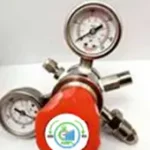
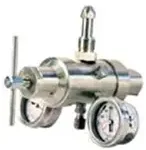
The regulator is fitted with two pressure gauges — one monitoring inlet (cylinder) pressure and one monitoring outlet (delivery) pressure. The dual-gauge arrangement provides complete pressure visibility at the point of regulation: the inlet gauge allows the operator to monitor remaining cylinder content and anticipate cylinder changeover before supply interruption, while the outlet gauge confirms the set delivery pressure is being maintained. In calibration and testing environments where delivery pressure accuracy directly affects measurement results, real-time outlet pressure monitoring is an operational requirement rather than a convenience feature.
Robust Stainless-Finished Body Construction
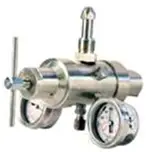
The regulator body is constructed to withstand the mechanical and environmental demands of industrial gas service — resistant to the corrosion, vibration, and handling conditions encountered in industrial plant rooms, gas cylinder stores, calibration labs, and field gas supply installations. The polished metal finish visible on the unit is consistent with the construction standards expected of high-pressure gas handling equipment where surface condition, cleanliness, and material integrity are relevant to both safety and regulatory compliance in oxygen and other reactive gas services.
Technical Specifications
Product Name: High Pressure Piston Type Regulator
Category: Span Gas and Regulator
Mechanism Type: Piston Type
Inlet Pressure: 0–400 Kg/Cm²
Outlet Pressure: 0–300 Kg/Cm²
Flow Rate: 100–400 LPM
Gas Service: Nitrogen (N₂) / Oxygen (O₂) / Hydrogen (H₂) / Carbon Dioxide (CO₂)
Gauge Configuration: Dual Gauge (Inlet + Outlet)
Application: Industrial Gas Supply, Calibration Gas Delivery, High-Pressure Process Gas Regulation
Benefits
For a safety officer or HSE manager overseeing gas detector calibration programmes, the most immediate benefit of this regulator is consistent, reliable delivery pressure to calibration equipment. Span gas calibration accuracy depends directly on the stability of gas delivery — a regulator that drifts under varying cylinder pressure or delivers inconsistent outlet pressure introduces an uncontrolled variable into what should be a tightly controlled calibration process. A piston-type regulator rated across the full cylinder pressure range eliminates that variable, supporting calibration programme integrity and the defensibility of calibration records under audit.
For industrial gas operations — nitrogen purging, oxygen supply, hydrogen test rig supply — the high inlet pressure rating means the regulator remains the correct tool for the job from the moment a fresh cylinder is connected through to cylinder change. There is no transition point at which the regulator is operating outside its rated inlet range, which matters for operations running high-pressure cylinders close to rated fill pressure and for those managing cylinder inventory down to low residual pressures.
Multi-gas compatibility across N₂, O₂, H₂, and CO₂ simplifies procurement for facilities operating mixed-gas services. A single regulator model that covers four gas types reduces the number of SKUs that procurement teams must manage, simplifies spare parts stocking, and reduces the risk of cross-service errors when deploying or replacing regulators across a multi-gas facility. For operations subject to change management procedures, fewer unique regulator models also reduces the administrative overhead of equipment management.
The 100–400 LPM flow range covers both the controlled low-flow requirements of calibration gas delivery and the higher-flow demands of industrial purge and process supply — meaning this single regulator model can serve across the full range of gas delivery applications encountered in a mixed industrial and calibration environment without requiring application-specific regulator selection for each service point.
Who It’s For
Calibration Laboratory Technicians and Gas Detector Service Engineers
A gas detection service engineer running calibration checks across a fleet of fixed or portable gas detectors needs span gas delivered at a consistent, accurate pressure to each instrument. Inconsistent delivery pressure — caused by an ageing diaphragm regulator that drifts as cylinder pressure drops — introduces calibration error that may not be caught until the next scheduled audit, creating a compliance gap in the detector maintenance record. This piston-type regulator, with its stable outlet pressure regulation across the full cylinder inlet range, eliminates that drift and supports gas detector calibration that holds up under regulatory scrutiny.
Industrial Plant HSE Officers and Process Engineers
A process engineer managing nitrogen purge procedures prior to maintenance entry into confined spaces — or an HSE officer overseeing oxygen supply to breathing air systems in confined space work — needs a regulator that delivers reliably at the set pressure under the flow demands of the operation. A regulator undersized for the application, or rated for a narrower gas service, introduces risk at a point in the process where equipment failure has direct safety consequences. The high inlet pressure rating, multi-gas compatibility, and 400 LPM upper flow capacity of this regulator support safe, compliant gas delivery across the high-consequence gas handling scenarios common to industrial plant HSE programmes.
Procurement Teams Supporting Industrial Gas Supply Infrastructure
For a procurement officer rationalising the regulator inventory across a multi-site industrial operation, the appeal of a single regulator model rated for N₂, O₂, H₂, and CO₂ service across a 400 kg/cm² inlet pressure range is straightforward: it replaces the need for separate regulator models per gas type, reduces SKU count, and simplifies the spare parts programme. Where current practice requires stocking and managing multiple regulator models matched to specific gas services at each site, consolidating to a multi-gas piston regulator with a wide pressure and flow range reduces procurement complexity and inventory holding cost without sacrificing service-specific technical suitability.
Possible Applications
Gas Detector Calibration — Portable and Fixed Detector Servicing
Delivering span gas from N₂/O₂/H₂/CO₂ calibration cylinders to portable gas detectors, fixed point gas detection systems, and gas analysers during scheduled calibration and bump testing. The controlled flow range and stable outlet pressure support accurate gas delivery to sensitive instrument inlets.
Nitrogen Purging — Pre-Maintenance Vessel and Pipeline Inerting
Controlling nitrogen delivery pressure and flow during inerting of process vessels, pipelines, and confined spaces ahead of hot work, maintenance entry, or storage layup. The high flow capacity of 400 LPM supports the purge volumes required for larger vessels and pipeline sections.
Oxygen Supply — Breathing Air, Cutting, and Welding Operations
Regulating high-pressure oxygen cylinder delivery for industrial cutting and welding operations, or for oxygen-enriched breathing air supply in confined space rescue or medical support applications. Oxygen-rated construction and high inlet pressure range covers the full operational requirements of oxygen cylinder service.
Hydrogen Gas Supply — Test Rigs and Fuel Cell Research
Delivering hydrogen from high-pressure cylinders to combustion test rigs, fuel cell test benches, or hydrogen atmosphere furnaces in research and materials testing environments. Hydrogen’s high pressure storage and small molecular size demand a regulator with appropriate leak integrity and rated hydrogen service compatibility.
CO₂ Gas Delivery — Calibration and Controlled Atmosphere Applications
Regulating CO₂ delivery from high-pressure cylinders for gas detector calibration, controlled atmosphere storage systems, beverage carbonation supply, or CO₂ incubator gas supply in laboratory environments. CO₂ service requires regulation across the phase transition pressure range of liquefied CO₂ cylinders, which this regulator’s wide inlet range accommodates.
Industrial Gas Manifold Supply — Multi-Point Distribution Systems
Serving as the primary pressure reducing regulator in a cylinder manifold system supplying multiple downstream use points — laboratory benches, process connections, or instrument supply headers — from a central high-pressure cylinder bank. The high flow capacity supports multi-point distribution downstream of a single regulator.
Gas Injection and Pressure Testing — High-Delivery-Pressure Applications
Delivering gas at elevated outlet pressures for high-pressure testing, pressure decay testing, or gas injection applications where downstream systems require working pressures above the range of standard low-pressure regulators. The 0–300 kg/cm² outlet range covers high-delivery-pressure requirements that eliminate the need for a booster or secondary pressure stage.
Trust & Certifications
Industrial Gas Service Construction Standards
High-pressure gas regulators for service in industrial, laboratory, and calibration environments are expected to meet the construction standards applicable to the specific gas types they handle — including oxygen-service cleanliness requirements (absence of hydrocarbon contamination, grease-free assembly, and compatible materials) and hydrogen-service leak integrity standards. Buyers should confirm with the supplier the specific certification basis and any third-party approvals applicable to the unit and the gas service intended, particularly for oxygen and hydrogen applications where service-specific approvals carry regulatory weight.
Oxygen Service Compatibility — Safety-Critical Material Requirement
For regulators used in oxygen service, compatibility with oxygen is a safety-critical designation — not a general marketing claim. Oxygen-compatible regulators must be assembled from materials that will not sustain combustion in an oxygen-enriched environment and must be free of hydrocarbon contamination that could create an ignition risk under the pressures and flow velocities encountered in high-pressure oxygen cylinder service. Buyers procuring this regulator for oxygen service should confirm oxygen-service suitability with the supplier and ensure installation and maintenance are carried out by personnel trained in oxygen-service safety protocols.
Pressure Equipment and Gas Handling Regulatory Requirements
In most jurisdictions, pressure equipment used in industrial gas handling is subject to pressure equipment regulations that establish requirements for design, manufacture, marking, and periodic inspection. The applicable regulatory framework varies by country — relevant frameworks include the EU Pressure Equipment Directive (PED 2014/68/EU), the Singapore Pressure Vessels (Licensing) Act, and equivalent national standards across Asia Pacific and the Middle East. Buyers should confirm that the regulator meets the pressure equipment regulatory requirements applicable in their operating jurisdiction and that installation and use comply with local gas safety regulations.
Span Gas and Regulator Category — Calibration Gas Supply Chain
This regulator is listed within the Span Gas and Regulator product category — a supply category that supports the calibration infrastructure of gas detection programmes across industrial safety, oil and gas, marine, and laboratory environments. For buyers operating under formal gas detector calibration management systems — including ISM Code-compliant vessel gas detection maintenance programmes, ISO 17025-accredited calibration laboratories, or OSHA-referenced industrial hygiene monitoring programmes — the regulator is a critical interface component between certified calibration gas supply and the instruments being calibrated. Procurement within a coherent span gas supply category simplifies sourcing of both calibration gas and the delivery equipment required to use it.
Accessories & Variants
Compatible Span Gas Cylinders — N₂, O₂, H₂, CO₂ Calibration Gas
Span Gas Cylinders (Nitrogen / Oxygen / Hydrogen / CO₂) — Pre-certified calibration gas mixtures or pure gas cylinders for use with this regulator in gas detector calibration, analyser span checking, and controlled atmosphere applications. Procuring span gas cylinders alongside the regulator from a single supplier ensures compatibility between cylinder valve connection and regulator inlet fitting, and supports a coherent calibration gas supply chain under a single supplier relationship.
High-Pressure Flexible Hose Connections
High-Pressure Gas Hoses — Rated flexible hose assemblies for connecting the regulator outlet to downstream instrument inlets, process connections, or manifold headers. High-pressure-rated hoses rated for the specific gas service (particularly oxygen and hydrogen) are required to maintain the integrity of the complete gas delivery assembly from cylinder through to point of use.
Cylinder Valve Connection Fittings
CGA / BS / DIN Cylinder Valve Adapters — Connection adapters for matching regulator inlet threads to the cylinder valve outlet standard used on the specific cylinder type in service. Cylinder valve connection standards vary by country of manufacture, gas type, and cylinder series — confirming the correct inlet connection for the cylinder in use before installation is essential for both leak integrity and safe cylinder connection.
Downstream Pressure Gauges and Flow Meters
Secondary Pressure Gauges / Rotameters / Mass Flow Controllers — Downstream flow and pressure monitoring instruments for applications requiring verification of delivery pressure or flow rate at the point of use, independently of the regulator-mounted outlet gauge. Relevant for multi-point distribution systems and calibration setups where per-instrument flow verification is part of the calibration procedure.
Product Variants — Gas Service and Connection Configurations
Nitrogen (N₂) Service — Standard configuration for nitrogen purge, blanketing, and calibration gas delivery applications
Oxygen (O₂) Service — Oxygen-clean configuration for industrial cutting, welding, and breathing air applications; oxygen-service material and assembly requirements apply
Hydrogen (H₂) Service — Hydrogen-rated configuration for fuel cell, test rig, and hydrogen atmosphere furnace applications; hydrogen leak integrity requirements apply
Carbon Dioxide (CO₂) Service — CO₂-compatible configuration for calibration gas, controlled atmosphere, and carbonation supply applications
Get in Touch
If you are sourcing a high-pressure piston type regulator for nitrogen, oxygen, hydrogen, or CO₂ gas service — whether for a calibration programme, industrial gas supply infrastructure, or a specific high-pressure process application — contact us to confirm the correct configuration for your cylinder connection type, outlet pressure requirement, and gas service, and to request a formal quotation.
Our team can assist with gas service compatibility confirmation, inlet connection specification for your cylinder type, and supply timelines for single units and multi-site procurement orders.