Cart (
Overview
A fire hose reel or lay-flat hose is only as useful as the condition it is in at the moment a fire breaks out. In buildings where fire hoses are stored in open brackets or unprotected positions — exposed to dust accumulation, mechanical damage from foot traffic or maintenance activity, UV degradation in naturally lit corridors, or deliberate tampering in public-access areas — there is a very real risk that the hose or coupling is compromised before it is ever needed. The fire safety system passes every annual inspection and then fails at the point of actual use: a scenario that building managers, fire risk assessors, and insurers are all acutely aware of.
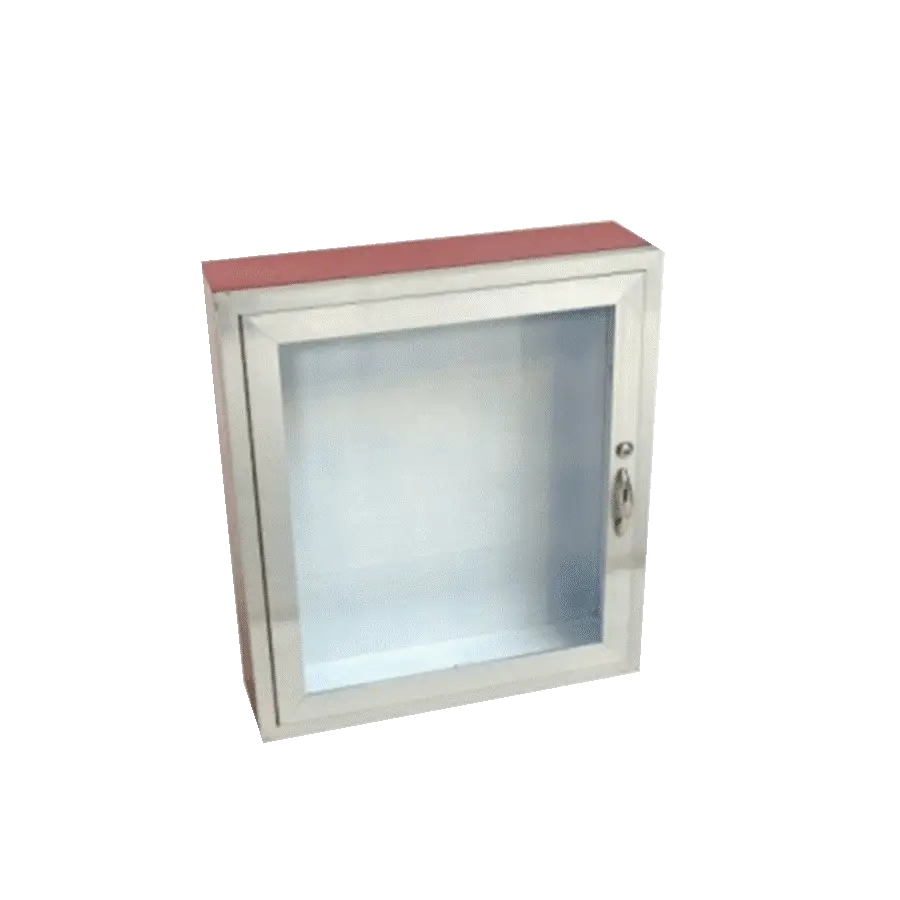
The Fire Hose Cabinet solves this problem directly. It provides a purpose-built, lockable, visually identifiable enclosure for a fire hose reel or hose length — protecting the equipment from physical damage, environmental contamination, and unauthorised access, while keeping it immediately visible and accessible to any building occupant in an emergency. The 1/8″ clear glass door means the cabinet contents are always visible without opening the unit, allowing building management teams to confirm the hose is present and undisturbed at a glance during routine patrols — without unlocking and inspecting the cabinet at every check.
What sets this cabinet apart from lighter-duty alternatives in the market is the structural specification: a Gauge #11 CR (cold-rolled) steel sheet body, combined with a red powder-coated aluminium frame. Gauge #11 CR sheet is a genuinely robust material specification for a fire hose enclosure — heavier than the thin-gauge pressed steel used in budget cabinets, and substantially more resistant to denting, deformation, and corrosion in the damp conditions found in stairwells, plant rooms, and service corridors. This is a cabinet built to remain serviceable and structurally intact across the full operational life of a building, not one that will show visible deterioration within a few years of installation.
Key Features
Gauge #11 CR Sheet Body — Heavy-Duty Structural Steel Construction
The cabinet body is fabricated from Gauge #11 cold-rolled (CR) steel sheet. Cold-rolled steel provides a consistent, smooth surface finish, tighter dimensional tolerances than hot-rolled alternatives, and greater surface hardness — all of which contribute to a cabinet body that resists denting, maintains its shape under impact, and provides a stable substrate for the powder coat finish. Gauge #11 specification (approximately 3mm) is substantially heavier than the thin-gauge pressed steel used in lower-cost fire hose enclosures, which are prone to deformation at hinge and latch points and visible panel denting in locations where the cabinet is exposed to trolley or equipment movement. For building managers specifying a cabinet that will remain presentable and structurally sound across a 20-year building service life, the material gauge is the specification detail that matters most.
Red Powder-Coated Aluminium Frame — Corrosion Resistance and Visual Identification
The cabinet frame is aluminium with a red powder-coat finish. Aluminium framing provides inherent corrosion resistance without the maintenance requirement of steel framing in damp or humid environments — relevant for cabinets installed in stairwells, basement plant rooms, car parks, and other locations where condensation and moisture exposure are routine. The red powder-coat finish serves the dual purpose of corrosion protection and fire safety colour coding: red is the universally recognised colour for fire safety equipment enclosures, ensuring the cabinet is immediately identifiable as a fire safety installation point to any building occupant or emergency responder navigating an unfamiliar building under stress.
1/8″ Clear Glass Door — Visibility Without Access
The cabinet door is glazed with 1/8″ clear glass, allowing the contents to be visually inspected from outside the cabinet without opening or unlocking it. In a fire emergency, a building occupant approaching the cabinet can confirm the hose is present and ready before they reach it — eliminating the delay and confusion of opening an empty or damaged cabinet under stress. For building management teams, the glass door enables routine visual checks during corridor patrols without requiring the key-holder to be present — a practical maintenance benefit in large buildings with multiple hose reel installation points spread across multiple floors. The 1/8″ glass specification provides adequate impact resistance for a door panel in a protected interior location while maintaining full optical clarity.
Ordinary Handle, Lock and Key — Controlled Access with Emergency Override
The cabinet is fitted with a standard handle, lock, and key mechanism. The lock provides controlled access in normal building operation — preventing casual opening, unauthorised removal of equipment, and the storage of non-fire-safety items inside the cabinet (a persistent problem with unlocked hose reel enclosures in occupied buildings). In a fire emergency, the glass door provides an immediate override: the occupant breaks the glass to access the handle and open the cabinet without a key. This is the standard emergency access arrangement for fire hose cabinets and is the configuration required by fire safety management protocols and fire safety inspectors in most jurisdictions. The key should be managed as part of the building’s fire safety key management system.
Recessed Installation Profile — Flush with Building Fabric
The fire hose cabinet is designed for recessed installation into a wall cavity or surface-mounted application depending on the building’s structural configuration and the M&E designer’s specification. Recessed installation — where the cabinet sits flush with or slightly proud of the finished wall surface — minimises corridor obstruction, eliminates the protruding cabinet profile that represents an impact hazard in high-footfall areas, and produces a cleaner architectural finish in occupied building spaces such as hotel corridors, hospital wards, and office lobbies where aesthetic integration is a consideration alongside fire safety function.
Standardised Enclosure Dimensions — Compatible with Standard Hose Reel Sizes
The cabinet is dimensioned to accommodate standard fire hose reel units and hose lengths in common use across commercial and industrial building installations. Standardised cabinet dimensions simplify specification for M&E contractors and fire system installers working across multiple building projects — a consistent cabinet form factor that accommodates the reel models in use across the installation programme reduces the risk of mis-specification and eliminates the on-site adjustment work that results from cabinet-to-reel dimensional mismatches. Confirm the specific internal dimensions against the hose reel model being installed at specification stage.
Technical Specifications
Product Type: Fire Hose Cabinet (Enclosure)
Body Material: Gauge #11 Cold-Rolled (CR) Steel Sheet
Frame Material: Aluminium — Red Powder Coated
Door Glazing: 1/8″ Clear Glass
Access Control: Ordinary Handle, Lock and Key
Finish Colour: Red (Frame) / Bare Steel / Powder Coated (Body — confirm with supplier)
Installation Type: Recessed or Surface-Mounted
Contents Compatibility: Fire Hose Reel / Lay-Flat Hose
Emergency Access: Break-Glass Door Panel
Dimensions: Confirm with supplier at specification stage
Benefits
The most immediate benefit of a properly specified fire hose cabinet is the protection of the fire hose installation itself. A hose stored in an open bracket in a building corridor is exposed to dust accumulation inside the hose and on couplings, physical damage from passing equipment and cleaning machinery, UV degradation if the location has natural light exposure, and the constant low-level risk of items being stored against or on top of the hose by building occupants. None of these damage mechanisms will be identified at an annual inspection if the visual check does not include unwinding and physically inspecting the hose length — and in most building maintenance programmes, it does not. A lockable cabinet eliminates these exposure pathways and ensures the hose is in the condition at the point of emergency use that it was in at the point of installation.
From a building management perspective, the glass-door cabinet reduces the time and effort required for routine hose reel location checks. A building fire warden conducting a floor sweep can visually confirm that the hose cabinet contains equipment and that the glass is intact in a single pass — compared to physically checking open brackets or unlocking solid-door enclosures at each location. Over the operational life of a building, the cumulative maintenance efficiency gain from glass-door cabinet installations across multiple floors is measurable.
For fire risk assessors and building insurance purposes, a locked, clearly identified, glass-door fire hose cabinet is a stronger evidence point in a fire safety management audit than an open bracket installation. The cabinet demonstrates that the building operator has taken active steps to protect and control access to first-attack firefighting equipment — a consideration that fire risk assessors and insurers factor into their assessment of a building’s overall fire safety management standard.
The Gauge #11 CR sheet specification means the cabinet will not require replacement due to body deformation or structural deterioration within a normal building service life — a total cost of ownership consideration that procurement teams should factor into the comparison between this specification and lighter-duty alternatives at a lower initial unit price.
Who It’s For
M&E Contractors and Fire System Installers
A mechanical and electrical contractor installing fire hose reel systems across a commercial building project needs a cabinet that fits the specified hose reel model, meets the building’s aesthetic requirements, and satisfies the fire engineer’s specification for enclosure type and access control. The Gauge #11 CR sheet body and aluminium frame construction of this cabinet provide the structural specification detail needed to satisfy a fire engineering specification that requires a heavy-duty enclosure — and the standardised design simplifies procurement across a multi-floor installation programme. Specifying the cabinet and hose reel from a single supplier relationship simplifies coordination and ensures dimensional compatibility between the reel unit and the enclosure.
Facilities Managers and Building Services Teams
A facilities manager responsible for a large commercial building, hotel, or hospital campus needs fire hose enclosures that remain serviceable and presentable across the years between major refurbishments — and that support, rather than complicate, the routine maintenance checks that the building’s fire safety management system requires. The glass door on this cabinet allows visual hose reel checks to be completed during routine floor patrols without key access, and the lockable enclosure prevents the accumulated unauthorised storage of non-fire-safety items that is a persistent problem in open bracket hose installations across large buildings. The red powder-coated frame maintains the correct fire safety colour coding that building occupants and emergency responders rely on to locate firefighting equipment under stress.
Fire Safety Consultants and Risk Assessors
A fire safety consultant specifying first-attack firefighting provision for a new building development or a building refurbishment project needs to document the enclosure specification as part of the fire engineering package. Specifying a glass-door, lockable cabinet with a heavy-gauge steel body and aluminium frame provides a defensible, clearly specified enclosure standard that can be referenced in the fire engineering report and verified at practical completion inspection — compared to the ambiguous “fire hose reel enclosure to be provided” specification that leaves product quality to the installer’s discretion. The cabinet’s standard construction specification supports a consistent, auditable fire safety installation record across the project.
Possible Applications
Commercial Office Buildings
Multi-storey office developments install fire hose cabinets at corridor positions on each occupied floor, housing the hose reel units that form part of the building’s first-attack firefighting system. Recessed cabinet installation in office corridor walls provides a flush finish that does not obstruct the corridor or create an impact hazard — while the glass door and red frame ensure immediate identification by building fire wardens and emergency responders navigating the floor.
Hotels and Serviced Apartments
Hotel corridor fire hose installations are among the highest-profile hose reel enclosure applications — the cabinet is visible to guests throughout their stay and is inspected by fire safety authorities during routine hotel compliance visits. A well-specified, red-framed, glass-door cabinet in a hotel corridor communicates a building management standard to guests and inspectors alike, and the lockable enclosure prevents the kind of casual interference with fire equipment that is a persistent issue in guest-accessible areas of hotel buildings.
Hospitals and Healthcare Facilities
Hospital fire hose installations in wards, corridors, and plant rooms must be immediately identifiable and accessible to clinical staff who may need to respond to a fire event while simultaneously managing patient care. The glass-door cabinet allows clinical staff to visually locate and identify fire hose equipment during an emergency without needing to open multiple enclosures to find the correct one — a meaningful operational benefit in a high-stress fire response scenario in a complex building environment.
Shopping Centres and Retail Developments
High-footfall retail environments expose fire hose enclosures to a higher than average risk of physical damage from shopping trolleys, delivery equipment, and general public contact. The Gauge #11 CR sheet body specification provides the panel rigidity needed to resist this kind of incidental impact damage across the years of retail operation — maintaining the cabinet’s structural integrity and finished appearance without the frequent repair or replacement that lighter-gauge enclosures require in these environments.
Car Parks and Basement Plant Rooms
Multi-storey car parks and basement plant rooms present a particularly demanding environment for fire hose enclosures: damp conditions, vehicle exhaust exposure, temperature variation, and the mechanical impact risk from vehicle manoeuvring. The corrosion-resistant aluminium frame and heavy-gauge steel body of this cabinet are appropriate specifications for these environments, where a lighter-duty or untreated steel enclosure would show accelerated corrosion and structural deterioration within a few years of installation.
Industrial and Warehouse Facilities
Warehouse environments with forklift truck operation, pallet movement, and heavy goods vehicle access present a serious mechanical impact risk to fire hose enclosures positioned at required coverage points throughout the facility. The heavy-gauge CR sheet body provides the physical robustness needed to withstand the incidental mechanical contact that is inevitable in an active warehouse environment — maintaining the cabinet’s lockable and weathertight integrity even where the surface has been contacted by passing equipment.
Construction Site Temporary Fire Protection
During the construction phase of a building project, fire hose reels installed as part of the site’s temporary fire protection arrangements benefit from cabinet enclosures that protect the equipment from the construction environment — dust accumulation, paint overspray, construction debris, and the general physical hazard of an active building site. A robust steel cabinet protects the hose reel investment across the construction phase and, where the cabinet specification matches the permanent installation requirement, can be retained as part of the building’s permanent fire safety installation at project completion.
Trust & Certifications
Gauge #11 CR Sheet — Industry-Standard Heavy-Duty Enclosure Specification
Gauge #11 cold-rolled steel sheet is a recognised material specification for heavy-duty fire safety equipment enclosures. Cold-rolling produces a steel sheet with tighter thickness tolerances, a smoother surface finish, and greater surface hardness than hot-rolled equivalents at the same nominal gauge — characteristics that directly affect the cabinet’s resistance to impact damage, its powder-coat adhesion quality, and its long-term dimensional stability. When fire safety enclosure specifications reference a material gauge, Gauge #11 represents a substantively heavier and more durable body construction than the Gauge #16 or Gauge #18 sheet used in budget-tier fire hose cabinets — a specification detail that procurement teams should verify when comparing products at different price points.
Red Powder Coat Finish — Fire Safety Colour Code Compliance
Red is the internationally recognised colour for fire safety equipment and fire safety equipment enclosures, referenced in ISO 3864, BS 5499, and national fire safety signage and equipment colour coding standards. A red powder-coated cabinet frame ensures that the installation meets the colour identification requirement for fire safety equipment enclosures in jurisdictions that reference these standards — relevant for building projects in the UK, EU, Middle East, and Asia Pacific where fire safety equipment colour coding requirements are enforced by building control authorities and fire safety inspectors. Powder coating provides a more durable and chemically resistant finish than liquid paint, maintaining the required red colour identification across the service life of the installation.
Lockable Glass-Door Design — Fire Safety Inspection Standard
The combination of a lockable enclosure with a clear glass door panel is the configuration most commonly specified by fire safety consultants and required by building regulations guidance documents for fire hose reel enclosures in occupied buildings. The lock provides access control; the glass provides visual inspection capability without access; and the break-glass emergency access arrangement provides the immediate equipment access required in a fire emergency without a key. This configuration satisfies the requirements of fire risk assessments and building control inspections that specify “lockable, visually inspectable enclosure” for first-attack firefighting equipment in public and commercial building environments.
Compatible with BS EN 671-1:2012 Hose Reel Installations
The fire hose cabinet is designed to house hose reel units installed to BS EN 671-1:2012, the British and European standard for semi-rigid hose reel systems in buildings. Specifying the enclosure from the same supplier as the hose reel unit ensures dimensional compatibility and a consistent compliance documentation trail for the complete hose reel installation — reel unit, enclosure, and installation together forming the compliant BS EN 671-1:2012 installation that the fire engineering specification and building control authority require.
Accessories & Variants
Fire Hose Reel Units (Manual and Automatic)
The fire hose cabinet is designed to be specified and installed alongside a compatible fire hose reel unit — either manual or automatic configuration. Sourcing cabinet and reel from a single supplier ensures dimensional compatibility between the enclosure internal dimensions and the reel unit footprint, and simplifies the procurement documentation and warranty management for the complete installation. Confirm the reel model and configuration at specification stage to ensure the cabinet internal dimensions are appropriate for the selected reel unit.
Fire Hose Reel Identification Signage
ISO 7010 compliant fire hose reel pictogram signage should be specified alongside the cabinet to ensure the installation location is identifiable to building occupants and emergency responders from a distance — particularly in long corridors or complex building layouts where the cabinet itself may not be immediately visible. Directional signage (arrow signs at corridor junctions) pointing to the nearest hose reel cabinet position is a standard element of a complete first-attack firefighting installation that fire risk assessors and building control officers verify at inspection.
Break-Glass Call Point Cover (for Cabinet Glass)
Where the building’s fire safety management protocol requires a break-glass element to be clearly identified on the cabinet door panel — ensuring building occupants understand that the glass can and should be broken to access the equipment in an emergency — a labelled break-glass cover or instruction panel can be specified for the cabinet door. This removes any ambiguity for occupants unfamiliar with fire hose cabinet access procedures and reduces the hesitation delay that can occur when an untrained occupant encounters a locked fire equipment cabinet for the first time in an emergency.
Surface-Mounted vs. Recessed Cabinet Configuration
The fire hose cabinet is available for surface-mounted installation on a flat wall surface, or for recessed installation into a prepared wall cavity. Surface mounting is appropriate for existing building refurbishments where creating a wall cavity is not practical, and for locations such as plant rooms and warehouses where aesthetic integration is not a priority. Recessed installation is standard for new-build commercial and hospitality projects where the cabinet is installed in a finished corridor wall and must sit flush with the wall surface. Confirm the required installation configuration and wall cavity dimensions with the building contractor and M&E installer at specification stage.
Get in Touch
If you are specifying fire hose cabinets for a building project, fit-out, or fire safety system upgrade — or if you need to confirm the correct cabinet dimensions, installation configuration, and compatible hose reel models for your specific application — contact us to discuss your requirement and request a formal procurement quotation.
Our team can assist with cabinet and hose reel selection against your fire engineering specification, confirm availability and lead times, and provide the compliance documentation needed to support building control and fire safety audit requirements.
📍 3791 Jalan Bukit Merah #06-01, E-Centre @ Redhill, Singapore 159471