Cart (
Overview
When a vessel sinks, the margin between a distress beacon activating in time and a crew lost at sea can come down to a single mechanical component most people never think about until it fails. The Emergency Position Indicating Radio Beacon (EPIRB) is only as effective as the mechanism that releases it from its bracket and allows it to float free and activate when the vessel goes under. If that mechanism is corroded, seized, incorrectly installed, or past its service life, the EPIRB stays on the bracket — and a working distress beacon goes to the bottom with the vessel.
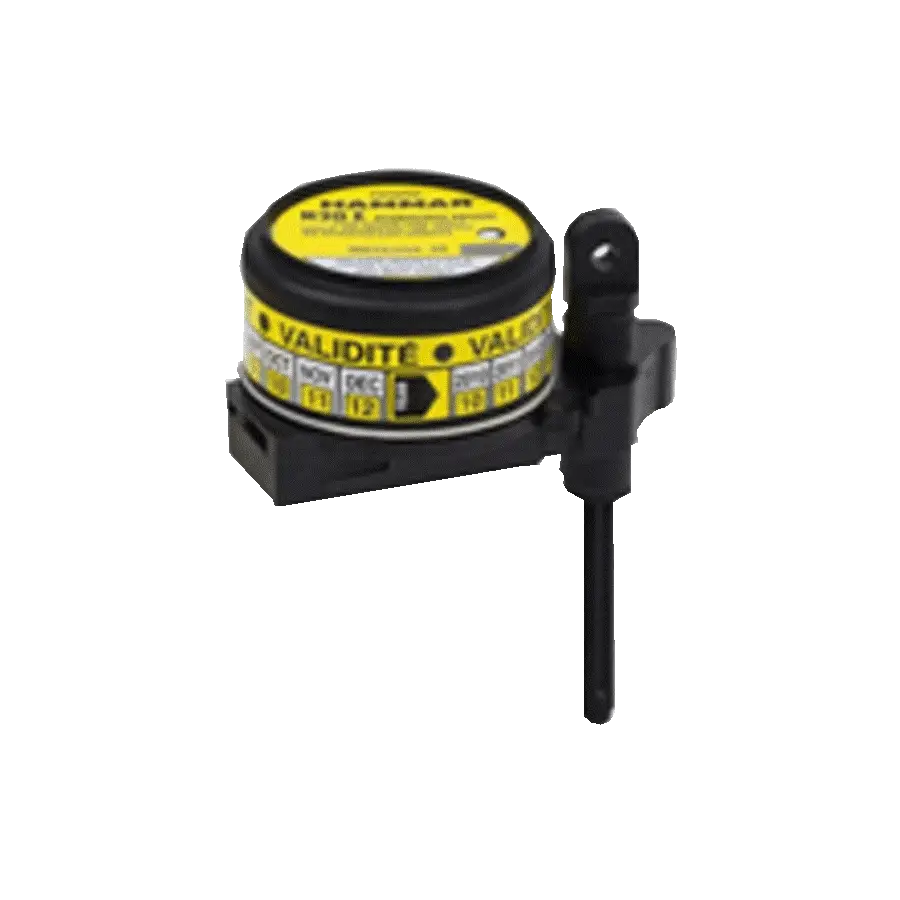
The Hydrostatic Release Unit (HRU) for EPIRB by HAMMAR is the component that prevents exactly that scenario. It is a purpose-designed hydrostatic release mechanism that automatically activates at a depth of 1.5–4 metres, cutting the retaining strap that holds the EPIRB in its bracket and allowing the beacon to float free to the surface, activate, and begin transmitting the vessel’s distress position to the international COSPAS-SARSAT satellite network. The entire release sequence happens without any crew action — a critical function in a scenario where the crew may be incapacitated, unable to reach the EPIRB bracket, or have had no time to manually release the beacon before abandoning ship.
What distinguishes the HAMMAR HRU from alternatives in the market is the combination of glass fibre reinforced nylon construction and a maintenance-free operational life. Most competing HRU products require annual inspection, servicing, or spare parts replacement to maintain SOLAS compliance — generating a recurring maintenance cost and an administrative burden for vessel operators managing compliance documentation across a fleet. The HAMMAR HRU requires no annual service, no maintenance, and no spare parts across its two-year service life. At the two-year mark, the unit is simply replaced with a new one. The maintenance programme is as simple as it can possibly be — which, in maritime safety equipment management, is a genuine operational advantage.
Key Features
Automatic Hydrostatic Activation at 1.5–4 Metres Depth — No Crew Action Required
The HRU activates automatically when submerged to a depth of between 1.5 and 4 metres, triggered by water pressure acting on the hydrostatic mechanism inside the unit. At that pressure, the mechanism releases the retaining strap, allowing the EPIRB to float free from its bracket. This activation sequence requires no crew intervention — it functions identically whether the crew have abandoned ship in an orderly fashion, whether the vessel has capsized suddenly, or whether the crew are incapacitated. For vessel operators and flag state surveyors, the automatic activation function is the fundamental safety requirement that the HRU exists to satisfy: the EPIRB must be capable of self-release and activation in a worst-case sinking scenario, regardless of crew condition or availability.
Glass Fibre Reinforced Nylon Construction — Corrosion-Free in Marine Environments
The HRU housing is made from glass fibre reinforced nylon — a composite material chosen specifically for its corrosion resistance, mechanical strength, and dimensional stability in the marine environment. Metal-bodied HRU components are subject to galvanic corrosion, particularly in tropical waters and salt spray environments where dissimilar metal contact accelerates deterioration. A corroded HRU mechanism may fail to activate at the correct depth — or fail to activate at all. Glass fibre reinforced nylon eliminates corrosion as a failure mechanism, ensuring the unit’s mechanical function is not compromised by the operating environment across the full two-year service life. For vessels operating in tropical, equatorial, or high-salinity coastal waters where corrosion rates are highest, this material specification is a directly relevant safety advantage.
No Annual Service, Maintenance, or Spare Parts Required
Unlike many HRU products that require annual inspection by an approved service station, replacement of internal components, or documentation of service by a certified technician to maintain flag state and class society compliance, the HAMMAR HRU is a sealed, maintenance-free unit across its entire two-year service life. There is no service schedule to manage, no approved service agent to coordinate, and no spare parts to stock. For ship managers and vessel operators managing safety equipment compliance across a fleet of multiple vessels — each with multiple EPIRBs and associated HRUs — the elimination of annual servicing from the HRU maintenance programme produces a measurable reduction in compliance management workload and third-party service cost across the fleet.
Two-Year Replacement Cycle — Clear, Simple Compliance Milestone
The HRU must be replaced after two years from the date of manufacture — this is both the manufacturer’s specification and the SOLAS requirement for hydrostatic release units used with EPIRB systems on SOLAS-compliant vessels. The two-year replacement date is marked on the unit, providing an unambiguous compliance deadline that port state control officers, flag state surveyors, and class society inspectors can verify at a glance. For vessel operators, the clarity of a single, marked replacement date — with no intermediate service requirements — simplifies compliance scheduling and reduces the risk of an HRU being found out-of-date at a port state control inspection.
VALIDITE Date Marking — Instant Expiry Verification
The HAMMAR HRU is marked with a VALIDITE (validity) date label on the unit body, clearly indicating the expiry date of the unit’s operational service life. This date marking is visible on the installed unit without removal from the bracket, allowing flag state surveyors, class society inspectors, and port state control officers to verify HRU currency as part of a routine safety equipment inspection without disassembly. For vessel operators maintaining SOLAS safety equipment records, the marked expiry date provides the documentary reference point for replacement scheduling and compliance records.
Compatible with EPIRB Float-Free Bracket Installations
The HAMMAR HRU is designed for use with float-free EPIRB bracket installations — the standard SOLAS-required mounting arrangement for Category I EPIRBs on commercial vessels, where the EPIRB is mounted in a bracket that allows it to float free when the vessel sinks, rather than being manually carried to a survival craft. The HRU connects the EPIRB retaining strap to the bracket mounting point and severs that connection at the activation depth, enabling the float-free release. Confirm compatibility with the specific EPIRB model and bracket configuration in use on the vessel at specification and installation stage.
Technical Specifications
Product Type: Hydrostatic Release Unit (HRU) for EPIRB
Brand: HAMMAR
Body Material: Glass Fibre Reinforced Nylon
Activation Depth: 1.5 – 4 metres (automatic, hydrostatic)
Activation Method: Automatic — water pressure actuated, no crew action required
Annual Service Requirement: None
Maintenance Requirement: None — sealed unit
Spare Parts Required: None
Service Life / Replacement Interval: 2 years from date of manufacture
Expiry Marking: VALIDITE date label on unit body
Compatibility: Float-free EPIRB bracket installations
Regulatory Compliance: SOLAS — confirm specific approval with supplier
Benefits
The most critical benefit of a correctly installed and in-date HAMMAR HRU is the one that is hardest to quantify until it is needed: the assurance that the EPIRB will release and activate automatically if the vessel sinks without any crew member reaching the beacon bracket. In a rapid sinking, a sudden capsize, or an incident where crew are injured or trapped, the automatic hydrostatic release function is the only reliable path to EPIRB activation. A properly maintained HRU — replaced on schedule, installed correctly, and not corroded or mechanically compromised — is the difference between a distress signal reaching the rescue coordination centre and a vessel that disappears without trace.
For ship managers and fleet safety officers, the no-annual-service design of the HAMMAR HRU produces a concrete operational benefit: it removes an annual compliance task from the safety equipment maintenance schedule. Across a fleet of vessels, each carrying one or more EPIRBs with associated HRUs, the elimination of annual HRU service coordination, approved service agent management, and service documentation filing represents a genuine reduction in compliance management workload — and a reduction in the risk of an HRU being inadvertently missed in the annual service cycle.
The glass fibre reinforced nylon construction provides confidence that the unit’s mechanical function will not be degraded by corrosion across the two-year service life — particularly for vessels trading in tropical or high-salinity waters where corrosion of metal HRU components is an accelerated risk. An HRU that is mechanically sound at the end of its service life, replaced on schedule, provides a consistent and reliable safety function across the vessel’s operational life.
The clear VALIDITE date marking simplifies the port state control inspection process for vessel operators — the inspecting officer can verify HRU currency without disassembly or documentation cross-referencing, reducing the risk of a deficiency being raised for an HRU that is actually in date but whose currency cannot be immediately confirmed.
Who It’s For
Ship Managers and Fleet Safety Officers
A ship manager responsible for SOLAS safety equipment compliance across a managed fleet needs to ensure that every EPIRB HRU on every vessel is in date, correctly installed, and documented in the vessel’s safety equipment records. Managing annual service requirements for HRUs across a fleet of ten or twenty vessels — coordinating approved service agents in multiple ports, tracking service documentation, and ensuring no unit is missed in the annual cycle — is a significant administrative burden. Specifying the HAMMAR HRU, with its maintenance-free design and two-year replacement cycle, reduces that burden to a single scheduled replacement task at the two-year mark — a compliance programme that is straightforward to manage, straightforward to document, and straightforward to verify at port state control inspection.
Vessel Masters and Safety Officers on SOLAS Vessels
A vessel master responsible for the safety equipment inventory on a commercial vessel needs to be confident that the EPIRB installation — the primary means by which a distress signal will reach rescue authorities if the vessel is lost — is operationally ready at all times. That confidence rests on the HRU being in date, correctly installed, and mechanically functional. The HAMMAR HRU’s no-maintenance design removes the uncertainty that comes with annual service requirements — there is no question of whether the unit has been serviced, whether the service was performed correctly, or whether service-introduced damage has affected the mechanism. The unit is either within its two-year service life and operationally ready, or it is past expiry and due for replacement.
Marine Equipment Surveyors and Class Society Inspectors
A flag state surveyor or class society inspector verifying SOLAS safety equipment compliance during a periodic survey needs to confirm that the EPIRB HRU is within its approved service life and meets the applicable performance standard. The VALIDITE date marking on the HAMMAR HRU provides an immediately verifiable expiry reference — the surveyor confirms the date has not passed, and the compliance check is complete. The glass fibre construction and sealed unit design present no corrosion or mechanical deterioration concerns for the surveyor to investigate and document. The inspection is fast, straightforward, and produces a clean compliance record.
Possible Applications
Commercial Cargo Vessels — SOLAS Category I EPIRB Compliance
All SOLAS cargo vessels above a certain gross tonnage are required to carry a Category I EPIRB in a float-free bracket mounting with an operational HRU. The HAMMAR HRU satisfies the SOLAS hydrostatic release requirement for Category I EPIRB installations on cargo ships, bulk carriers, tankers, and container vessels trading on international voyages — the most common SOLAS safety equipment compliance application for this product.
Passenger Vessels and Ferries
Passenger vessels and ro-ro ferries operating on domestic and international routes carry EPIRB installations as part of their SOLAS Life Saving Appliance (LSA) inventory. The HRU fitted to each EPIRB bracket must be in date and operationally compliant for the vessel to pass flag state and port state control inspection. The clear VALIDITE marking on the HAMMAR HRU simplifies the inspection process on passenger vessels, where safety equipment inventories are large and inspection thoroughness is high.
Offshore Supply Vessels and Platform Support Vessels
Offshore support vessels operating in support of oil and gas platforms carry SOLAS safety equipment inventories that are subject to regular audit by both flag state authorities and oil major safety management system requirements. The maintenance-free HAMMAR HRU reduces the compliance management burden for vessel operators managing safety equipment audits across an offshore support fleet — a fleet type where safety equipment compliance documentation is scrutinised with particular thoroughness by offshore operators and their HSE teams.
Fishing Vessels
Fishing vessels operating beyond coastal limits carry EPIRBs as a primary distress alerting system — often in environments where the risk of sudden vessel loss from capsize, structural failure, or collision is higher than in commercial shipping. For fishing vessel operators managing safety equipment compliance with limited administrative resource, the HAMMAR HRU’s no-annual-service design and simple two-year replacement schedule is a practical advantage over maintenance-intensive alternatives that require service coordination between fishing trips.
Superyachts and Large Private Vessels
Large private vessels and superyachts operating under flag state regulations that require SOLAS-equivalent safety equipment carry Category I EPIRBs with HRUs as part of their safety equipment inventory. For superyacht owners and managers, the HAMMAR HRU’s corrosion-resistant construction is particularly relevant in tropical cruising areas where the vessel may spend extended periods in salt water and high humidity environments that accelerate the deterioration of metal safety equipment components.
Liferaft and Survival Craft EPIRB Installations
Some vessel safety equipment configurations include EPIRB installations associated with liferaft hydrostatic release systems — where the HRU for the EPIRB bracket may be installed in proximity to liferaft float-free release equipment. In these configurations, the maintenance-free HAMMAR HRU simplifies the combined safety equipment compliance schedule, as both the liferaft HRU and the EPIRB HRU are managed on replacement-only schedules without annual service requirements.
Coast Guard and Naval Auxiliary Vessels
Government and naval auxiliary vessels carrying EPIRB equipment as part of their distress alerting and search and rescue self-protection inventory use HRUs that meet the same performance standard as commercial SOLAS equipment. The HAMMAR HRU’s established compliance credentials and maintenance-free design make it an appropriate specification for government fleet procurement programmes where compliance documentation simplicity and operational reliability are both high priorities.
Trust & Certifications
SOLAS Compliance — International Convention for the Safety of Life at Sea
SOLAS Chapter III, Regulation 7 requires that EPIRBs on SOLAS vessels be stowed in a float-free mounting arrangement with a hydrostatic release unit that activates automatically when the vessel sinks. The HRU must meet the performance requirements specified in IMO Resolution MSC.98(73) (LSA Code) and must be approved by the flag state administration or a recognised organisation on its behalf. An HRU used on a SOLAS vessel that does not meet this requirement — whether because the unit is out of date, unapproved, or mechanically non-compliant — will result in a deficiency being raised at port state control inspection and may result in vessel detention. Confirm the specific flag state approval status of the HAMMAR HRU for the vessel’s flag state with the supplier at procurement stage.
IMO LSA Code — Life Saving Appliance Performance Standard
The IMO Life Saving Appliance (LSA) Code sets the international performance standard for hydrostatic release units, specifying the activation depth range (1.5–4 metres), the release force requirements, the corrosion resistance requirements, and the service life marking requirements that an HRU must meet to be approved for use on SOLAS vessels. The HAMMAR HRU is designed to meet these requirements — the glass fibre reinforced nylon construction addresses the corrosion resistance requirement, the 1.5–4 metre activation depth satisfies the LSA Code performance specification, and the VALIDITE date marking meets the service life marking requirement.
Two-Year Replacement — SOLAS and IMO Requirement
SOLAS and IMO requirements specify that hydrostatic release units for EPIRBs must be replaced at intervals not exceeding two years. This is not simply the manufacturer’s recommendation — it is a mandatory regulatory requirement for SOLAS vessel compliance. The HAMMAR HRU’s two-year service life aligns directly with this mandatory replacement interval, ensuring that the unit’s specified service life matches the regulatory replacement requirement without leaving any compliance gap. For vessel operators, this alignment means the replacement schedule required by the manufacturer and the replacement schedule required by SOLAS are identical — eliminating any confusion about whether early replacement is required for regulatory reasons.
HAMMAR — Established Marine Safety Equipment Brand
HAMMAR is a Swedish manufacturer with a long-established reputation in the marine safety equipment sector, particularly for hydrostatic release units used with EPIRB and liferaft systems on commercial vessels worldwide. HAMMAR HRU products are specified by vessel operators, ship managers, and flag state authorities across international maritime markets, and the brand’s products appear on the approved equipment lists of multiple flag state administrations and classification societies. For procurement teams and vessel operators specifying safety equipment that will be subject to flag state and port state control scrutiny, the established market standing of the HAMMAR brand provides a credible specification basis.
Accessories & Variants
Compatible EPIRB Float-Free Brackets
The HAMMAR HRU is installed as part of a complete float-free EPIRB mounting arrangement, which includes the bracket itself, the HRU, and the retaining strap that the HRU severs at activation. When replacing an HRU, confirm that the bracket and strap are also inspected and replaced as required — the HRU replacement interval does not necessarily align with the bracket replacement schedule, and a compromised bracket or strap will defeat the HRU’s function even if the HRU itself is in date. Source bracket and strap components from the EPIRB manufacturer or an approved marine safety equipment supplier to ensure compatibility.
Category I EPIRB Units — Companion Product
The HRU is a component of the Category I EPIRB installation — it does not function independently of the EPIRB it is fitted to. When specifying or replacing an HRU, confirm compatibility with the specific EPIRB model in the bracket. Different EPIRB manufacturers use different bracket and strap configurations, and the HRU must be compatible with the specific retaining strap geometry of the EPIRB bracket in use. Where an EPIRB is approaching the end of its own battery or registration service life, consider whether the EPIRB and HRU should be replaced together to simplify the compliance schedule going forward.
HRU Replacement Service — Fleet Compliance Programme
For ship managers operating multiple vessels, a scheduled HRU fleet replacement programme — coordinated with vessel port calls and annual safety equipment inspections — can simplify the compliance management of HRU replacement across the fleet. Contact the supplier to discuss fleet supply arrangements, scheduled delivery programmes, and the compliance documentation support available for fleet-scale HRU replacement programmes.
Get in Touch
If you are procuring hydrostatic release units for EPIRB installations on a commercial vessel, offshore support vessel, fishing vessel, or yacht — or if you need to confirm the correct HRU model, flag state approval status, and compatibility with the EPIRB and bracket configuration in use on your vessel — contact us to discuss your requirement and request a formal procurement quotation.
Our team can assist with HRU selection and compatibility confirmation, fleet supply arrangements, and compliance documentation support for port state control and flag state survey purposes.
📍 3791 Jalan Bukit Merah #06-01, E-Centre @ Redhill, Singapore 159471