Cart (
Overview
Marine and offshore confined space entry presents a combination of challenges that standard portable gas monitors are not always designed to handle. Vessel holds, cargo tanks, ballast tanks, and enclosed ship compartments can contain multiple simultaneous gas hazards — combustible gas from cargo residue, oxygen deficiency from inert gas blanketing, hydrogen sulfide from biological or cargo contamination, and carbon monoxide from adjacent combustion sources. Pre-entry assessment requires sampling the atmosphere at depth inside the space before anyone enters. And the instrument used must be certified for the explosive atmospheres found in classified marine hazardous areas — not just general industrial ATEX zones.
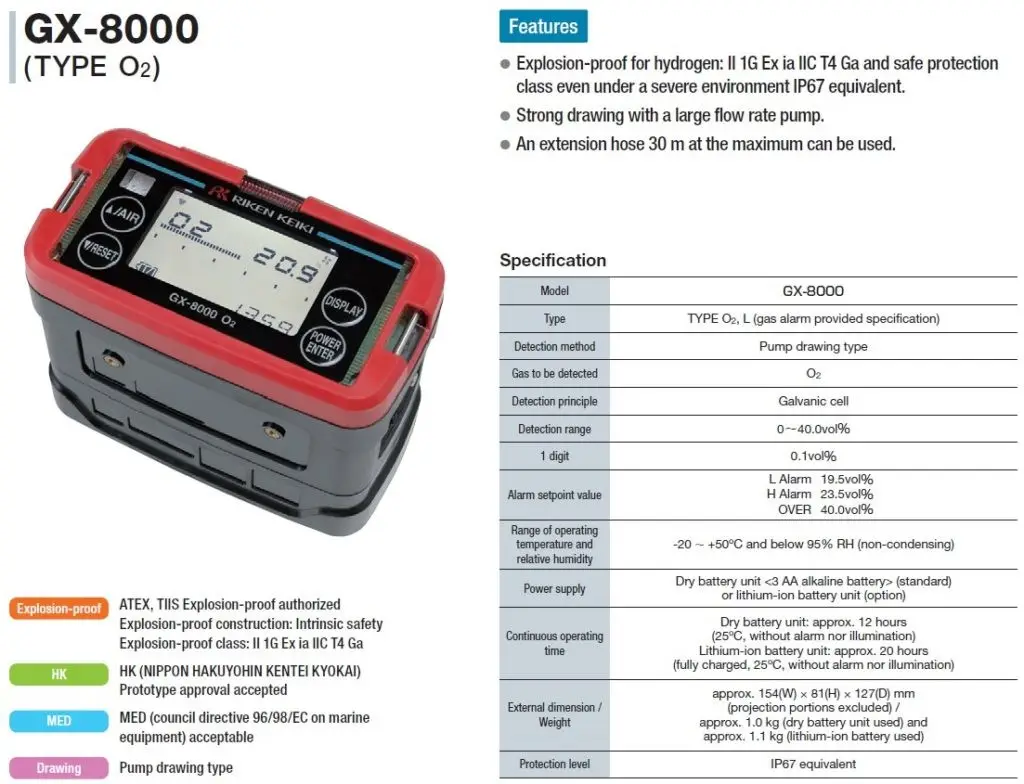
The GX-8000 Sample Draw Portable Multi Gas Monitor is built specifically to meet that full set of requirements. It simultaneously detects combustible gas across five ranges (including 100% VOL and 100% LEL), oxygen, hydrogen sulfide, and carbon monoxide via an integrated sample draw pump — providing both pre-entry atmospheric assessment and continuous personal monitoring from a single instrument. Its IP67 water and dust resistant construction, ATEX Ex ia IIC T4 certification, 95dB alarm buzzer with three LED alarm lamps, and standard datalogging make it a purpose-built instrument for the marine gas detection applications where it was designed to perform.
What sets the GX-8000 apart from comparable sample draw monitors is the combination of marine-specific design heritage and five combustible gas detection ranges in a single instrument — including full 100% VOL capability alongside the standard LEL range. Most portable gas monitors provide LEL detection only, which gives no reading above the lower explosive limit. In cargo tanks and vessel holds where hydrocarbon concentrations can range from trace to pure, a monitor that reads only to 100% LEL leaves the operator uninformed about the upper concentration range that matters for tank cleaning, gas freeing, and cargo operations. The GX-8000’s 100% VOL range closes that gap.
Key Features
Five Combustible Gas Ranges — Including 100% VOL and 100% LEL
The GX-8000 detects combustible gas across five ranges simultaneously — including both 100% volume and 100% LEL ranges. This dual-range capability covers the full spectrum of combustible gas concentrations encountered in marine confined space operations: from trace LEL during post-entry monitoring through to pure hydrocarbon atmospheres in cargo tanks before gas freeing operations. For tanker operators, offshore gas carrier operators, and confined space supervisors on chemical tankers, having both LEL and VOL readings from a single instrument eliminates the need to carry separate instruments for different concentration ranges and ensures the operator has accurate readings at both ends of the concentration spectrum.
Integrated Sample Draw Pump
The built-in sample draw pump draws atmospheric samples through a probe or hose, enabling pre-entry assessment from outside the confined space before any worker enters. For marine vessel entry, this means the atmosphere inside a hold, tank, or enclosed compartment can be assessed at depth — reaching the bottom of the space where heavy gases accumulate — from the deck level entry point. The strong sample drawing capability is specifically highlighted as a design priority, reflecting the marine use case where sampling at depth through long hoses and sampling tubes is a routine pre-entry requirement.
Large Simultaneous Display with Auto Back Lighting
The GX-8000 displays all monitored gas channels simultaneously on a large display with automatic back lighting. All gas readings — combustible gas (both VOL and LEL), O2, H2S, and CO — are visible at a single glance without scrolling or channel switching. Auto back lighting ensures display readability in the low-light environments encountered during marine confined space entry — ship holds, below-deck spaces, and enclosed vessel compartments where ambient lighting is limited.
95dB Loud Alarm Buzzer and Three LED Alarm Lamps
The GX-8000 triggers a 95dB audible alarm alongside three bright LED alarm lamps when gas concentrations breach alarm thresholds. The 95dB alarm level — significantly louder than standard 70–75dB personal monitor alarms — is designed to penetrate the high-noise environments encountered on vessel decks, in engine rooms, and at industrial process facilities where background noise can mask a standard alarm. Three LED alarm lamps provide bright visual indication in all directions — ensuring the alarm is visible from multiple angles in the confined and awkward positions encountered during vessel and industrial confined space work.
ATEX Ex ia IIC T4 Certified
ATEX Ex ia IIC T4 certification confirms the GX-8000 is approved for use in explosive gas atmospheres under the European intrinsic safety standard. IIC gas group covers the most ignition-sensitive gases including hydrogen — ensuring the instrument is certified for the full range of explosive gas atmospheres encountered in oil tanker, gas carrier, chemical tanker, and petrochemical facility environments. T4 temperature class provides a 135°C surface temperature limit suitable for the temperature-sensitive gas environments found in marine and petrochemical applications.
IP67 Water and Dust Resistant
IP67 provides complete dust ingress protection and resistance to temporary water immersion to 1 metre depth for 30 minutes. The tough, water-proof design is specifically referenced as a core design characteristic reflecting the marine application focus — instruments used on vessel decks, in wet holds, and in offshore environments are routinely exposed to rain, spray, wash-down, and accidental immersion that would disable instruments with lower ingress protection ratings.
Standard Datalogging
Datalogging is standard on the GX-8000 — not an optional accessory. Continuous logging of gas concentration data, alarm events, and monitoring records throughout each confined space entry provides the documentary evidence required for permit-to-work systems, vessel operator safety management requirements, and post-incident investigation. For marine operators and inspection contractors where entry records are a regulatory and contractual requirement, standard datalogging removes the risk of operating without records due to an unpurchased option.
Lithium-Ion Rechargeable Battery — Compact and Lightweight
The GX-8000 is powered by a lithium-ion rechargeable battery in a compact, lightweight ergonomic body with wrist strap attachment for hands-free survey operation. The combination of compact form factor and wrist strap enables the instrument to be carried on the wrist while the operator manages sample probes, ladder access, and confined space entry equipment simultaneously — the practical operating condition for one-person confined space pre-entry assessment on board vessels and at industrial sites.
Technical Specifications
Model: GX-8000
Target Gases: Combustible gas (5 ranges incl. 100% VOL and 100% LEL), O2, H2S, CO
Display: Large simultaneous display with auto back lighting
Sampling Method: Sample draw pump
Battery: Lithium-ion rechargeable
IP Rating: IP67 (water and dust resistant)
Alarm Types: Audible (95dB buzzer), Visual (3 bright LED alarm lamps)
Safety Approvals: ATEX Ex ia IIC T4
Data Logging: Standard (included)
Carrying: Ergonomic design with wrist strap for hands-free operation
Benefits
Complete combustible gas picture from 0% LEL through to 100% volume. The dual LEL and VOL range capability means the operator never loses a reading at either end of the concentration spectrum. During gas freeing operations on a tanker, the instrument reads the full drop from concentrated hydrocarbon atmosphere down through the explosive range to clear — with a continuous reading throughout, not a gap between where the VOL sensor stops and the LEL sensor starts.
Pre-entry assessment at depth before any worker enters. The sample draw pump enables the atmosphere at the lowest point of the confined space to be assessed from the entry hatch — covering the zone where heavy gases accumulate and where the actual atmospheric risk is highest before entry. This is the pre-entry assessment practice that prevents confined space incidents, and the GX-8000’s pump capability makes it operationally practical across the range of vessel and industrial confined space geometries.
95dB alarm penetrates high-noise marine and industrial environments. A 95dB alarm is loud enough to be heard over vessel machinery, deck operations, and industrial process noise that would mask a standard 70dB personal monitor alarm. Combined with three LED alarm lamps visible from multiple angles, the GX-8000’s alarm system is designed to be noticed in the actual operating environments where it is deployed — not just in a quiet laboratory test condition.
Standard datalogging removes the documentation gap from confined space entry records. Every entry is automatically logged — gas concentrations, alarm events, and monitoring data — without requiring a separate data logger purchase or a manual record-keeping process. For vessel operators and industrial facilities with permit-to-work documentation requirements, standard datalogging means the record is always there, regardless of whether the operator remembered to activate a non-standard logging option.
IP67 and tough construction for marine deck and vessel hold conditions. Water and dust resistance rated to IP67 in a tough enclosure designed from the ground up for the marine environment means the GX-8000 continues to operate in the deck spray, rain exposure, wet hold conditions, and rough handling that characterise vessel confined space inspection work — where instruments with lower protection ratings regularly fail.
Who It’s For
The Marine Safety Officer Conducting Confined Space Entry on Cargo Vessels
You manage confined space entry programmes on board oil tankers, gas carriers, bulk carriers, and chemical tankers. Every entry requires pre-entry atmospheric assessment of the full cargo space at depth, a complete multi-gas reading covering combustible gas at both LEL and VOL ranges, O2, H2S, and CO, and a documented entry record for the vessel’s safety management system. The GX-8000’s sample draw pump, five combustible gas ranges, standard datalogging, and ATEX IIC certification cover your complete pre-entry assessment and documentation requirements in a single instrument.
The Confined Space Supervisor at a Refinery or Petrochemical Plant
You oversee pre-entry atmospheric assessment for vessel and equipment entries during planned maintenance and turnaround operations. Your process vessels can contain concentrated hydrocarbon atmospheres above LEL before gas freeing, requiring combustible gas detection across the full VOL range as well as the LEL range during the gas freeing process. The GX-8000’s dual-range combustible gas capability provides a continuous reading throughout that full concentration range — from concentrated atmosphere through the explosive range to clear.
The Gas Detection Equipment Supplier Specifying for Marine Clients
You’re specifying portable gas detection for vessel operators, shipyards, and offshore service companies. Your clients need instruments that are genuinely designed for marine environments — not general industrial detectors adapted for marine use. They need ATEX IIC certification, IP67 protection, strong sample draw capability, loud alarms for noisy deck environments, and standard datalogging. The GX-8000 was designed to meet those marine-specific requirements from the outset.
Possible Applications
- Oil tanker, gas carrier, and bulk carrier confined space entry — Pre-entry assessment of cargo holds, ballast tanks, pump rooms, and enclosed vessel spaces with full VOL and LEL combustible gas detection
- Chemical tanker cargo space inspection — Multi-gas atmospheric assessment before entry into chemical cargo tanks with H2S, CO, O2, and combustible gas monitoring
- Refineries and petrochemical plants — Pre-entry assessment of process vessels, storage tanks, and heat exchangers during planned maintenance with full-range hydrocarbon detection
- Wastewater treatment confined space entry — Pre-entry H2S, CO, O2, and LEL assessment of pump stations, digesters, and underground treatment structures
- Fire services and emergency response — Multi-gas atmospheric assessment of incident scenes and unknown environments before emergency response team entry
- Power plants and fuel cell facilities — Confined space and enclosed area atmospheric monitoring at power generation facilities with combustible gas, O2, CO, and H2S hazards
- Gas plants and gas supplier services — Atmospheric survey and confined space entry at natural gas processing, storage, and distribution facilities
- Coating and painting confined space work — Combustible gas monitoring (LEL and VOL) during confined space painting and coating operations where solvent vapour accumulation is a fire and health risk
Trust and Certifications
ATEX Ex ia IIC T4 — Intrinsic Safety, Highest Gas Group
Ex ia (intrinsic safety) is the preferred protection concept for portable instruments carried by personnel in explosive atmospheres — it limits the electrical energy available to the circuit to below ignition levels under both normal operation and fault conditions. IIC gas group covers the full range of explosive gas categories including hydrogen — the most ignition-sensitive classification. T4 temperature class provides a 135°C surface temperature limit. Together, these certifications confirm the GX-8000 is approved for the most demanding explosive gas atmospheres found in marine cargo operations and petrochemical environments.
IP67 — Marine-Grade Ingress Protection
IP67 provides complete dust exclusion and protection against temporary water immersion to 1 metre for 30 minutes — the standard appropriate for instruments used in marine deck environments, wet vessel holds, and industrial outdoor conditions where rain, spray, and accidental water exposure are routine. The GX-8000’s tough, water-proof design is a core specification, not a secondary feature.
Standard Datalogging — No Additional Purchase Required
Datalogging as a standard feature — not an optional accessory — ensures that every instrument in a fleet has complete entry record capability from day one, without configuration variation between units. For vessel operators and industrial facilities with consistent documentation requirements across a multi-instrument operation, standard datalogging eliminates the documentation inconsistency risk that comes with optional logging configurations.
Marine Application Design Heritage
The GX-8000 Marine Gas Monitor is specifically positioned as a marine application instrument — designed with vessel confined space entry requirements, marine certification needs, and shipboard operating conditions as primary design parameters. This marine application heritage reflects in instrument features: the 95dB alarm for noisy deck environments, the strong sample draw capability for deep tank assessment, the IP67 construction for deck and hold conditions, and the five combustible gas ranges for tanker gas measurement operations.
Authorised by Alright Engineering Solutions
The GX-8000 is supplied through Alright Engineering Solutions Pte. Ltd., an authorised distributor of personal and portable gas detection equipment in Singapore. Alright Engineering Solutions provides local procurement support, instrument configuration guidance, and after-sales service for the Singapore and regional market.
Accessories and Variants
Sample Draw Probe and Extension Hose
Sampling probes and hose extensions for deep tank and long-distance pre-entry atmospheric assessment — reaching the bottom of cargo tanks, the far end of horizontal spaces, and deep underground structures from the entry point.
Wrist Strap (Included)
Enables hands-free instrument carrying during probe-assisted survey operations on vessels, confined spaces, and industrial entry points — freeing both hands for probe management, ladder access, and safety equipment operation.
Lithium-Ion Battery Charger
Compatible charger for the GX-8000’s lithium-ion battery — available for single-unit and multi-unit charging configurations for vessel and site operations deploying multiple instruments.
Calibration Gas Kits
Multi-gas calibration kits for bump testing and full calibration across all detection channels — combustible gas, O2, H2S, and CO. Regular calibration maintains detection accuracy and supports compliance with vessel operator and facility safety management system calibration requirements.
Related Products from Alright Engineering Solutions
RX-8700 Portable Gas Detector — Alternative sample draw multi-gas monitor with ATEX/IECEx/MED certification and IR sensor option
GX-6000 Sample Draw Multi Gas Monitor — Alternative 6-gas sample draw monitor with ATEX/IECEx and colour LCD display
BELL LITE Multi Gas Detector — Personal wearable 4-gas monitor for workers entering spaces assessed by the GX-8000
BELLMINI Single Gas Detectors — Personal clip-on monitors for individual gas hazards worn by workers during confined space entry
Get in Touch
If your marine vessel operations, confined space entry programme, or industrial inspection work requires a rugged, certified sample draw multi-gas monitor with full-range combustible gas detection and marine-environment construction — the GX-8000 is worth a detailed evaluation.
Contact Alright Engineering Solutions to request a formal quote, discuss instrument configuration for your specific vessel or facility application, or arrange a product demonstration for your safety or inspection team.
📍 3791 Jalan Bukit Merah #06-01, E-Centre @ Redhill, Singapore 159471