Cart (
Overview
Dry powder extinguishers are effective — but they leave behind a residue that can cause significant secondary damage in environments where sensitive equipment, precision machinery, or valuable goods are present. A CO2 discharge suppresses the fire and then dissipates completely: no powder contamination on electrical panels, no agent residue fouling switchgear contacts, no cleanup cost, no equipment downtime beyond the fire event itself. In environments where the secondary damage from the extinguishing agent can rival the fire damage in cost and operational disruption, CO2 is not an alternative to powder — it is the correct specification.
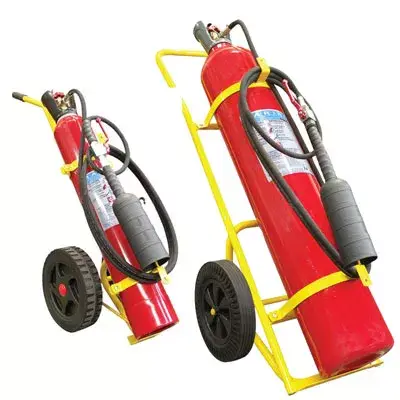
The ABS CO2 Trolley Fire Extinguisher is a wheeled, stored-pressure CO2 unit available in four agent capacities — 10 KG, 20 KG, 30 KG, and 50 KG — covering the full range of Class B fire suppression requirements from moderate-risk electrical and flammable liquid positions through to large-area fire risk in industrial and marine environments. CO2 is both the extinguishing agent and the propellant in these units: no separate propellant cartridge, no nitrogen charge, no powder charge to inspect or replace. The cylinder contains pressurised liquid CO2 which vaporises on discharge, displacing oxygen and cooling the fire simultaneously.
All four variants are tested to EN 1866 standard, rated at 60 Bar working pressure and 250 Bar test pressure, and operate across a -30°C to +60°C temperature range — the same consistency of specification across the range that makes the ABS ABC and BC trolley families suitable for vessel, offshore, and industrial deployment. The 50 KG variant’s 52-second discharge time and the common 4-metre throw distance across all four models reflect the operational characteristics of CO2 as an agent: shorter range than powder but clean, residue-free suppression in the spaces where it matters most.
Key Features
CO2 Agent — Clean Suppression, Zero Residue
Carbon dioxide extinguishes fire by displacing the oxygen concentration in the fire zone below the level required to sustain combustion, while simultaneously providing a cooling effect on the fuel surface. On discharge, CO2 vaporises and disperses — leaving no residue, no contamination, and no cleanup requirement beyond ventilating the space after the fire is out. In electrical switchgear rooms, generator sets, server rooms, control panels, and precision equipment areas, this zero-residue characteristic directly determines how quickly the space can be returned to operation after a fire event: dry powder contamination in the same spaces would require full equipment inspection, cleaning, and potentially component replacement before returning to service.
Four Capacity Variants — 10 KG to 50 KG
The range covers four agent capacities with discharge times scaled to the agent mass: 10 KG at 17 seconds (Model 14311), 20 KG at 32 seconds (Model 14321_6), 30 KG at 35 seconds (Model 14322), and 50 KG at 52 seconds (Model 14352). The 10 KG variant provides a rapid, concentrated CO2 discharge for small-area fire events; the 50 KG variant delivers the sustained discharge duration needed to suppress fires in larger enclosed spaces where oxygen displacement requires maintaining CO2 concentration across a greater volume. All four variants share the same 4-metre throw distance — the standard CO2 discharge characteristic — and the same EN 1866 test certification and operating temperature specification.
Stored-Pressure CO2 — Self-Contained, No Cartridge Components
CO2 trolley extinguishers are stored-pressure units: the cylinder contains liquid CO2 under its own vapour pressure, and discharge is initiated directly by opening the valve — no separate propellant cartridge, no piercing mechanism, no pre-actuation step beyond directing the horn and opening the valve. This simplicity of operation reduces the number of mechanical components that can fail between service intervals and makes operation straightforward for trained crew under the stress of a fire event. After discharge, the cylinder requires workshop recharge — a distinction from cartridge-operated powder trolleys — and this should be factored into maintenance planning for remote site deployments.
60 Bar Working Pressure / 250 Bar Test Pressure — High-Pressure Vessel Standards
CO2 extinguisher cylinders operate at significantly higher pressures than dry powder trolleys: 60 Bar working pressure compared to 14 Bar for the ABS powder trolley range. The 250 Bar test pressure reflects the pressure vessel certification standard required for high-pressure CO2 cylinders — a hydraulic proof test at more than four times working pressure. These pressure specifications require compliance with pressure vessel regulations applicable in the installation jurisdiction — flag state requirements for vessels, national pressure vessel legislation for industrial facilities. The EN 1866 test certification covers extinguisher performance; pressure vessel certification is an additional compliance requirement that procurement teams should confirm with the supplier for their specific installation jurisdiction.
4-Metre Effective Throw Distance — Designed for Enclosed Spaces
CO2 discharge achieves a 4-metre effective throw distance across all four variants — shorter than the 11-12 metre range of the ABS powder trolley range, reflecting the physical properties of CO2 gas discharge compared to powder agent projection. The 4-metre range is suited to the enclosed environments where CO2 trolleys are typically deployed: electrical switchgear rooms, generator rooms, server rooms, and enclosed equipment spaces where the operator can approach to within 4 metres of the fire source. In open industrial environments where approach distance is constrained by heat radiation or fire perimeter, CO2 trolleys are not the correct specification — powder trolleys with 11-12 metre throw distance are the appropriate equipment for open-area Class B fire positions.
-30°C to +60°C Operating Range — Consistent Global Specification
All four CO2 trolley variants operate across a -30°C to +60°C temperature range — the same operating window as the ABS powder trolley range. This consistent specification across the ABS extinguisher portfolio means that vessel operators and industrial facilities specifying both CO2 and powder trolley equipment for the same site can do so from a single product family with a common operating temperature basis, simplifying the environmental specification process for multi-unit deployments in diverse climate conditions.
EN 1866 Tested — Verified Performance Across All Variants
EN 1866 testing covers wheeled fire extinguisher construction, discharge performance, operating mechanism reliability, pressure containment, and environmental resistance. EN 1866 certification across all four CO2 trolley variants provides the compliance documentation basis for fire equipment specification in European Union facilities, under European flag state vessel regulations, and in international facilities aligning fire equipment to European standards. The fire ratings — 144 IV B for the 10 KG variant and 233 IV B for the 20 KG, 30 KG, and 50 KG variants — provide the standardised Class B suppression performance documentation that fire risk assessments and HSE compliance verification require.
Technical Specifications
Model: 14311 (10KG) | 14321_6 (20KG) | 14322 (30KG) | 14352 (50KG)
Extinguish Agent: 10KG CO2 | 20KG CO2 | 30KG CO2 | 50KG CO2
Test Standard: EN1866 (all variants)
Propellant: CO2 (stored pressure — all variants)
Discharge Distance: 4M (all variants)
App Discharge Time: 17 Sec (14311) | 32 Sec (14321_6) | 35 Sec (14322) | 52 Sec (14352)
Height: 980MM (14311) | 970MM (14321_6) | 1140MM (14322) | 1435MM (14352)
Width: 370MM (14311) | 400MM (14321_6) | 520MM (14322) | 650MM (14352)
Depth: 1060MM (14311) | 600MM (14321_6) | 1150MM (14322) | 1400MM (14352)
App Total Weight: 38KG (14311) | 70KG (14321_6) | 85KG (14322) | 156KG (14352)
Operating Temperature: -30°C to +60°C (all variants)
Working Pressure: 60 BAR (all variants)
Test Pressure: 250 BAR (all variants)
Fire Rating: 144 IV B (14311) | 233 IV B (14321_6, 14322, 14352)
Part No: FEM-AB-C10 (14311) | FEM-AB-C20 (14321_6) | FEM-AB-C30 (14322) | FEM-AB-C50 (14352)
Benefits
Equipment Returns to Service Faster After a Fire Event
The operational cost of a fire event in an electrical or equipment room is not limited to the fire damage itself — it includes the cleanup, inspection, and recommissioning time before the space and its equipment can return to service. In a switchgear room or generator set space, dry powder contamination requires full equipment cleaning, contact inspection, and often component replacement before electrical equipment can be safely re-energised. CO2 discharge leaves no residue: once the space is ventilated and the fire confirmed out, the timeline to equipment recommissioning is determined by fire damage alone, not agent contamination. For operations where equipment downtime has direct production or operational consequences, CO2 is the specification that minimises total incident cost.
No Secondary Damage to Sensitive Equipment
Control rooms, server rooms, electrical switchgear, precision instruments, and high-value manufacturing equipment are damaged by dry powder discharge even when the powder successfully suppresses the fire. Powder particles penetrate enclosures, contaminate electrical contacts, and can cause equipment failures separate from and additional to any fire damage. CO2 addresses this by leaving nothing behind. For facilities where the equipment at risk is worth significantly more than the cost of the fire protection system — data centres, power generation control rooms, precision manufacturing, vessel wheelhouses and navigation equipment spaces — CO2 is the agent specification that protects the full asset value, not just the structural fabric.
Simplified Agent Specification for Electrical Fire Risk
CO2 is electrically non-conductive and leaves no residue — the two agent properties that make it the standard specification for electrical fire positions. For HSE officers specifying fire protection for switchgear rooms, generator sets, UPS systems, and electrical distribution equipment, CO2 trolley units provide Class B and electrical fire suppression from a single agent specification that meets both the suppression performance and the equipment protection requirements of the electrical fire risk environment. The 233 IV B fire rating on the 20 KG, 30 KG, and 50 KG variants confirms Class B suppression performance to the same standard as the ABS powder trolley range.
Consistent Compliance Basis Across the ABS Portfolio
Specifying ABS CO2 trolleys alongside ABS ABC and BC powder trolleys provides a consistent EN 1866 test certification baseline across all wheeled extinguisher types on a site or vessel — a single compliance standard, a single documentation framework, and a single supplier relationship for the complete wheeled extinguisher inventory. For safety managers preparing compliance documentation for flag state surveys, HSE audits, or insurance inspections, a consistent product family specification simplifies the certification verification process compared to a mixed-brand inventory with multiple test standard references.
Who It’s For
Electrical Engineers and Facility Managers Responsible for Switchgear and Power Systems
An electrical engineer managing fire protection for a large industrial switchgear room or substation understands that a powder discharge in that space — even a successful one — means days of cleanup, contact inspection, and equipment recommissioning before the electrical infrastructure is back in service. The decision to specify CO2 trolleys for electrical fire positions is driven by total incident cost, not just suppression performance. A 30 KG or 50 KG CO2 trolley positioned at a switchgear room entrance provides the agent mass and discharge duration to suppress a fire in that enclosed space, with zero residue cost on top of the fire damage itself.
Marine Technical Superintendents Specifying Wheelhouse and Control Room Protection
Vessel navigation equipment, electronic chart systems, radar installations, and engine control room electronics represent significant capital investment and are critical to safe vessel operation. A powder discharge in a wheelhouse or engine control room suppresses the fire but leaves behind agent contamination that can disable navigation and communication equipment far beyond the fire-affected zone. Marine technical superintendents specifying fire protection for enclosed equipment spaces — wheelhouses, ECRs, electrical equipment rooms — specify CO2 precisely because the zero-residue characteristic protects the secondary equipment from agent contamination while the primary fire is being suppressed.
Data Centre and IT Infrastructure Managers
Data centres and server rooms present a specific fire protection challenge: the equipment at risk is dense, high-value, and extremely sensitive to contamination, while the fire load — typically from electrical faults and cable insulation — is primarily Class B and electrical in nature. Fixed gaseous suppression systems are the primary protection for many data centre environments, but wheeled CO2 trolleys positioned at access points provide first-response capability for personnel to address a localised fire before the fixed system activates or to address fires in adjacent spaces not covered by the fixed system zone.
Possible Applications
Electrical Switchgear Rooms and High-Voltage Substations
Switchgear rooms and substations are the standard CO2 trolley deployment environment. The 30 KG and 50 KG variants provide sufficient agent mass for sustained CO2 discharge in medium to large switchgear rooms; the 20 KG variant addresses smaller electrical equipment rooms. All variants are electrically non-conductive and leave zero residue — the two mandatory agent characteristics for electrical fire positions.
Vessel Engine Control Rooms and Wheelhouses
Marine engine control rooms and wheelhouses contain electronic navigation and control equipment that cannot tolerate powder contamination. CO2 trolleys positioned at ECR and wheelhouse access points provide first-response capability for localised electrical fires in these spaces without the secondary equipment damage that dry powder discharge would cause — a critical distinction for vessels where navigation equipment availability is a safety-of-life requirement.
Generator Sets and Emergency Power Rooms
Generator room fires involve both Class B risk (fuel system leaks) and electrical risk (alternator windings, control panels). CO2 addresses both simultaneously without residue contamination of the generator set’s electrical components. The 20 KG and 30 KG variants are suitable for enclosed generator room fire positions at most industrial and marine installation sizes.
Server Rooms and Data Centres
Server room fire events — typically from cable insulation faults or power supply unit failures — require an agent that suppresses the fire without damaging adjacent servers and networking equipment through contamination. CO2 trolleys at server room access points provide manual first-response capability and a backup to fixed gaseous suppression systems for facilities where first-responder access is part of the emergency response plan.
Industrial Paint Stores and Solvent Handling Areas
Flammable liquid stores — paint stores, solvent handling areas, chemical storage rooms — present Class B fire risk in enclosed spaces where discharge at close range (4 metres) is often achievable. CO2 trolleys address the Class B fire risk in these enclosed spaces; the clean agent characteristic is also relevant in finished goods storage areas where powder contamination would damage stored product.
Offshore Platform Control Rooms and Instrument Rooms
Offshore platform control rooms and instrument rooms house SCADA systems, process control panels, and communication equipment critical to platform operations. Fire protection for these spaces requires an agent that suppresses the fire without destroying the control systems that manage the platform’s response to the fire event itself. CO2 is the standard specification for these enclosed, equipment-critical spaces on offshore installations.
Vehicle and Equipment Paint Booths
Industrial paint booths handling solvent-based coatings present significant Class B fire risk in an enclosed environment. CO2 trolleys positioned at paint booth access points provide first-response suppression capability for solvent fire events without contaminating the paintwork or equipment surfaces in the booth — relevant where work-in-progress product quality would be compromised by powder agent discharge.
Trust & Certifications
EN 1866 — European Standard for Wheeled Fire Extinguishers
EN 1866 testing verifies wheeled fire extinguisher construction, discharge performance, operating mechanism reliability, pressure containment, temperature resistance, and corrosion resistance to the European harmonised standard for this equipment category. EN 1866 certification across all four ABS CO2 trolley variants provides the compliance documentation basis for fire equipment specification in EU facilities, under European flag state regulations, and in international facilities aligning to European fire safety standards. For HSE officers and procurement teams building compliance documentation files for audit, survey, or insurance purposes, EN 1866 certification is the foundational performance verification record.
144 IV B and 233 IV B Fire Ratings — Verified Class B Suppression
Fire ratings are assigned following standardised Class B fire test arrays under EN 3 / EN 1866 conditions. The 10 KG variant (Model 14311) carries a 144 IV B rating — appropriate for the agent mass and discharge characteristics of a 10 KG CO2 unit. The 20 KG, 30 KG, and 50 KG variants carry 233 IV B ratings — the same Class B suppression performance benchmark as the ABS ABC and BC powder trolley range, providing a consistent fire rating basis across the ABS wheeled extinguisher portfolio for sites and vessels specifying both CO2 and powder trolley equipment. Fire ratings give procurement teams and HSE officers the performance verification data needed to match extinguisher specification to the fire size requirements of a site risk assessment.
High-Pressure Vessel Compliance — 60 Bar / 250 Bar
CO2 cylinders operate at significantly higher pressures than dry powder extinguishers and are subject to pressure vessel regulations in addition to fire extinguisher performance standards. The 60 Bar working pressure and 250 Bar test pressure specifications reflect the pressure vessel certification requirements for high-pressure CO2 cylinders — hydraulic proof testing at more than four times working pressure, consistent with international pressure vessel standards. Procurement teams should confirm pressure vessel certification compliance with the supplier for their specific installation jurisdiction, as pressure vessel regulations vary between flag states, national regulatory frameworks, and classification society requirements.
ABS Brand — Consistent Product Family for Marine and Industrial Deployment
The ABS CO2 trolley range is part of the broader ABS fire extinguisher portfolio — a product family that includes ABC powder trolleys, BC powder trolleys, and CO2 trolleys across multiple agent capacities, all tested to EN 1866 standard and sharing a common -30°C to +60°C operating range and documented fire rating basis. Specifying across the ABS family provides a consistent compliance documentation framework, a single supplier relationship for the complete wheeled extinguisher inventory, and a uniform service standard across equipment types — relevant for ship managers and facility operators maintaining large and diverse extinguisher inventories.
Accessories & Variants
Available Variants — Full Model Reference
FEM-AB-C10 (Model 14311) — 10KG CO2 | 4M throw | 17 Sec discharge | 38KG total weight | EN1866 | 144 IV B
FEM-AB-C20 (Model 14321_6) — 20KG CO2 | 4M throw | 32 Sec discharge | 70KG total weight | EN1866 | 233 IV B
FEM-AB-C30 (Model 14322) — 30KG CO2 | 4M throw | 35 Sec discharge | 85KG total weight | EN1866 | 233 IV B
FEM-AB-C50 (Model 14352) — 50KG CO2 | 4M throw | 52 Sec discharge | 156KG total weight | EN1866 | 233 IV B
Related Products — ABS Wheeled Extinguisher Range
ABS 25KG / 50KG / 100KG ABC Powder Trolley (FEM-ABDC25 / FEM-ABDC50 / FEM-ABDC100) — ABC dry powder trolley units for open-area Class A, B, and C fire positions where 11-12 metre throw distance is required; cartridge-operated field-recharge design for vessels and remote sites
ABS 50KG Karate BC Powder Trolley (FEM-AB-DC50-BC) — BC dry powder trolley for flammable liquid and electrical fire positions in refineries, airports, and fuel handling environments where BC Karate powder is the specified agent type
Portable CO2 Extinguishers (2KG / 5KG) — Hand-portable CO2 units for personal-issue positioning in electrical equipment rooms and server rooms; complement wheeled CO2 trolleys as immediate first-response capability for personnel nearest the fire point before the trolley can be positioned
Service and Maintenance
CO2 trolley extinguishers require workshop recharge after discharge — the cylinder must be returned to a CO2 filling facility to restore the agent charge. Unlike cartridge-operated powder trolleys, field recharge of CO2 stored-pressure cylinders is not possible. Maintenance planning for CO2 trolleys deployed on vessels or at remote sites should account for the lead time and logistics of cylinder recharge, including the availability of a replacement cylinder or a pre-charged spare to maintain fire protection coverage during the recharge period.
Get in Touch
If you are specifying CO2 trolley fire extinguishers for electrical equipment rooms, generator spaces, server rooms, vessel control spaces, or any enclosed environment where clean-agent suppression is required — contact us to confirm the correct capacity variant for your fire risk assessment and request a formal procurement quotation.
Our team can advise on CO2 trolley sizing for your specific space volume and fire risk profile, confirm EN 1866 certification documentation, and assist with procurement planning for vessel and site deployments where CO2 recharge logistics need to be factored into the maintenance schedule.
📍 3791 Jalan Bukit Merah #06-01, E-Centre @ Redhill, Singapore 159471