Cart (
Overview
Most real-world fire incidents do not announce themselves with a predictable fire class. A fire in a vessel engine room may begin as a Class C electrical fault before it ignites hydraulic oil and becomes a Class B liquid fire spreading across Class A materials on the surrounding surfaces. A fire in an industrial facility store room may start as a Class A combustible fire and reach cable trays and electrical equipment before the first responder arrives. First-attack portable extinguishers in mixed-risk environments need to address all three common fire classes — Class A solid combustibles, Class B flammable and combustible liquids, and Class C energised electrical equipment — from a single unit, without requiring the operator to assess which class is present before choosing the correct extinguisher.
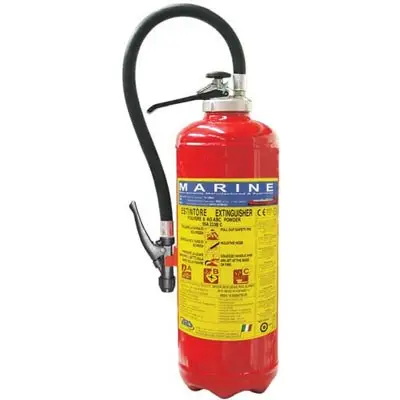
The ABS 6KG, 9KG, and 12KG ABC Fire Extinguisher (Cartridge) is a cartridge-operated ABC dry powder extinguisher available in three capacity options, tested to EN 3, and rated across all three common fire classes — 34A 233B for the 6KG unit, and 55A 233B for both the 9KG and 12KG variants. The ABC dry powder agent provides broad-spectrum fire suppression capability, making it the standard first-attack extinguisher specification for general industrial, marine, and commercial installations where mixed fire class risk is present and a single extinguisher type needs to address the full hazard profile of the location.
The cartridge-operated design is the specification differentiator that separates this product from stored-pressure ABC powder alternatives in marine, offshore, and remote industrial applications. After discharge, the unit is recharged by replacing the spent CO2 propellant cartridge and refilling the powder agent — tasks completed by the operator’s own maintenance team, in the field, without a pressurised workshop or a contracted service engineer. On a vessel at sea or an offshore platform between supply visits, this independent recharge capability keeps the fire equipment inventory fully serviceable throughout the operational period, not just between shore-based service intervals.
Key Features
ABC Dry Powder Agent — Class A, B, and C Coverage from a Single Unit
The ABC dry powder formulation suppresses Class A fires involving solid combustibles (wood, paper, textiles, plastics), Class B fires involving flammable and combustible liquids (fuels, oils, solvents, hydraulic fluid), and Class C fires involving energised electrical equipment (switchgear, generators, control panels, motors). For general industrial buildings, vessel accommodation and machinery spaces, offshore accommodation modules, commercial premises, and any installation where solid combustible material, flammable liquids, and electrical equipment coexist in the same space — which describes the majority of working environments — ABC powder is the agent type that eliminates the need to specify separate extinguisher types for each fire class. One unit, trained on once, covering all common fire scenarios in the installation.
Cartridge-Operated Recharge — Field Serviceability Without Workshop Dependency
Propellant is delivered by a separate CO2 cartridge (150g for the 6KG unit; 210g for both the 9KG and 12KG units) that is not under pressure between activations — meaning the cylinder body does not carry stored pressure during normal storage and transport. After discharge, the unit is recharged by replacing the spent cartridge and refilling the powder agent. On a vessel between port calls, at an offshore platform between supply vessel visits, or at a remote industrial site without a local fire equipment service contractor, this means the extinguisher is returned to service by the operator’s own team — the same day it was used — rather than being stood down until the next scheduled service visit.
Three Capacity Variants — 6KG, 9KG, 12KG for Installation-Specific Specification
The three capacity options allow procurement teams and fire safety consultants to match the agent volume to the fire risk assessment finding and the installation position constraints. The 6KG unit (10.7 KG charged, 560mm height, fire rating 34A 233B) suits personal-issue, vehicle-mounted, and space-constrained positions. The 9KG unit (16 KG charged, 545mm height, fire rating 55A 233B) provides higher Class A suppression performance in a compact format. The 12KG unit (19 KG charged, 605mm height, fire rating 55A 233B) delivers the largest agent charge for fixed wall-mount positions in higher-risk areas — engine rooms, machinery spaces, process equipment areas, and industrial storage areas. All three variants share the same agent type, cartridge-recharge procedure, and operating protocol, simplifying crew training and maintenance workflows across mixed-capacity deployments.
-30°C to +60°C Operating Temperature Range — Global Deployment Without Variants
All three capacity variants are rated for operation from -30°C to +60°C — covering the full range from Arctic offshore operations and cold-climate vessel voyages to equatorial refineries, tropical coastal installations, and desert industrial facilities. For procurement teams managing fire equipment across geographically diverse vessel fleets or multi-climate facility portfolios, this operating range eliminates the need for climate-specific product variants and supports standardisation of a single product line across the entire inventory.
7-Metre Discharge Distance — Adequate Standoff for First-Attack Response
All three variants deliver a 7-metre discharge distance, enabling the operator to begin agent application from a safe standoff position relative to the fire source — particularly important for Class B liquid fires and Class C electrical fires where close-range approach creates additional hazard from radiant heat, vapour ignition, and electrical exposure. The 7-metre range supports the standoff distances specified in many industrial fire response protocols for first-attack extinguisher use on flammable liquid and electrical fires.
Wide Cylinder Opening — In-Field Powder Condition Check
The cylinder is fitted with a wide opening that allows maintenance personnel to confirm the condition of the ABC powder charge using an adjustable spanner, without specialist tools or a contracted service engineer. ABC dry powder can compact, cake, or absorb moisture over time in humid or high-vibration environments — degrading discharge performance without any visible external indication. The wide opening enables visual inspection and physical confirmation of powder condition at each periodic maintenance check, ensuring the unit is confirmed serviceable at the point of the inspection rather than assumed serviceable based on the last service date alone.
EN 3 Tested — Documented Performance Basis for Compliance Specification
All three variants are tested to EN 3, the European standard for portable fire extinguishers, with fire ratings (34A 233B for the 6KG; 55A 233B for 9KG and 12KG) assigned on the basis of standardised fire test performance. For HSE officers, fire safety consultants, and procurement teams specifying extinguishers against fire risk assessment findings, the EN 3 fire rating provides the quantitative performance basis for confirming that the specified unit is adequate for the identified fire hazard — not just nominally sized. For fire authority inspections, classification society surveys, and insurance risk assessments, the EN 3 test basis and documented fire ratings provide the compliance evidence required for installation acceptance.
Technical Specifications
Model: 14167 (6KG) | 14194 (9KG) | 14173 (12KG)
Part No: FEM-ABDC06 (6KG) | FEM-ABDC09 (9KG) | FEM-ABDC12 (12KG)
Extinguishing Agent: ABC Dry Chemical Powder
Agent Capacity: 6 KG | 9 KG | 12 KG
Propellant Cartridge: 150g CO2 (6KG) | 210g CO2 (9KG) | 210g CO2 (12KG)
Test Standard: EN 3 (all variants)
Fire Rating: 34A 233B (6KG) | 55A 233B (9KG) | 55A 233B (12KG)
Fire Classes Covered: Class A, Class B, Class C (all variants)
Discharge Distance: 7 m (all variants)
Approx. Discharge Time: 18 sec (6KG) | 20 sec (9KG) | 26 sec (12KG)
Working Pressure: 13 bar (all variants)
Test Pressure: 26 bar (all variants)
Operating Temperature: -30°C to +60°C (all variants)
Body Diameter: 160 mm (6KG) | 190 mm (9KG) | 190 mm (12KG)
Height: 560 mm (6KG) | 545 mm (9KG) | 605 mm (12KG)
Approx. Total Weight (Charged): 10.7 KG (6KG) | 16 KG (9KG) | 19 KG (12KG)
Operation Method: Cartridge Operated (all variants)
Benefits
Standardising on an ABC dry powder cartridge extinguisher across a facility or vessel fleet delivers a tangible simplification in fire safety management. Where a site previously carried separate extinguisher types for Class A, Class B, and Class C risks — each with different agent specifications, different service procedures, and different crew training requirements — the ABC cartridge unit consolidates those three product lines into one. Fewer SKUs in the inventory, one service procedure for all positions, and one operating protocol for crew to be trained on — regardless of which extinguisher position they access in an emergency.
For vessel operators and offshore platform managers, the cartridge-recharge design changes the maintenance model from reactive — discharged unit goes out of service until the next shore visit — to immediately corrective. A discharged unit is recharged the same day by the vessel’s own crew, returned to its mounting position, and logged as serviceable in the fire equipment maintenance record. Annual service costs are reduced because the majority of recharge work is completed in-house rather than by a contracted service engineer at each service interval.
For HSE compliance, the EN 3 test basis and documented fire ratings provide the audit-ready evidence chain that fire authority inspectors, classification society surveyors, and insurance risk assessors require to confirm that installed extinguishers are appropriate for the identified fire hazards. Three part numbers — FEM-ABDC06, FEM-ABDC09, FEM-ABDC12 — provide unambiguous procurement references for inventory records, repeat orders, and service parts sourcing, supporting the traceability requirements of ISO-certified HSE management systems and vessel safety management system documentation.
Who It’s For
Vessel Deck Officers and Marine Safety Officers
A deck officer responsible for fire equipment readiness on a commercial vessel carrying mixed cargo on a month-long voyage needs to know that every extinguisher position on board can be returned to service by the vessel’s own crew if it is discharged — not held out of service until the next port call. The ABC cartridge extinguisher addresses this directly. Spare CO2 cartridges and ABC powder refill stock are carried in the ship’s stores, the recharge procedure is straightforward enough for a trained AB or engine rating to complete, and the wide cylinder opening allows the chief officer to confirm powder condition at each weekly fire safety inspection without sending the unit ashore. For SOLAS-applicable vessels carrying ABC powder extinguishers in accommodation spaces, cargo areas, and machinery spaces, this is the design that keeps the inventory fully serviceable between port calls.
Industrial Facility HSE Officers
An HSE officer managing fire equipment provision across a manufacturing plant, warehouse complex, or process facility is typically responsible for extinguisher positions covering a mix of office areas, storage rooms, production areas, and plant rooms — all with different fire risk profiles but all requiring first-attack ABC coverage. Specifying the ABS ABC cartridge series across all positions consolidates the product inventory to a single agent type and recharge procedure, simplifying the annual service schedule, reducing the parts inventory required for in-house recharge capability, and ensuring that any trained maintenance technician can service any position on site. The 6KG, 9KG, and 12KG variants allow each position to be right-sized against the fire risk assessment without introducing additional product complexity.
Offshore Installation Managers and Procurement Officers
An installation manager on a fixed or floating offshore platform is managing a fire equipment inventory across accommodation modules, process areas, utility rooms, and helideck positions — in an environment where resupply logistics are constrained, equipment maintenance must be largely self-sufficient, and fire safety compliance is subject to regular flag state and classification society inspection. The cartridge-operated ABC extinguisher series supports the self-sufficient maintenance model through in-house recharge capability, and the EN 3 certification and documented fire ratings support the compliance evidence requirements for offshore installation safety case documentation and periodic inspection submissions.
Possible Applications
Marine Vessel Accommodation Spaces and Passageways
Accommodation passageways, cabin areas, and public spaces on commercial vessels carry Class A fire risk from furnishing materials, bedding, and electrical equipment. The ABC cartridge extinguisher provides the Class A suppression performance required for accommodation fire scenarios alongside Class B and C coverage for the electrical and fuel-related risks present throughout the vessel — from a single unit type carried at accommodation deck extinguisher stations.
Offshore Platform Accommodation and Process Modules
Accommodation modules on fixed and floating offshore platforms require Class A first-attack coverage in cabin and public areas, and Class B and C coverage in utility and plant rooms within or adjacent to the accommodation module. The ABC dry powder cartridge extinguisher’s triple-class rating and self-sufficient recharge design make it the practical choice for all accommodation module extinguisher positions on self-maintaining offshore installations.
Industrial Warehouses and Distribution Centres
High-bay warehousing with racked storage of mixed goods — packaged products, electrical equipment, cleaning chemicals, and packaging materials — presents Class A, B, and C fire risk at racking bay access points and loading bay areas. ABC powder extinguishers at each racking bay access point provide universal first-attack coverage for the full range of fire classes likely to be encountered in a mixed-goods warehouse environment.
Manufacturing Plants — General Production and Assembly Areas
Production and assembly areas in manufacturing facilities typically combine Class A combustible material risk from raw materials and packaging with Class B risk from lubricants, coolants, and process chemicals, and Class C risk from production machinery, control panels, and electrical distribution equipment. The ABC cartridge extinguisher at production floor access points and workstation positions provides coverage for all three fire classes from a single unit type — simplifying the extinguisher layout plan and reducing the number of product lines in the site’s fire equipment inventory.
Coastal Installations — Port Facilities, Marine Workshops
Port facilities and coastal marine workshops combine Class B risk from fuel handling and vessel maintenance operations with Class A risk from workshop materials and stored goods, and Class C risk from workshop electrical equipment. The ABC powder extinguisher’s triple-class rating covers the mixed fire hazard profile of a working port facility from a single unit type at each workshop and facility access point position.
Commercial Buildings — Office and Retail Premises
General commercial buildings — offices, retail premises, and mixed-use developments — carry Class A fire risk from furnishing materials and paper, Class B risk from cleaning chemicals and stored flammable materials in service areas, and Class C risk from electrical installation and IT equipment throughout. The ABC cartridge extinguisher provides universal first-attack coverage for building-wide extinguisher positions, allowing a single product type to be specified across all floor areas and service spaces.
Military Installations and Government Facilities
Military bases, government facilities, and secure installations often operate in locations where civilian fire equipment service contractors do not have access. The cartridge-operated ABC extinguisher’s in-house recharge capability — using base maintenance personnel and spare stock carried within the installation — addresses the access constraint directly, ensuring fire equipment remains serviceable without external contractor dependency.
Trust & Certifications
EN 3 — European Standard for Portable Fire Extinguishers
EN 3 is the European standard series governing the design, construction, performance testing, and marking of portable fire extinguishers. All three ABS ABC Cartridge variants are tested to EN 3, with fire ratings (34A 233B for 6KG; 55A 233B for 9KG and 12KG) assigned on the basis of standardised fire test array performance. For fire authority inspections, building control sign-off, classification society surveys, and insurance risk assessments, EN 3 test compliance is the foundational performance verification requirement for portable fire extinguisher specification and installation acceptance across EU member states and international projects aligning to European fire safety standards.
34A 233B and 55A 233B Fire Ratings — Class A and B Performance Verification
The fire ratings are assigned following successful standardised EN 3 fire test performance. The A-class numeric (34 or 55) reflects Class A solid combustible fire suppression capability — the 55A rating of the 9KG and 12KG units represents a higher Class A performance tier than the 34A rating of the 6KG unit, relevant for fire risk assessments identifying larger Class A fire scenarios. The 233B rating (common to all three variants) reflects Class B flammable liquid fire suppression performance. For HSE officers and fire safety consultants matching extinguisher specification to risk assessment findings, the fire rating provides the quantitative performance basis for confirming that the specified unit is adequate for the identified fire hazard size.
SOLAS Chapter II-2 Alignment — Marine Fire Extinction Equipment
SOLAS Chapter II-2 specifies fire protection, detection, and extinction requirements for commercial vessels by vessel type and space category. Portable fire extinguishers on SOLAS-applicable vessels must meet defined performance standards and be maintained to the manufacturer’s service schedule. EN 3-tested ABC powder extinguishers with documented fire ratings and cartridge-recharge design provide the compliance evidence and in-service maintenance capability basis for SOLAS Chapter II-2 fire fighting equipment requirements — supporting flag state inspections, classification society surveys, and port state control verification.
ABS — Marine and Industrial Fire Safety Equipment
ABS fire extinguisher products are specified and tested for demanding marine, industrial, and military environments. The three part numbers — FEM-ABDC06, FEM-ABDC09, FEM-ABDC12 — provide unambiguous procurement references for inventory management, repeat procurement, and service parts sourcing, supporting the documentation trail required by vessel safety management systems, HSE management systems, and institutional procurement processes where product traceability is a compliance requirement.
Accessories & Variants
Replacement CO2 Propellant Cartridge — 150g (6KG) / 210g (9KG & 12KG)
Replacement CO2 cartridges should be stocked alongside the extinguishers to enable immediate field recharge following discharge. Confirm the correct specification for each unit size: 150g CO2 for FEM-ABDC06; 210g CO2 for FEM-ABDC09 and FEM-ABDC12. Stocking cartridges for each unit size in the installation avoids cross-specification errors at recharge.
ABC Dry Powder Refill — 6 KG / 9 KG / 12 KG
Following discharge, the powder agent charge is replaced with fresh ABC dry chemical powder in the correct quantity for each unit variant. Confirm ABC powder specification (not BC powder) to maintain the Class A fire rating and EN 3 fire rating compliance on the recharged unit.
Wall Mounting Bracket — Steel Bulkhead and Masonry Options
Dedicated mounting brackets secure the extinguisher at a fixed, identifiable position for immediate access. Select the bracket type appropriate for the mounting surface: steel bulkhead bracket for marine and offshore installations; heavy-duty masonry anchor bracket for industrial building and facility wall positions.
Fire Extinguisher Cabinet — Surface Mount and Weatherproof Options
Protective cabinets provide physical protection and clear visual identification for extinguisher installations in semi-exposed positions — outdoor covered equipment areas, vessel deck positions, port facility walkways, and coastal installation access routes subject to weather exposure. Cabinet installation also supports regulatory requirements for fire equipment identification in public buildings and commercial premises.
Available Variants — Part Number Reference
FEM-ABDC06 — 6 KG ABC | Model 14167 | 150g CO2 | EN 3 | 34A 233B | -30°C to +60°C | 10.7 KG charged | 560mm height
FEM-ABDC09 — 9 KG ABC | Model 14194 | 210g CO2 | EN 3 | 55A 233B | -30°C to +60°C | 16 KG charged | 545mm height
FEM-ABDC12 — 12 KG ABC | Model 14173 | 210g CO2 | EN 3 | 55A 233B | -30°C to +60°C | 19 KG charged | 605mm height
Related Fire Safety Products
ABS BC Karate Powder Extinguisher (6KG / 12KG Cartridge) — BC-only rated units for installations where Class A risk is not present and higher Class B performance per kg of agent is the primary specification requirement; engine rooms, flammable liquid stores, and electrical equipment rooms with no solid combustible material
ABS 50 KG BC Karate Powder Trolley Extinguisher — Wheeled trolley unit for high-risk industrial positions requiring agent volume beyond portable extinguisher capacity; refinery process areas, fuel jetty access points, and large equipment rooms
CO2 Extinguishers (2 KG / 5 KG) — Clean-agent electrical fire suppression for sensitive equipment areas — switchgear rooms, server rooms, and control panel positions where ABC powder contamination would cause secondary damage to electrical and electronic equipment
Get in Touch
If you are specifying ABC dry powder fire extinguishers for a vessel fleet, offshore installation, industrial facility, or commercial building portfolio — or if you need to confirm the correct capacity variant, fire rating, and quantity for a specific risk assessment or SOLAS fire safety schedule — contact us to discuss your requirement and request a formal procurement quotation.
Our team can assist with product selection against your fire safety specification, confirm EN 3 certification documentation for fire authority or classification society submission, and support procurement documentation for HSE compliance, audit, and inventory management purposes.
📍 3791 Jalan Bukit Merah #06-01, E-Centre @ Redhill, Singapore 159471