Cart (
Overview
Fixed gas detection is the foundation of any industrial safety monitoring system — and the component where failure is least tolerable. Portable personal monitors protect individual workers. Fixed detectors protect the facility, the process, and everyone in it, operating continuously in the most challenging locations on a site: process areas, plant rooms, storage zones, and outdoor installations where temperature swings, humidity, and operational contamination are the norm rather than the exception. A fixed gas detector that drifts out of calibration, gives false alarms in temperature extremes, or fails mechanically due to environmental ingress is not a safety system — it is a liability.
The GTYQ-Z60 Fixed Gas Detector is a wall-mounted, continuously operating detection instrument covering both combustible gas (via catalytic sensor) and toxic gas (via electrochemical sensor), designed for permanent installation in industrial hazardous area environments. Its defining engineering decisions — temperature compensation, low drift sensor technology, explosion proof housing to Ex db IIC T6 Gb, and IP66 ingress protection — are all directed at the same operational goal: a detection system that keeps working accurately across the full range of conditions that industrial installations actually experience.
What sets the GTYQ-Z60 apart from comparable fixed detectors in the combustible and toxic gas monitoring category is its explicit temperature compensation feature. Temperature variation is one of the primary sources of measurement drift in both catalytic bead and electrochemical sensors — a detector without active compensation will read differently at -20°C than it does at 50°C, potentially triggering false alarms in cold conditions or under-reading in heat. The GTYQ-Z60’s temperature compensation maintains measurement accuracy across its full -20°C to 50°C operating range, making it a genuinely reliable instrument for outdoor and variable-temperature industrial installations.
Key Features
Temperature Compensation — Stable Accuracy Across Operating Range
Temperature compensation is an active correction applied to the GTYQ-Z60’s sensor signal to account for the effect of ambient temperature on sensor output. Both catalytic bead (for combustible gas) and electrochemical sensors (for toxic gas) produce outputs that vary with temperature — without compensation, a reading taken at -10°C and a reading taken at 45°C from the same actual gas concentration will differ. The GTYQ-Z60’s compensation circuitry corrects for this variation, maintaining consistent measurement accuracy across the full -20°C to 50°C working range. For outdoor installations, cold store environments, and process areas subject to significant temperature variation between seasons or between day and night cycles, this is the feature that determines whether the instrument is reliable or merely functional.
Low Drift Sensor Technology — Reduced Calibration Burden
Low drift sensor specification means the GTYQ-Z60’s sensors maintain their calibration setpoint over extended periods with minimal deviation. Sensor drift — the gradual shift in a sensor’s baseline or sensitivity away from its calibrated value — is a fundamental characteristic of all electrochemical and catalytic sensors, but its rate varies significantly between sensor grades. Low drift sensors require less frequent recalibration to maintain accuracy within acceptable tolerances, reducing the maintenance overhead of the fixed detection system and reducing the risk of the detector operating out of specification between calibration intervals. For facilities managing multiple fixed detection points, lower drift rates translate directly into lower ongoing maintenance costs and higher system availability.
Dual Sensor Type — Combustible and Toxic Gas Coverage
The GTYQ-Z60 is available with either a catalytic gas sensor for combustible gas detection or an electrochemical sensor for toxic gas detection, covering the two primary hazard categories in industrial gas monitoring within the same instrument housing and installation footprint. Catalytic bead sensors are the established technology for LEL (Lower Explosive Limit) monitoring of flammable gases — measuring the heat released by catalytic combustion of the target gas. Electrochemical sensors are the standard technology for toxic gas detection, measuring the current generated by an electrochemical reaction specific to the target gas. The common housing and installation specification means that changing the monitored gas type requires a sensor swap rather than a full instrument replacement.
Explosion Proof Housing — Ex db IIC T6 Gb (Zone 1, Gas Group IIC)
The GTYQ-Z60 carries an Ex db IIC T6 Gb classification — Zone 1 hazardous area certification with flameproof (Ex d) protection concept for gas group IIC, the highest gas group classification covering hydrogen and acetylene. The flameproof construction means the enclosure is engineered to contain any internal ignition event without allowing propagation to the surrounding atmosphere. T6 temperature class confirms the external surface of the enclosure does not exceed 85°C — below the ignition temperature of the gases in the IIC group. For fixed installation on petrochemical sites, chemical plants, hydrogen handling facilities, and other Zone 1 classified environments where IIC gas group coverage is a requirement, Ex db IIC T6 Gb is the certification that confirms compliance.
IP66 Ingress Protection — Dust and High-Pressure Water Jet Resistant
IP66 is a step above the IP65 rating common on many industrial instruments — it provides full dustproof protection and resistance to powerful water jets from any direction, including high-pressure spray that would overwhelm IP65-rated equipment. For fixed detectors installed in process areas subject to high-pressure wash-down, outdoor installations exposed to heavy rain and driven water, or locations near process water or steam, IP66 provides the additional margin of protection that keeps the instrument operational through cleaning and operational conditions that IP65 cannot fully address.
LED Display and Remote Control
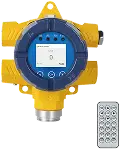
The GTYQ-Z60 features an LED display for real-time gas concentration readout, visible on the installed unit without requiring a handheld reader or laptop connection. The product image shows a compatible remote control unit alongside the detector, enabling parameter adjustment and function configuration from a distance — relevant for instruments installed at height, in restricted access locations, or in areas where close approach requires PPE or access control procedures. Remote configurability reduces the operational overhead and access risk associated with routine parameter adjustments.
Low Power Consumption — ≤2W
The GTYQ-Z60 operates at a maximum power consumption of 2W at 24V DC. Low power consumption is relevant to fixed detection system design from two perspectives: it reduces the electrical load on the 24V DC detection system power supply (allowing more detection points per supply circuit), and it minimises heat generation within the flameproof enclosure — an important consideration for maintaining T6 temperature class compliance across the detector’s operating range.
G3/4 Conduit Entry — Standard Industrial Wiring Integration
The GTYQ-Z60 uses a G3/4 conduit entry thread, compatible with standard industrial conduit fittings used in hazardous area wiring installations. G3/4 is a widely used thread standard for industrial instrumentation conduit entries in European and international installations, ensuring the detector integrates straightforwardly into an existing conduit-wired detection system without requiring adaptor fittings or non-standard installation components.
Technical Specifications
Model: GTYQ-Z60
Detect Gas: Combustible gas (catalytic sensor) / Toxic gas (electrochemical sensor)
Sensor Type: Catalytic gas sensor (combustible) / Electrochemical sensor (toxic)
Sampling Method: Natural diffusion
Power Supply: 24V DC
Power Consumption: ≤2W
Display: LED display
IP Rating: IP66
Working Temperature: -20°C to 50°C
Humidity: ≤93% RH (no condensation)
Working Pressure: 86–106 kPa
Dimensions: 181 × 154 × 93mm
Cable: RVVP 0.75mm² × 2
Conduit Entry: G3/4
Safety Approvals: Ex db IIC T6 Gb; Ex tb IIIC T80°C Db
Wireless Connectivity: Not specified — hardwired installation
Battery / Backup: Not applicable — fixed 24V DC powered
Response Time: Not stated on listing — confirm with supplier
Data Logging: Via connected control panel or monitoring system
Weight: Not stated — confirm with supplier
Benefits
For facilities engineers and safety system designers, the GTYQ-Z60’s temperature compensation removes one of the most common sources of false alarms and missed detections in fixed gas monitoring installations — sensor output variation driven by ambient temperature rather than actual gas concentration. A fixed detection system that generates false alarms trains workers to ignore alarms. A system that under-reads at elevated temperatures creates a safety gap at exactly the conditions when process risks tend to be highest. Temperature compensation addresses both failure modes at the sensor level, before they can propagate into system behaviour.
For HSE managers overseeing fixed detection systems with multiple monitoring points, low drift sensor technology reduces the calibration frequency required to keep the detection system operating within specification. Fewer calibration visits per year, per instrument, across a multi-point installation represents a meaningful reduction in maintenance cost and system downtime — and a higher proportion of operating time within the calibrated specification that the safety case for the installation depends on.
For procurement teams specifying fixed combustible gas detectors or toxic gas detectors for Zone 1 hazardous area installations, the GTYQ-Z60’s Ex db IIC T6 Gb certification covers the broadest gas group classification available — meaning a single product specification is appropriate across process areas with different gas types, without requiring variant selection by gas group. The IP66 rating provides a higher level of environmental protection than the IP65 standard specified for many comparable fixed instruments, relevant for outdoor and wash-down environments where the additional margin makes a practical operational difference.
Who It’s For
Facilities Engineer — Fixed Detection System Design and Commissioning
You’re designing or commissioning a fixed gas detection system for a new or expanded process plant. You need instruments that can be specified across multiple detection points with different gas hazards — combustible gas in process areas, toxic gas in maintenance areas and utility rooms — within a common installation architecture. The GTYQ-Z60’s common housing for both catalytic and electrochemical sensor variants, standard G3/4 conduit entry, and 24V DC supply mean it integrates into a single detection system design rather than requiring separate instrument types for different gas hazard locations.
HSE Manager — Petrochemical, Chemical, or Refinery Site
You’re responsible for the fixed gas detection infrastructure on a Zone 1 classified site where IIC gas group certification is a mandatory installation requirement. Your site operates 24 hours, and the detection system needs to maintain accuracy across the full ambient temperature range experienced between winter nights and summer process area temperatures. The GTYQ-Z60’s Ex db IIC T6 Gb certification satisfies your Zone 1 IIC requirement, and its temperature compensation addresses the calibration accuracy concern that affects installations across a wide temperature range without active compensation.
Safety Systems Maintenance Manager — Industrial Plant
You’re responsible for maintaining a fixed gas detection system across a multi-point industrial installation — annual calibration schedules, false alarm management, and system availability reporting. You need detection instruments with low drift characteristics that hold their calibration between service visits, and that generate alarm events based on actual gas concentrations rather than temperature-induced signal variation. The GTYQ-Z60’s low drift sensors and temperature compensation directly reduce the two most common maintenance problems you’re managing in a large fixed detection system.
Possible Applications
Petrochemical and Refinery Process Areas — Zone 1 Fixed Detection — Process areas on petrochemical and refinery sites require fixed gas detection certified for Zone 1 hazardous atmospheres across gas group IIC. The GTYQ-Z60’s Ex db IIC T6 Gb certification confirms Zone 1 IIC suitability for detection points monitoring hydrogen, light hydrocarbons, and other combustible or toxic gases in these environments.
Chemical Manufacturing — Toxic and Combustible Gas Monitoring — Chemical production facilities require fixed monitoring of both combustible gas and toxic gas hazards across process, storage, and utility areas. The GTYQ-Z60’s dual sensor variant availability — catalytic for LEL monitoring, electrochemical for toxic gas — covers both monitoring requirements within the same instrument specification.
Hydrogen Production and Distribution Facilities — Hydrogen facilities specifically require IIC gas group certified detection equipment, due to hydrogen’s exceptionally low minimum ignition energy. Fixed detection points for H2 monitoring in production, storage, compression, and distribution areas require Ex db IIC certification — which the GTYQ-Z60 provides.
LNG and Gas Storage Terminals — Natural gas and LNG facilities require fixed combustible gas detection across multiple points in storage, loading, and process areas. Fixed detectors in these environments face wide ambient temperature ranges and high humidity, making temperature compensation and IP66 protection particularly relevant to operational reliability.
Offshore Oil and Gas Platforms — Fixed gas detection on offshore platforms operates in one of the most demanding environmental combinations: salt spray, high humidity, variable temperature, high-pressure wash-down during cleaning operations, and Zone 1 classified gas hazard areas throughout the process deck. IP66 and Ex db IIC T6 Gb certification make the GTYQ-Z60 appropriate for these combined requirements.
Pharmaceutical and Solvent-Handling Facilities — Flammable solvent vapours and toxic process gases in pharmaceutical manufacturing require fixed detection in production areas, solvent storage, and reactor rooms. The GTYQ-Z60’s low drift sensors and temperature compensation support the measurement accuracy required for COSHH and process safety compliance monitoring in these environments.
Water Treatment and Chemical Dosing Areas — Chlorine (Cl2), ammonia (NH3), and other toxic gases used in water treatment require fixed detection in dosing areas, chemical storage rooms, and plant buildings. The electrochemical sensor variant of the GTYQ-Z60 provides the detection technology appropriate for these toxic gas monitoring applications.
Trust & Certifications
Ex db IIC T6 Gb — Zone 1, Gas Group IIC Flameproof Certification
Ex db (flameproof enclosure) means the GTYQ-Z60’s housing is engineered to contain any internal ignition and prevent propagation to the surrounding explosive atmosphere. IIC is the highest gas group classification in the ATEX system, covering hydrogen, acetylene, and carbon disulphide alongside all gases in the lower IIA and IIB groups. T6 temperature class confirms the enclosure surface temperature does not exceed 85°C under any operating condition within the device’s specified range. Zone 1 (II 2G) classification covers areas where explosive atmospheres may be present during normal operation — the standard requirement for active process environments. For procurement on sites where Zone 1 IIC certification is mandatory, Ex db IIC T6 Gb confirms the GTYQ-Z60 meets this requirement for the broadest gas group coverage available.
Ex tb IIIC T80°C Db — Zone 21, Combustible Dust Certification
The secondary ATEX classification covers Zone 21 combustible dust environments — areas where combustible dust clouds may be present during normal operation. Ex tb (dust ignition proof enclosure) with IIIC dust group classification (the most sensitive dust group, including metal dusts such as aluminium and magnesium) and T80°C surface temperature class confirms the GTYQ-Z60 is certified for installation in the most demanding combustible dust hazardous areas. For facilities where both flammable gas and combustible dust hazards are present — grain processing with solvent use, pharmaceutical manufacturing, certain chemical plants — the dual gas and dust Zone certification allows a single instrument specification to cover both classified area types.
IP66 Ingress Protection
IP66 provides full dustproof protection (6 in the first digit) and resistance to powerful water jets from any direction (6 in the second digit), independently tested and verified. The step from IP65 to IP66 is relevant in environments with high-pressure cleaning operations or exposed outdoor installations subject to driving rain — conditions where IP65’s protection against lower-pressure water jets may be insufficient for reliable long-term protection of the instrument enclosure.
Temperature Compensation — Calibration Accuracy Assurance
Temperature compensation in a fixed gas detector is an active measurement correction rather than a passive hardware characteristic — it reflects deliberate engineering investment in measurement accuracy across the operating range. For a safety instrument where calibration accuracy directly affects the reliability of the safety case built around it, active temperature compensation provides a documented and verifiable basis for measurement accuracy claims that ambient-temperature-uncompensated sensors cannot provide.
Accessories & Variants
Remote Control Unit (shown in product image)
Compatible remote control for parameter configuration and function adjustment without close approach to the installed instrument. Particularly useful for detectors installed at height, in restricted access areas, or in locations where repeated close approach for configuration requires PPE or safety procedures. Reduces the access risk and time cost associated with routine parameter adjustments after installation.
Signal Cable — RVVP 0.75mm² × 2
The GTYQ-Z60 specifies RVVP 0.75mm² × 2 signal cable for the 4–20mA or relay output connection to the detection system controller. Cable should be sourced to this specification and routed in accordance with the site’s hazardous area wiring requirements and conduit system design.
Conduit Fittings — G3/4 Compatible
G3/4 conduit entry fittings, cable glands, and sealing compound appropriate to the hazardous area zone classification are required for compliant installation. Conduit hardware should be specified in conjunction with the site’s electrical contractor and hazardous area installation designer.
Available Variants
Combustible Gas Variant — Catalytic bead sensor for LEL monitoring of flammable gases (methane, propane, hydrogen, and other combustible gases within the IIC group)
Toxic Gas Variant — Electrochemical sensor for specific toxic gas monitoring (H2S, CO, NH3, Cl2, SO2, and other toxic gases available depending on sensor selection)
Contact our technical team to confirm available toxic gas sensor options, detection ranges, and the correct variant configuration for your specific monitoring requirements and hazardous area classification.
Request a Quote or Technical Consultation
If you’re specifying fixed gas detection for a Zone 1 hazardous area installation — whether for a new build, a system expansion, or a replacement of ageing detection equipment — and you need instruments with IIC gas group certification, IP66 environmental protection, and temperature compensation for reliable long-term performance across variable operating conditions, the GTYQ-Z60 is worth a detailed technical evaluation.
Speak with our team to discuss sensor type selection for your specific gas hazards, confirm ATEX certification applicability for your zone classification, request pricing for individual units or multi-point system quantities, and get technical guidance on installation design, cable specification, and system integration. We work with facilities engineers, HSE managers, safety system designers, and procurement teams across petrochemical, chemical, utilities, and industrial process applications.