Cart (
Overview
For tanker operators, the Oil Discharge Monitoring and Control system is the last line of defence against a MARPOL Annex I violation during ballast water discharge. When that system produces inaccurate ppm readings, responds too slowly to rising oil content, or fails to interface correctly with the vessel’s GPS and valve control systems, the result is either an undetected overboard discharge above the 15 ppm threshold or a false alarm that interrupts a legitimate discharge operation — both of which create operational and compliance problems for the crew and the operator. The performance of the ODME is not a secondary equipment concern; it is the basis of every overboard discharge decision the vessel makes under MARPOL.
The VAF Instruments Oilcon Mark 6M (MK6M) is an Oil Discharge Monitoring and Control system developed in full compliance with IMO Resolution MEPC 108(49), Regulation 31 Annex I of MARPOL 73/78 (2011 consolidated edition), and as amended by IMO Resolution MEPC 240(65) for bio fuel blends. It covers the full range of oil types encountered in current tanker operations — conventional petroleum products under MEPC 108(49) and bio fuel blends under MEPC 240(65) — within a single approved system that does not require configuration changes or additional modules when the vessel’s fuel type changes.
What sets the VAF Oilcon MK6M apart from many comparable ODME systems in the tanker segment is its Ex-proof classification covering both the interface unit and the detector cell: Ex II(1)G [Ex ia] IIB for the interface and Ex II 1 G Ex ia IIB T4 for the detector cell. On tankers and combination carriers where the sample extraction point, detector cell installation, and associated wiring runs through areas classified as Zone 1 hazardous — pump rooms, cargo areas, void spaces adjacent to cargo tanks — this dual Ex-proof certification means the system can be installed in the correct measurement location without requiring protective enclosures, barriers beyond the intrinsically safe design, or zone boundary management workarounds that compromise measurement accuracy or installation integrity. That is a direct and meaningful operational advantage on tanker vessels where the measurement location is often in or adjacent to a hazardous area.
Key Features
Dual MEPC Approval — MEPC 108(49) and MEPC 240(65) Bio Fuel Blends
The Oilcon MK6M is type-approved for oils in accordance with MEPC 108(49) and for bio fuel blends in accordance with MEPC 240(65) — both approvals are held within the base system. For tanker operators whose vessels have transitioned or are transitioning to bio fuel operation, this dual approval means the installed ODME remains fully compliant with current MARPOL requirements without requiring a separate type approval upgrade, additional module, or system replacement when bio fuel blends are in use. MEPC 240(65) compliance is not an optional add-on to the MK6M; it is part of the standard type approval certificate, which simplifies both the initial procurement specification and the ongoing compliance documentation.
Ex-Proof Classification — Zone 1 Hazardous Area Installation
The MK6M detector cell is classified Ex II 1 G Ex ia IIB T4 — certified for installation in Zone 1 hazardous areas where flammable gas may be present during normal operation. The interface unit holds Ex II(1)G [Ex ia] IIB classification. This dual Ex-proof certification is essential for tanker installations where the detector cell is located in a pump room, in proximity to cargo tank ullage openings, or in any area where the hazardous area classification precludes the use of standard (non-Ex) instrumentation. Installing a non-Ex-certified detector in a Zone 1 area requires explosion-proof enclosures and additional engineering — the MK6M’s Ex certification eliminates this complication and gives the installation team the correct equipment for the actual location without compromise.
Sub-40 Second Response Time — MEPC 108(49) Compliant
The MK6M delivers a system response time of less than 40 seconds, confirmed in accordance with IMO Resolution MEPC 108(49). Response time is a direct compliance specification under MEPC 108(49) — a system that responds too slowly to rising oil content may not trigger the overboard valve closure before a non-compliant discharge has already occurred, even if the measurement is eventually accurate. The under-40-second response time means that when oil content in the sample water rises toward the 15 ppm threshold, the system detects and responds within the time window required by the IMO standard, giving the overboard valve control the signal it needs to act before a compliance event occurs.
Zero Noise Below 2 ppm — Clean Baseline Measurement
The MK6M maintains a zero noise figure of less than 2 ppm — meaning that in clean water, the system’s output does not drift above 2 ppm due to electronic noise, optical scatter, or other instrument artefacts. A low zero noise figure matters because it determines how close to the 15 ppm discharge threshold the operator can safely run the discharge before the margin between clean water noise and the alarm trigger becomes operationally restrictive. A system with high zero noise effectively forces the operator to set a lower practical alarm threshold to avoid false alarms — which reduces the usable discharge window. The MK6M’s sub-2 ppm zero noise maintains a clear working margin between the clean water baseline and the compliance threshold.
Dual Standard Sample Points — Up to 6 Optional
The MK6M is configured with 2 standard sample points, expandable to a maximum of 6 sample points as an option. On tankers where ballast is carried in multiple segregated ballast tanks or cargo tanks used for ballast in different discharge sequences, the ability to monitor multiple sample points from a single ODME system — rather than requiring a separate system for each discharge point — simplifies the installation, reduces equipment count, and provides the crew with a consolidated monitoring interface for discharge operations across multiple points simultaneously. The 6-point maximum covers the sample monitoring requirements of most tanker ballast arrangements without requiring multiple ODME installations.
GPS NMEA 0183 Integration — Position Logging for ORB Compliance
The MK6M accepts GPS position data directly via GPS NMEA 0183 RS485 2-wire input, reading RMC, GLL, and GGA strings for the vessel’s position. MARPOL Annex I requires that overboard discharge operations be logged with the vessel’s position at the time of discharge — a requirement enforced by PSC inspectors who cross-reference ORB entries against GPS tracking data, AIS records, and ODME discharge logs. Direct GPS integration ensures that position data is recorded automatically as part of the ODME discharge log without requiring manual position entry by the crew — eliminating a common source of ORB discrepancy that PSC inspectors identify during MARPOL document examinations.
Ship’s Log Interface — Speed and Distance Monitoring
The MK6M interfaces with the vessel’s ship’s log via a pulse input accepting 100, 200, or 400 pulses per nautical mile — the standard pulse output formats used by electromagnetic and Doppler log systems fitted on commercial vessels. Ship’s log integration provides the vessel speed and distance data required by MARPOL Annex I for calculating and recording the instantaneous rate of oil discharge in litres per nautical mile during overboard operations. Automatic log data integration means this calculation is made by the ODME system in real time, supporting accurate ORB entries without manual calculation and providing a cross-check against the vessel’s navigation records that PSC inspectors use during MARPOL document examination.
Independent Emergency Supply — Continuous Operation During Power Events
The MK6M includes an emergency supply input of 24VDC sourced independently from the main supply, ensuring that the ODME continues to operate and the overboard valve control remains active during a main power supply interruption. A discharge operation that is interrupted by a power event but where the overboard valve fails to close — because the ODME controlling it has lost power — creates a direct MARPOL compliance risk. The independent emergency supply ensures that the overboard valve control signal from the ODME remains active during power events, maintaining the compliance protection function of the system regardless of the vessel’s main electrical supply status.
Technical Specifications
Model: VAF Instruments Oilcon Mark 6M (MK6M)
Measurement Range: 0 – 1000 ppm
Response Time: Less than 40 seconds (MEPC 108(49) compliant)
Zero Noise: Less than 2 ppm
Alarm Adjustment Range: 0 – 1000 ppm
Sample Points: 2 standard (optional up to 6)
Electrical Supply: 24VDC – 0.1A
Emergency Supply: 24VDC – 0.1A (independent from main supply)
Power Consumption: 2.4W
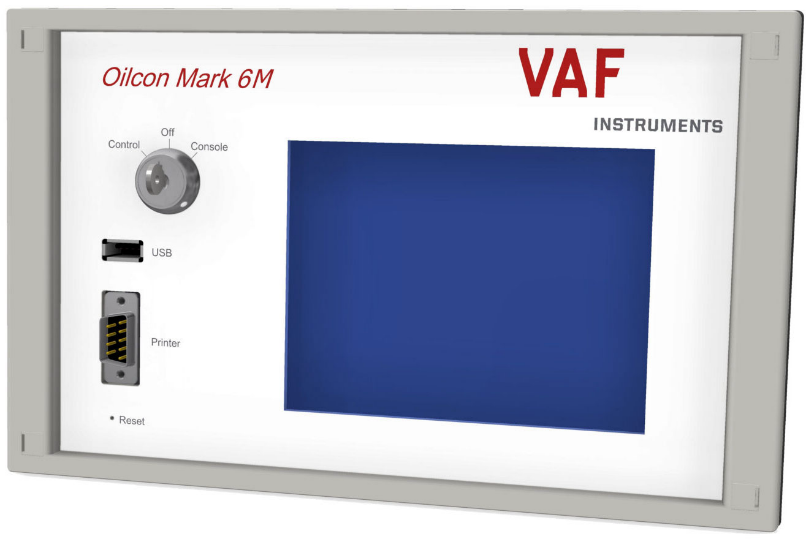
Display: Panel-mounted colour screen (Oilcon Mark 6M interface)
Mounting: Panel mounted (see drawing 0806-1285 for dimensions)
Ambient Temperature: –20°C to +55°C
Humidity Range: 0 – 95% RH
Communication: RS422/485 4-wire to EPU | Baud: 9600 | Data: 8 | Parity: None | Stop: 1
GPS Input: NMEA 0183 RS485 2-wire | Baud: 4800 | Strings: RMC, GLL, GGA
Ship’s Log Input: 100, 200 or 400 p/NM | Rating: 5 mA
Pollution Degree: I acc. to IEC 664 | Installation Category II
Ex Classification (Interface): Ex II(1)G [Ex ia] IIB
Ex Classification (Detector Cell): Ex II 1 G Ex ia IIB T4
MARPOL Compliance: MEPC 108(49) + MEPC 240(65) bio fuel blends
Ventilation Requirements: No special requirements
Benefits
For chief officers and chief engineers managing tanker ballast discharge operations, the MK6M’s sub-40-second response time and less-than-2-ppm zero noise translate into an ODME that can be operated with confidence at discharge oil contents approaching the 15 ppm threshold — without the margin erosion that high zero noise or slow response forces on the crew when setting conservative operational alarm levels. That confidence in the instrument’s accuracy and response characteristics directly affects how efficiently the discharge operation can be conducted without compromising the compliance margin.
The integrated GPS and ship’s log interfaces remove two of the most common manual data entry gaps from the ORB discharge record. PSC inspectors examining MARPOL documentation on tankers regularly identify discrepancies between manually entered discharge positions and independent navigation records — discrepancies that trigger further investigation even when the actual discharge was compliant. Automatic GPS position and log data integration means the ODME discharge record and the ORB entry are drawn from the same data source as the navigation records, removing the position entry gap as a vulnerability in the documentation trail.
The dual Ex-proof certification of the detector cell and interface eliminates the installation compromise that occurs when a non-Ex-certified ODME detector is required to be located in a hazardous area. On tankers where the technically correct measurement location is in a Zone 1 classified area, fitting a non-Ex detector requires either protective enclosures that add complexity and maintenance burden, or relocating the measurement point to a non-hazardous area that is less representative of the actual discharge stream. The MK6M’s Zone 1 certified detector can be installed at the correct measurement location without either compromise.
The independent emergency supply ensures that the overboard valve control function of the ODME remains active during main power supply interruptions — protecting against the specific scenario where a power event during an active discharge operation leaves the overboard valve open without ODME control. For operators managing MARPOL compliance risk across a fleet, an ODME with confirmed emergency supply independence removes this failure mode from the compliance risk register.
Who It’s For
Chief Officers on Tankers with Hazardous Area Installations
If you are managing ballast discharge operations on a crude tanker or product tanker where the ODME detector cell is installed in or adjacent to the pump room — a Zone 1 classified area — and you have experienced measurement reliability issues or installation complications with a non-Ex-certified detector, the MK6M’s Zone 1 Ex ia IIB T4 detector cell is the specification that allows the detector to be installed at the correct measurement point without a Zone 1 installation workaround. Operating the ODME with the detector at the correct measurement location, rather than a relocated position chosen to avoid hazardous area requirements, produces more representative oil content readings and a more defensible ORB record.
Fleet Technical Superintendents Specifying ODME for Bio Fuel Transition
For technical superintendents managing a tanker fleet that is transitioning toward bio fuel operation — or where vessels carry bio fuel-blended bunkers that affect bilge water and ballast water composition — specifying an ODME with both MEPC 108(49) and MEPC 240(65) type approval as a standard installation means the equipment specification remains current regardless of which fuel the vessel is burning. The MK6M’s dual approval covers this requirement without requiring fleet-specific variants or future upgrade planning for the ODME installation as fuel transition progresses.
Vessel Owners and DPAs Managing MARPOL Documentation Quality
For designated persons ashore managing the MARPOL compliance documentation profile of a tanker fleet — particularly vessels trading on routes with high PSC inspection frequency under the Paris MOU, Tokyo MOU, or USCG regimes — an ODME with automatic GPS position and ship’s log data integration directly addresses the ORB documentation quality issues that generate the largest proportion of MARPOL-related PSC findings on tanker vessels. Replacing ODME installations where position and log data entry is manual with systems that log this data automatically removes a systematic documentation vulnerability that experienced PSC inspectors specifically target on tanker MARPOL examinations.
Possible Applications
Crude Tanker Ballast Discharge — Zone 1 Pump Room Installation — Ex ia IIB T4 certified detector cell installation in crude tanker pump rooms classified Zone 1, providing accurate oil content measurement at the correct piping location without explosion-proof enclosure requirements.
Product Tanker Bio Fuel Operations — MEPC 240(65) approved monitoring of ballast discharge on product tankers operating with bio fuel blended bunkers, maintaining MARPOL compliance across fuel transitions without ODME system changes.
Multi-Point Ballast Discharge Monitoring — Up to 6-sample-point configuration for tankers discharging ballast from multiple segregated ballast tanks or cargo tanks used in ballast service, monitored from a single MK6M installation.
Tanker ODME Replacement on High-PSC-Frequency Routes — ODME replacement on vessels trading Paris MOU, Tokyo MOU, or USCG routes where ORB documentation quality and ODME type approval status are consistently examined, with automatic GPS and log data integration directly addressing the most common documentation finding categories.
Combination Carrier Cargo Space Ballast Monitoring — OBO and combination carrier installations where cargo space ballast discharge requires MEPC 108(49)-approved ODME coverage equivalent to dedicated tanker requirements during oil-carrying voyage legs.
Newbuilding ODME Specification — Bio Fuel Ready — Newbuilding tanker specifications where the ODME must be type-approved for both conventional and bio fuel operation from delivery, with Ex-proof certification suitable for pump room detector installation as standard.
Tanker Drydock ODME Upgrade — Low Power Consumption — Drydock ODME replacement on vessels where the existing ODME’s power demand or wiring arrangement is being rationalised, with the MK6M’s 2.4W consumption and standard 24VDC supply simplifying the electrical integration.
Trust & Certifications
IMO Resolution MEPC 108(49) — MARPOL Annex I Regulation 31
Resolution MEPC 108(49) is the IMO performance standard for Oil Discharge Monitoring and Control systems under MARPOL Annex I Regulation 31 — the regulation that makes ODME installation mandatory on tankers. Type approval to MEPC 108(49) confirms that the system meets IMO’s defined requirements for measurement accuracy across approved oil types, response time, overboard valve control, GPS and log integration, and data recording. The MK6M is approved in full compliance with MEPC 108(49) as referenced in the MARPOL 73/78 2011 consolidated edition — the current edition that flag state and class surveyors reference when verifying ODME approval status during vessel surveys.
IMO Resolution MEPC 240(65) — Bio Fuel Blend Compliance
MEPC 240(65) amends the ODME performance standard to address the measurement accuracy challenges presented by bio fuel blends — specifically that bio fuel components in bilge and ballast water affect the optical properties of the water in ways that older ODME systems calibrated only for conventional petroleum products do not measure correctly. The MK6M’s type approval under MEPC 240(65) confirms that the system maintains measurement accuracy across petroleum oil and bio fuel blend compositions, keeping the vessel compliant with current MARPOL requirements across the full range of fuel types in current and planned commercial vessel operation.
Ex II(1)G [Ex ia] IIB — Interface Hazardous Area Certification
The Ex II(1)G [Ex ia] IIB classification of the MK6M interface unit confirms certification for use in equipment group IIB (covering most flammable vapours including petroleum products), with intrinsically safe [Ex ia] protection method — the highest safety integrity level for intrinsically safe equipment, where the circuit is incapable of causing ignition even under two concurrent faults. This classification satisfies the requirements for installation in areas adjacent to Zone 1 classified spaces with wiring running into Zone 1 — the typical installation arrangement on tankers where the interface panel is outside the hazardous area but connected to a detector cell inside it.
Ex II 1 G Ex ia IIB T4 — Detector Cell Zone 1 Certification
The detector cell’s Ex II 1 G Ex ia IIB T4 classification confirms Zone 1 installation capability with surface temperature class T4 (maximum 135°C surface temperature), IIB equipment group, and Ex ia intrinsically safe protection for the detector circuit. Zone 1 certification for the detector cell is the specification required for pump room installation on tankers — where the detector must be located in the discharge piping within the pump room itself, in a space that is classified Zone 1 under IEC 60079 hazardous area requirements for tanker vessels. This certification eliminates the need for explosion-proof enclosures or zone boundary management for the detector installation.
VAF Instruments — Marine Instrumentation Specialist
VAF Instruments is a Netherlands-based manufacturer with decades of experience developing marine measurement and monitoring instrumentation for the commercial shipping industry. The Oilcon product line represents VAF’s dedicated ODME product family, with the MK6M as the current-production system incorporating MEPC 240(65) bio fuel approval alongside the core MEPC 108(49) certification. VAF’s established presence in the tanker instrumentation market, combined with the MK6M’s comprehensive approval and Ex certification profile, provides procurement teams with a supplier whose product documentation trail and approval history can be verified against current IMO and IEC certification standards.
Accessories & Variants
EPU (Electronic Processing Unit) — RS422/485 Communication Interface
The MK6M communicates with the EPU via RS422/485 4-wire connection at 9600 baud — the electronic processing unit that manages discharge data logging, overboard valve control outputs, and integration with the vessel’s GPS and ship’s log inputs. The EPU is the central data processing component of the MK6M system. Confirm EPU configuration requirements with your supplier based on your vessel’s existing electrical arrangement and the number of sample points required for your installation.
Extended Sample Point Configuration — Up to 6 Points
The standard MK6M configuration includes 2 sample points. For tankers with more complex ballast arrangements requiring monitoring of more than 2 discharge locations, the optional extended configuration supports up to 6 sample points from the single MK6M installation. Specifying the extended sample point configuration at the time of procurement rather than as a later modification simplifies the installation and avoids the additional engineering associated with a post-installation expansion.
USB Interface — Front Panel Data Port
The MK6M front panel includes a USB interface, visible in the unit image, for data download and system access. Confirm the data download format and ORB record export capability with your supplier to ensure compatibility with your fleet’s MARPOL documentation management system or vessel management software.
Printer Interface — Discharge Record Printing
A printer interface is available on the MK6M front panel for connection to a compatible printer for discharge record documentation. Printed discharge records support Oil Record Book entries and provide a physical documentation trail for PSC examination. Confirm printer compatibility and consumable specification with your supplier at procurement to ensure onboard spares are correctly identified from installation.
Available Variant
VAF Oilcon MK6M — MEPC 108(49) + MEPC 240(65) approved | Ex II 1 G Ex ia IIB T4 detector cell | Ex II(1)G [Ex ia] IIB interface | 2 standard sample points (optional up to 6) | GPS NMEA 0183 integration | Ship’s log interface | Independent emergency supply | <40 second response time | <2 ppm zero noise | 24VDC 2.4W power consumption | Panel mount installation
Get in Touch
If you are specifying an ODME for a new tanker build, planning a replacement on an existing vessel with pump room hazardous area requirements, managing a fleet upgrade to MEPC 240(65) bio fuel compliance, or need to confirm Ex certification suitability for your vessel’s specific installation location — contact us to discuss your requirement and request a formal procurement quotation.
Our technical team can assist with product configuration against your vessel’s sample point requirements, confirm Ex certification compatibility with your installation’s hazardous area classification, and provide the procurement documentation your class survey and flag state records require.
📍 3791 Jalan Bukit Merah #06-01, E-Centre @ Redhill, Singapore 159471