Cart (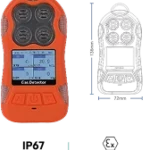
Overview
Occupational gas exposure isn’t always about a single dramatic event. For many workers in chemical plants, wastewater treatment facilities, and industrial processing environments, the greater risk is cumulative — low-level exposure across a full shift that stays below the immediate alarm threshold but builds up to levels that cause long-term health damage. Standard gas detectors alarm when a gas concentration crosses a set point. What they often don’t do is track how that exposure accumulates over time against the occupational health standards that are actually designed to protect workers: the TWA and STEL limits.
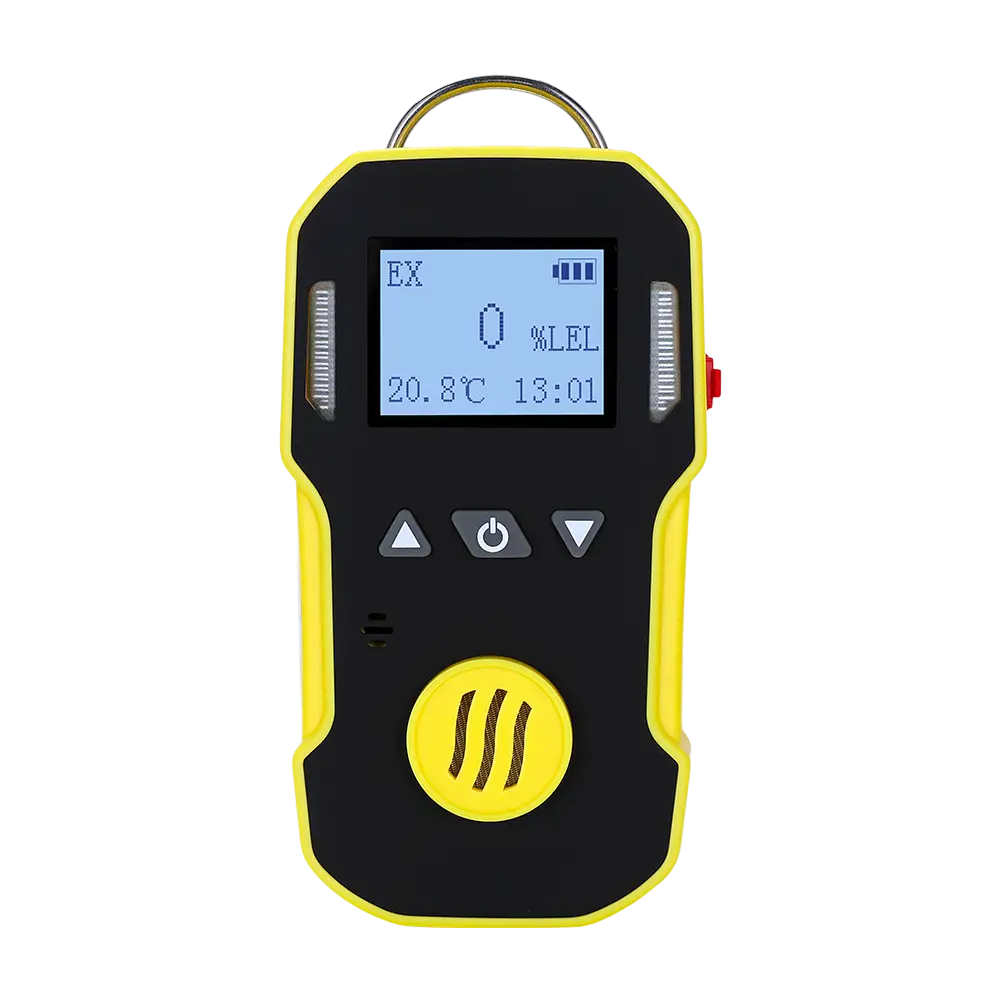
The K10 Portable Gas Detector addresses this directly. In addition to conventional over-limit and high concentration alarms, the K10 supports TWA (Time-Weighted Average) and STEL (Short-Term Exposure Limit) alarm functions for toxic gas monitoring — the two exposure metrics that occupational health regulations use to define safe working conditions across a shift and within any 15-minute period. For HSE officers and safety managers who need their monitoring equipment to align with how exposure limits are actually defined in legislation, this is a meaningful functional difference.
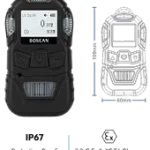
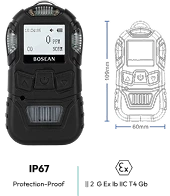
Built to IP67 and certified to II 2G Ex ib IIC T4 Gb, the K10 covers the full IIC gas group — the highest classification in the ATEX system, encompassing hydrogen and acetylene alongside the more common IIA and IIB gases — making it one of the more broadly applicable personal gas detectors in its category for hazardous area deployment across diverse gas types and industrial environments.
Key Features
TWA and STEL Alarm Support — Occupational Exposure Limit Monitoring
The K10’s TWA and STEL alarm functions continuously calculate the worker’s time-weighted average exposure across the shift and the short-term peak exposure across any 15-minute window, triggering an alarm when either threshold is approached or exceeded. These are the two exposure metrics used by the UK HSE’s Workplace Exposure Limits (EH40), OSHA’s Permissible Exposure Limits, and ACGIH’s TLVs to define legally compliant working conditions for toxic gas exposure. A detector that monitors gas concentration but doesn’t track cumulative exposure provides incomplete occupational health protection — the K10 closes that gap for toxic gas monitoring applications where long-term exposure management is as important as immediate hazard response.
Four-Mode Alarm System (Sound, Light, Vibration, Display)
All gas alarm events activate four simultaneous alarm channels: audible alarm, LED visual indicators, physical vibration, and an on-screen display notification. In the environments where personal toxic gas monitors are most critical — noisy processing environments, confined spaces, outdoor sites — a single-channel alarm carries a meaningful failure risk in terms of the worker perceiving and responding to it. The simultaneous four-mode response removes that single point of failure and ensures alarm delivery regardless of whether the worker can hear, see, or feel the device at the moment of alarm activation.
Over-Limit and High Concentration Alarm
Beyond TWA and STEL, the K10 supports both over-limit and high concentration alarm thresholds — providing a two-stage warning system that distinguishes between a gas reading that has crossed the lower action level and one that has reached a level requiring immediate evacuation. For sites using a two-stage response protocol — first alarm triggers precautionary action, second alarm triggers immediate evacuation — this two-threshold alarm structure supports that workflow directly without requiring manual re-evaluation of a single alarm reading.
II 2G Ex ib IIC T4 Gb — Broadest Hazardous Area Gas Group Coverage
The K10’s ATEX certification to II 2G Ex ib IIC T4 Gb covers Zone 1 hazardous areas across gas group IIC — the highest classification in the ATEX gas group system, which includes hydrogen (the most easily ignitable common industrial gas) and acetylene alongside all gases in the IIA and IIB groups below it. An IIC-rated device is appropriate for use in environments containing any of these gas types, giving procurement teams a single device specification that covers the widest range of industrial gas hazard scenarios without requiring different equipment variants for different process areas or gas types.
IP67 Weatherproof Construction
The K10 carries an IP67 rating — fully dustproof and protected against temporary immersion in water to one metre depth. For field workers in outdoor environments, industrial plant areas subject to wash-down, or wet confined spaces, IP67 provides independently tested ingress protection that ensures the device continues operating through real working conditions. At 136 × 72 × 32mm and approximately 300 grams, the K10 is a substantive field instrument sized for the sensors, battery, and rugged housing its industrial specification requires.
Three-Defense Design — Durability for Field Conditions
The K10’s Three-Defense Design addresses water, dust, and physical impact resistance as a combined design objective — complementing the IP67 certification with a housing architecture built to absorb the mechanical stresses of industrial fieldwork. Drop resistance, contamination resistance, and environmental sealing work together in the K10’s construction, reducing the device failure rates that drive fleet attrition and replacement costs over a multi-year deployment.
One-Button Mute Function
The K10 includes a one-button mute function for alarm acknowledgement. In practice, this means the worker can silence the audible alarm after acknowledging it — confirming they’ve received the warning — without navigating a multi-step menu sequence. In a gas event where the worker is already managing an evolving situation, the ability to acknowledge and silence an alarm with a single button press reduces cognitive load and keeps the interface simple under pressure.
Industrial-Grade Sensors with ±5% FS Accuracy
The K10’s industrial-grade sensors deliver a measurement accuracy of ±5% full scale — a standard performance specification for industrial electrochemical and catalytic bead sensors used in safety-critical monitoring applications. Combined with a two-year rated sensor life and a T90 response time of under 60 seconds, the sensor specification confirms the K10 is performing continuous, accurate monitoring throughout the shift rather than providing an approximate indication of atmospheric conditions.
Technical Specifications
Model: K10
Display: 1.77 inch LCD
Dimensions: 136 × 72 × 32mm
Weight: Approximately 300g
Power Supply: 1800mAh Lithium Battery (DC 3.7V)
Charging Time: 4–6 hours
Working Time: ≥8 hours continuously
IP Rating: IP67
Alarm Types: Sound, Light (LED), Vibration, Display — four simultaneous modes; TWA alarm, STEL alarm, over-limit alarm, high concentration alarm
Sampling Method: Natural diffusion
Response Time: T90 <60 seconds
Sensor Accuracy: ≤±5% FS
Working Temperature: -10°C to 55°C
Humidity: ≤95% RH (no dew)
Sensor Life: 2 years (depending on usage environment)
Safety Approvals: II 2G Ex ib IIC T4 Gb; IP67 Protection-Proof
Wireless Connectivity: Not specified
Data Logging: Not specified — confirm with supplier
Benefits
For individual workers in toxic gas environments, the K10’s TWA and STEL alarm functions change what personal gas monitoring actually protects against. A device that only alarms on instantaneous concentration gives no warning about cumulative exposure building toward a harmful total dose across a shift. The K10’s occupational exposure limit monitoring means the device is tracking the same parameters that define legal compliance — and alerting the worker before those parameters are breached, not after they’ve been exceeded.
For HSE managers and occupational health teams, the TWA and STEL data generated by the K10 during a monitored shift provides exposure evidence that is directly relevant to occupational health records, long-term health surveillance programmes, and regulatory compliance demonstrations. When an inspector or auditor asks how the organisation monitors and manages chronic exposure to toxic gases — not just acute events — a monitoring programme built around K10 devices provides a credible, documented answer.
For procurement teams assessing toxic gas personal monitors for industrial fleet deployment, the K10’s IIC gas group certification is a practical advantage. Rather than maintaining separate device variants for different process areas with different gas types, a single IIC-rated device covers the full range — simplifying procurement, reducing inventory complexity, and ensuring workers moving between areas with different hazard profiles are always carrying a device certified for the environment they’re entering.
Who It’s For
Occupational Hygienist or Industrial Physician — Exposure Monitoring Programme
You’re responsible for monitoring worker exposure to toxic gases against occupational exposure limits and maintaining the health surveillance records that demonstrate compliance. You need monitoring equipment that tracks TWA and STEL exposure in real time — the same metrics defined in EH40 and equivalent regulatory frameworks — not just peak concentration readings that don’t map directly onto exposure limit calculations. The K10’s TWA and STEL alarm functions align the monitoring data with the regulatory framework you’re working within, making the evidence it generates directly relevant to your occupational health documentation.
HSE Manager — Chemical Plant or Pharmaceutical Manufacturing
Your facility handles toxic process gases where both acute exposure and chronic cumulative exposure are genuine health risks requiring active management. Your permit-to-work system requires workers in at-risk areas to carry certified personal monitors throughout their time in the zone. You need those monitors to be certified for the highest relevant gas group — IIC — to cover hydrogen and other reactive gases used in your processes, and you need TWA and STEL monitoring capability so your programme can demonstrate compliance with occupational exposure limits, not just alarm response.
Field Maintenance Engineer — Petrochemical or Refinery Site
You work maintenance shifts on a hazardous area site where your personal gas monitor is a site access requirement, not an optional extra. The site operates a two-stage alarm protocol, and you need a monitor with separate over-limit and high concentration thresholds that matches that protocol without manual threshold interpretation in the field. The K10’s dual alarm stage system supports your site’s evacuation procedure directly, and its IP67 construction handles the outdoor and confined space conditions you work in across a standard maintenance shift.
Possible Applications
Toxic Gas Occupational Exposure Monitoring — Chemical and Pharmaceutical Production — Workers handling toxic process gases, solvents, and reactive chemicals require personal monitors that track cumulative exposure against TWA and STEL limits, not just peak concentration. The K10’s occupational exposure limit alarm functions make it appropriate for these compliance-driven monitoring requirements.
Petrochemical Plant Maintenance — Zone 1 Hazardous Areas — Maintenance engineers and contractors working in classified Zone 1 areas on petrochemical sites require IIC-rated personal gas monitors that cover hydrogen and other high-risk gases present in these environments. The K10’s II 2G Ex ib IIC T4 Gb certification satisfies this requirement across the broadest range of gas types.
Hydrogen Production and Handling Facilities — Hydrogen is the most common gas type that specifically requires IIC-rated detection equipment, due to its exceptionally low minimum ignition energy. Workers in hydrogen production, storage, and distribution environments require personal monitors certified to IIC — a requirement the K10 meets where many IIB-rated alternatives do not.
Wastewater Treatment — H2S and Confined Space Entry — H2S monitoring with TWA and STEL tracking is directly relevant to wastewater treatment workers, who face both acute and chronic toxic gas exposure risks in pump stations, treatment plant enclosed areas, and sewer infrastructure. The K10’s occupational exposure limit monitoring provides appropriate protection for both risk types.
Mining and Tunnelling — Toxic Gas and Combustible Gas Monitoring — Underground and surface mining operations involve toxic gas risks from geological sources and blasting operations alongside combustible gas hazards. The K10’s industrial-grade sensors and Three-Defense housing handle the physical demands of mining environments, and its IIC certification covers the broadest range of gas types encountered in these settings.
Semiconductor and Electronics Manufacturing — Specialty gases used in semiconductor fabrication — including hydrogen, silane, and various toxic process gases — require IIC-rated detection equipment and occupational exposure monitoring. The K10’s gas group coverage and TWA/STEL alarm capability address both requirements in a single portable instrument.
Research and Industrial Laboratories — Hydrogen and Toxic Gas Environments — Laboratory environments using hydrogen, toxic gases, or reactive chemicals require personal monitoring for researchers and technicians. The K10’s IIC certification and TWA/STEL tracking support both acute hazard protection and occupational health exposure management in research settings.
Trust & Certifications
II 2G Ex ib IIC T4 Gb — Zone 1, Gas Group IIC Intrinsic Safety Certification
The K10’s ATEX certification to II 2G Ex ib IIC T4 Gb is the highest gas group classification available in the ATEX system. Gas Group IIC covers hydrogen, acetylene, and carbon disulphide — the gases with the lowest minimum ignition energy — alongside all gases in the IIA and IIB groups. A device certified to IIC is appropriate for use in any hazardous area where a gas in any of the three gas groups may be present, without needing to verify which specific sub-group applies. Zone 1 (II 2G) classification covers environments where explosive atmospheres may be present during normal operation — the standard hazardous area classification for most active process environments on petrochemical, chemical, and oil and gas sites.
IP67 Ingress Protection — Independently Verified
IP67 certification confirms full dust protection and protection against temporary immersion in water to one metre depth, independently tested and verified. For procurement teams specifying equipment for outdoor, wet, or wash-down environments, IP67 provides documented environmental performance evidence that underpins the device’s reliability claims under real field conditions.
TWA and STEL Alarm Compliance Alignment
The K10’s TWA and STEL alarm functions directly reflect the exposure metrics defined in occupational health legislation and guidance — including the UK HSE’s EH40 Workplace Exposure Limits, OSHA PEL/STEL standards, and ACGIH TLVs. This alignment means the monitoring data generated by the K10 is directly relevant to demonstrating regulatory compliance with occupational exposure limit requirements, supporting both internal health surveillance programmes and external regulatory audit responses.
±5% FS Sensor Accuracy — Documented Performance Specification
A measurement accuracy of ±5% full scale is a recognised industrial sensor performance standard, providing procurement teams with a documented accuracy specification they can use in risk assessment and monitoring programme validation. Combined with the two-year sensor life rating, this specification supports a predictable and manageable sensor maintenance schedule over the device’s operational lifespan.
Accessories & Variants
Charging Cable / Power Adapter
Charging accessories compatible with the K10’s power input interface. For fleet deployments, multi-port charging solutions allow simultaneous charging of multiple units between shifts without requiring individual charger units per device.
Carry Clip / Belt Holster
Positions the K10 at breathing zone height for representative gas readings throughout the shift. Essential for diffusion-type personal monitors where sensor positioning relative to the worker’s breathing zone directly affects the accuracy of personal exposure assessment.
Calibration Gas (single gas, target-specific)
Certified calibration gas cylinders for bump testing and full span calibration. For devices used in TWA and STEL monitoring applications, accurate sensor calibration is particularly important — sensor drift affects cumulative exposure calculations as well as instantaneous readings. Regular calibration and bump testing are strongly recommended.
Available Variants
The K10 is available in single-gas configurations for a range of target gases within the IIC gas group coverage, including H2, H2S, CO, O2, NH3, Cl2, and other toxic and combustible gas types. Contact our technical team to confirm available sensor options, detection ranges, and the correct variant for your site’s specific gas hazard profile and regulatory exposure limit requirements.
Request a Quote or Technical Consultation
If you’re specifying personal gas monitors for a toxic gas exposure monitoring programme — particularly one where TWA and STEL compliance tracking is a regulatory requirement — or for Zone 1 hazardous area deployment covering hydrogen or other IIC gas group hazards, the K10 is worth a detailed technical evaluation against your site’s specific requirements.
Speak with our safety equipment team to confirm sensor configuration and ATEX certification applicability for your hazardous area classification, discuss alarm threshold setup for your site’s TWA and STEL action levels, or request pricing for individual units or fleet quantities. We work directly with HSE managers, occupational health teams, and procurement leads, and can provide technical guidance on the full specification and deployment process from initial enquiry through to ongoing calibration and maintenance management.